
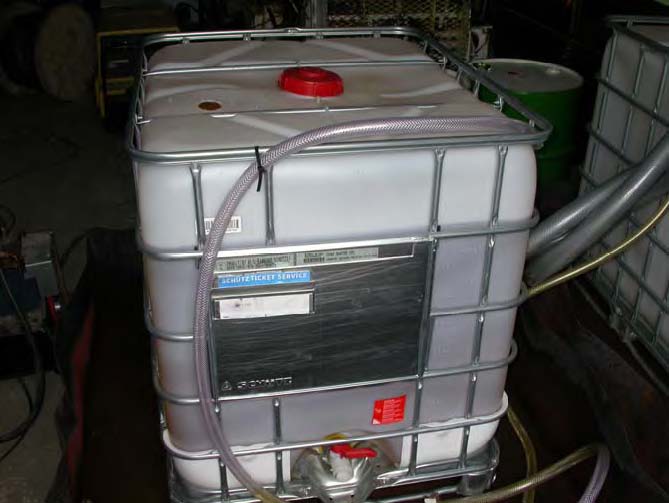
I have written extensively on flammable liquids and the hazards they present to work environments; but there is one hazard associated with using plastic containers for flammable liquids that tends to be lost in all the attention that is focused on what is happening within the containers and not outside the container. In this article I reveiw a MUST READ report titled Plastic containers for flammable liquids/hazardous areas – Electrostatic risks prepared by the Health and Safety Laboratory for the Health and Safety Executive in 2010. I will touch on the hazards that plastic containers present to a work environment REGARDLESS of what they are filled with, with a focus on static charges that are being generated on the OUTSIDE of the plastic containers. Bottom Line… These plastic containers can NOT be presumed in their present form to be inherently safe for use in flammable atmospheres!
The most likely ignition hazard associated with small /medium size plastic containers is a brush discharge from the surface of the container as a result of it being charged by some sort of physical action. This might be rubbing, removal of an adhesive label, contact with air driven particles or other mechanisms in which electrons can be physically removed. A brush discharge is analogous to a spark discharge from a conductor, but because it occurs from an insulating surface, the charge can only be gathered from a limited area of the surface and also cannot concentrate at one point. Consequently it is spacially and temporally different to a spark discharge and has different ignition characteristics. Brush discharges occur when insulating surfaces become charged and an grounded conductor is brought close to the surface.
Test methods to investigate this involve measuring the level of electrical charge transferred in the discharge in order to assess its incendivity. To attempt to produce an electrostatic brush discharge, each container was charged and brought close to the surface of a conducting sphere. The sphere was connected to a capacitor and a high impedance voltmeter. Generally, as the charged object is brought close to the conducting sphere, initially a voltage is produced on the capacitor, which disappears if the object is moved away. This is an induced voltage, which increases as the separation between the object and the sphere electrode decreases. If the object is sufficiently charged and the separation between it and the sphere small enough, then an electrostatic discharge can occur to the sphere from the plastic surface. The voltage on the capacitor is a measure of the charge transferred during the discharge, which can also be used to assess the igniting ability of the discharge. This technique enables very small discharges to be detected, which are difficult to see or hear but are still capable of igniting flammable atmospheres.
IGNITION TESTS ON SMALL/MEDIUM SIZE CONTAINERS
In addition to the charge transfer testing, actual ignition testing was carried out. This testing was performed in the same manner as for the charge transfer tests, but the sphere was earthed and surrounded with a flammable gas/air mixture through which the charge transfer occurred Tests were carried out on the discharges from the charged containers to determine their incendivity in various flammable gas/air mixtures. A gas/air mixture was used which corresponded with each of the three gas groups: 20 unsuccessful attempts were made on each container before it was classified as a non-ignition in that particular gas group.
CHARGE TRANSFER MEASUREMENTS ON RIGID INTERMEDIATE BULK CONTAINERS (RIBC)
Charge transfer measurements were carried out on a selection of different types of 1000 litre (264 Gallons) RIBC, using the same methods of charging and discharge collection and measurement described in the test on small/medium size containers. Because it was not possible to fit a standard 1000 litre size RIBC in the temperature and humidity controlled room used for the previous tests, a dehumidifier and control system was incorporated in a more suitable situation. The humidity was monitored during the tests and was maintained at 20-±5 % RH. When the humidity rose over 25% due to activity such as the rubbing it was allowed to reduce again before recommencing testing.
FLUID TRANSFER TESTS ON RIBC
Fluid transfer tests were carried out using both a high and low conductivity liquid. Because of the risk of an ignition of the liquids if substantial charging occurred, an important criteria in choosing which liquids to use were that they were ideally non-flammable. Water was used for the high conductivity liquid for this reason and also convenience, but any low conductivity liquids, which are readily and economically available in quantity, tend to be flammable. Consequently a series of low conductivity, but high flashpoint liquids, were measured to find one with a suitable value. All the liquids tested were variations on light petroleum products – diesel/kerosene.
It is accepted that liquids with conductivities greater than 50 pS/m, provided they are single phase, are unlikely to produce electrostatic charging hazards in most (NOT ALL) circumstances. Consequently a liquid with conductivity significantly lower than 50 pS/m is required for the tests, but if the conductivity is very low (<1pS/m) then although it will retain charge for long periods, there are also not many charge carriers present to produce charging. Either the zero sulphur diesel or the heating oil should have been a reasonable compromise between the two extremes and the heating oil was chosen because it was readily available at low cost.
Tests were carried out by pumping the low conductivity Kerosene liquid between the two standard RIBC, and by pumping water between the standard and the metal clad RIBC as used for the rubbing tests. A fieldmill meter, which gives an indication of the electric field produced by a charged body, was placed at a set distance above the liquid surface after the liquid transfers were completed. A selection of metal plates 100 mm, 200 mm and 300 mm square were placed on the plastic area on the RIBC top surface to act as isolated conductors in order to measure any charge that may be induced from the charged liquid. A capacitor was connected to the plate to limit the voltage induced in the plate, the charge being calculated using Q =CV, where Q is the charge, C the plate capacitance, and V the charged voltage. Attempts were made to measure charge transfer from the plastic parts of the RIBC using the same measuring arrangements and techniques as with the small container tests. Various tests were carried out at different flow rates, with and without the frame earthed, but stood on metal and concrete, and also with the RIBC completely isolated from ground. 10 m lengths of nylon reinforced PVC pipe were used to transfer the fluids, which were allowed to splash feed centrally from just below the top of the RIBC. A hole was cut to allow this as the normal hole provided was used to mount the fieldmill centrally.
DISCHARGE AND IGNITION TESTING OF SMALL CONTAINERS
A number of general observations from these results are:
i. Based on the charge transfer measurements, even some of the smallest containers tested (50 ml/1.7 ounces) produce charge transfers, which could be incendive for IIC atmospheres (e.g. Hydrogen and Acetylene) and are even close to the limit for IIB atmospheres (e.g. Coal gas, Ethylene, Ethylene glycol, Ethyl methyl ether). In terms of the incendivity for Group IIA atmospheres (e.g. Hydrogen and Acetylene), one (1) container of 60 ml/2.0 oz capacity, some containers of 100ml/ 3.0 oz capacity and most containers of 250 ml/8.5 oz capacity and above produced discharges above the minimum ignition energy.
ii. During the actual ignition testing, discharges from containers of 60ml/2.0 oz capacity were shown to ignite hydrogen); containers of 125 ml/ 4.2 oz capacity and above ignited ethylene and a 1000ml/33.8oz capacity container ignited methane.
iii. In terms of the different materials, Fluorinated HDPE had the maximum charge transfer values. Clearly from these observations there are general points regarding the risk of ignition from different types of containers if used in explosive atmospheres.
- Containers as small as 50ml/1.7oz produced charge transfers in excess of the minmum ignition energies for IIA gases and vapours. (e.g.Acetone, Ethanol, Diesel fuel, Acetaldehyde)
- The ignition testing demonstrates that electrostatic discharges from even very small plastic containers (60 to 125 ml) can ignite IIB (e.g. Coal gas, Ethylene, Ethylene glycol, Ethyl methyl ether) and IIC flammable atmospheres (e.g. Hydrogen and Acetylene)
- Fluorinated plastics generally charged readily, and produced greater charge transfer than untreated containers of the same size and material.
There is a debate at the moment amongst members of the BSI electrostatic committee about the origin and hence the validity of the figures for the maximum allowable charge transfer given in European Standard EN13463-1:2001 Annex C (BSI GEL 601 electrostatics meeting 21/11/06 at Avecia, Blackley), but the results from these tests, plus other ignition tests carried out previously, indicate that the figures are sufficiently low to leave a suitable safety margin compared to typical charge transfer figures at which ignitions of the various gas groups occur in practice irrespective of their validity.
DISCHARGE TESTING OF LARGE CONTAINERS (RIBC) – Charge transfer considerations
Charge transfer tests on the various RIBC showed very mixed results. The standard common type open framed container (shown below) first tested failed to produce any brush discharges from most of the outer plastic surfaces and especially the top surface, which is very easily accessible for rubbing, although there was evidence that considerable charging was occurring. The first RIBC tested had a fairly rough outside surface with a blotched pattern possibly caused by water being present during the moulding process.
The level of induced charge on the measuring sphere suggests that the surface charged readily, and the permanent charge level slowly increased when the sphere was brought close. No distinct brush discharges were observed and any charge transferred was likely due to a corona discharge effect as a result of the surface roughness. Corona discharges occur around objects with edges of small radius of curvature around which the electric field, which is radius dependant, is sufficiently high to cause localised breakdown of the air. This type of discharge is commonly observed as the visible light seen when certain types of clothing are removed and is generally non-incendive. Because of this lack of distinct discharges with the first container, a second of the same type was tested which had a smoother surface than the first, but however gave very similar results. However both did produce substantial discharges from the area around the tap, well in excess of the 60 nC set limit, and at a similar level to that which actually ignited a IIA gas in the ignition tests using the smaller containers.
The Mauser repaltainer (shown below) was in principle similar to the two standard type containers intended for common usage, but using a recycled plastic pallet and top section. It had a substantial open area of plastic on the top surface, which in this case produced substantial discharges again of likely IIA (e.g. Hydrogen and Acetylene) incendive levels, but had a mesh around the sides with smaller spacing than the more open design. The finer mesh made rubbing difficult and may offer better, but not complete protection, against mechanical puncture damage by forks etc. The plastic inners on both types, and similar offerings from other manufacturers, are nominally of the same material (HDPE) and as demonstrated can potentially produce incendive discharges. The fact that some areas on the tote did not when they might have been expected to suggests that the surface texture is very important, and this effect should probably be investigated as a means to reduce the likelihood of brush discharge occurring. Some plastic petrol containers previously tested appeared to be deliberately produced in this way, and were effective in inhibiting discharges compared to smooth finished containers of the same material.
A further hazard present with containers having large exposed areas of plastic particularly on the top surface, is that they are a convenient place to leave tools and other conducting objects whilst working in the vicinity. This leaves an isolated conducting object, which can then become charged by induction from the charged liquid contents of the RIBC following a filling operation. This can produce a spark discharge with a potentially higher charge transfer value than a brush discharge from the plastic surface. Also a spark discharge is temporally and spatially different to a brush discharge, and has different ignition characteristics. The tests on the smaller containers also showed variations in the incendivity of the brush discharges for similar values of charge transfer from different materials. For example a 500ml/17.0oz polycarbonate (PC) bottle was very easy to charge and gave obvious clearly audible discharges, which from observation and comparison would have been expected to have a higher charge transfer value than the 54 nC measured. A 250ml/8.4oz fluorinated HDPE bottle had a similar charge transfer value of 53 nC but the discharge was short and barely audible. However the discharges from the fluorinated vessel easily ignited ethylene while those from the PC bottle had difficulty in igniting hydrogen. The PC discharges were much longer, up to 50mm/2.0″ in comparison to approximately 10mm/0.4″ for the fluorinated HDPE and hence spatially less concentrated which may account for the difference in incendivity.
Tests on one of the metal clad RIBC (shown below) were carried out to investigate the worst-case condition of it being stood on an insulating surface, unearthed, and being externally charged. This could happen as a result of it being bombarded externally by dust or liquid droplets, and there are even examples of snow causing significant charging. Filling the RIBC with a highly charged liquid will cause the outer conducting layer to become charged by induction and very high-energy spark discharges are possible due to either internal or external charging. These effects are likely to be more significant with a metal clad RIBC as there is far greater surface area to be affected by the charging mechanism than with a metal framed or mesh covered type of RIBC. If the conducting cladding becomes charged by some external means there is also the possibility of a charge being induced on the inside plastic surface and a brush discharge occurring to the liquid surface and igniting an internal flammable vapour.
No significant charging was obtained by rubbing methods, but spraying on charge using a high voltage power supply from a point source at 30 kV for 1 minute produced a very large spark discharge (e.g. do NOT pressure wash your plastic containers in Hazardous Locations and do NOT forget that pressure washing should be TREATED as Hotwork in these locations). The charge transfer measured from the spark was 5590 nC, which assuming the capacitance of the isolated RIBC was fully charged in this time, the spark energy can be calculated.
Using Q = CV where Q is the charge, C the RIBC capacitance, and V the charged voltage
C = Q/V = 186 pF
Using E = 0.5 CV2 where E is the spark energy
E = 83 mJ
A spark of this energy would be sufficient to very easily ignite all gases and vapours, and a significant number of dusts. For use in potential flammable atmospheres or when containing flammable liquids it is therefore very important that the RIBC frame is reliably earthed during any situation where a charging mechanism may be present.
FLUID MOVEMENT CONSIDERATIONS
Electrostatic charging occurs as a result of electrons being transferred by physical interaction from one material to another, resulting in a net charge on the materials of either positive or negative polarity depending if they have lost or gained electrons Charging occurs as in this case when flowable materials (liquids and dusts) are passed through pipes/hoses/tubing, and physical interaction occurs between the flowing material and the pipe/hose/tube wall, and in all other situations where relative motion occurs. The highest rates of charge transfer occur between materials whose atomic structure is such that one can easily lose electrons and one can easily gain electrons. This effect occurs with all motion and materials, but the effects are not usually apparent, unless very high resistance materials are involved, any charge formed recombines very quickly and its effect is unnoticed. The electrical resistance or its reciprocal-conductivity, is in effect a measure on the abilities of electrons to move within the material. The higher the resistance (lower the conductivity) then the more difficult it is for electron movement and the longer time taken for displaced electrons to recombine in order that the material becomes electrically neutral again. If the rate of displacement of electrons due to the physical interaction during relative movement is greater than the rate of recombination, then electrostatic charging now occurs. The charged material is then deposited in an isolating RIBC tank and is unable to dissipate quickly. This difference between displacement and recombination will become greater as the flow speed increases or if the flow becomes turbulent (also usually speed related).
In addition to the potential charging of the material as a result of interaction with the pipe/hose/tubing wall, if the liquid is allowed to fall into the container such that the liquid surface is agitated (splash filling) then additional charging can also occur. The mechanism is different (and complex) and also occurs in high conductivity liquids. The charge polarity can be different depending on conditions and impurities, and hence may reinforce or diminish charge acquired in pipework.
None of the liquid transfer tests conducted using high conductivity liquids produced substantial charging. This is to be expected with the high conductivity liquid (water) and with the chassis grounded (either deliberately or standing on a reasonably conducting surface such as concrete in this case), with the modified RIBC as these have a deliberate wire connection between the liquid at the tap and the chassis. This connection will quickly dissipate a high conductivity liquid via the chassis to earth. This ground lead is NOT present in the standard tote types not intended for flammable atmosphere use, and if the liquid acquires charge as a result of pumping and filling there is the potential for a charged liquid to be isolated in the container tank, provided the tank material resistance is sufficiently high that charge dissipation through the walls is slow. In practice, the tote used for the water tests despite lack of ground wire proved to have a resistance of 400 M Ohms measured from the filler neck to the frame which is low enough to dissipate any charge on the liquid quickly, so any charge developed by splash filling would not be apparent.
During the low conductivity liquid tests (kerosene) the fieldmill meter indicated that some charge was present on the liquid surface after filling, but the polarity of the charge was opposite when transferred back to the original RIBC with a change in pipe diameter. It is not clear why this polarity reversal occurred, but it may be due to the effects of a fairly moderate charge due flow in the pipe being cancelled by charge of opposite polarity due to splash filling. In the test using the larger 50mm/2″ pipe, flow was quite smooth with little liquid surface disturbance, whilst there was more turbulence using the smaller 25mm/1″ pipe. However the kerosene was rather too viscous to break up in the manner that slightly less viscous liquids would do at similar flow rates. Unfortunately, both tests and in practice, the lower flashpoint hydrocarbon liquids which have less carbon atoms in their molecular chain, being less viscous, tend to produce more turbulence and hence greater charging during splash filling. These characteristics makes them too dangerous to use for the tests, although desirable for their charging ability.
Mechanical considerations such as potential puncture damage from forks etc. and potential effects of fires should also be considered in conducting a risk assessment, and if the use of a RIBC reinforces potential dangers of using compared with more moderately sized containers. It was observed that the metal clad containers tested had a relatively thin plastic body compared with the standard type, and the cladding was also of light guage. Consequently this may render them less physically robust then the standard type, and one of the test metal clad IBC was found to be punctured when received (probably fork damage).
CONCLUSIONS
- Discharges from containers as small as 50ml/2.0 oz produced charge transfer levels in excess of the limits stated in EN 13463 annex C for IIC (e.g. Hydrogen and Acetylene) and came close to the limit for IIB gases and vapours (e.g. Coal gas, Ethylene, Ethylene glycol, Ethyl methyl ether).
- Some containers of 100ml/4.0oz capacity and most containers of 250ml/8.5oz capacity and above produced charge transfer levels in excess of the Minimum Ignition Energy for IIA gases and vapours (e.g.Acetone, Ethanol, Diesel fuel, Acetaldehyde)
- Discharges from containers as small as 60ml/2.0oz produced ignitions in a IIC gas (e.g. Hydrogen and Acetylene).
- Discharges from containers of almost all containers of 100ml/4.0oz and above produced ignitions in a IIB gas mixture (e.g. Coal gas, Ethylene, Ethylene glycol, Ethyl methyl ether)
- Discharges from a 1000ml/33.0oz container produced ignitions in a IIA gas (e.g.Acetone, Ethanol, Diesel fuel, Acetaldehyde).
- The results from these small container tests plus other ignition tests carried out previously on charged plastic objects, indicate that the limits stated in EN 13463 annex C are sufficiently low to leave a suitable safety margin compared to typical charge transfer figures at which ignitions of the various gas groups occur in practice.
- ALL the RIBC tested produced electrostatic discharges from some areas including caps and tap handles. Most of the discharges were in excess of the 60 nC limit for IIA gases and vapours. Many of the RIBC produced discharges in excess of 100 nC from the tank area around the tap, including both clad types which were indicated as being suitable for Ex zones 1 and 2, and for containing liquids of the explosion group IIA, and group IIB provided its minimum ignition energy is > 0.2 mJ. Based on the ignition tests on the smaller containers it is likely that these discharges from the tap area would be incendive for both these gas groups.
- Based on the charge transfer values obtained from the clad type containers, although much has been done to reduce the likelihood of an electrostatic ignition compared with the standard RIBC, neither can be presumed in their present form to be inherently safe for use in flammable atmospheres. A process risk assessment should be carried out with a view to potential charging mechanisms before they are used in flammable atmospheres or to contain flammable liquids.
- Tests on the RIBC with the dissipative outer plastic tank suggest that this design has advantages over the clad type from an electrostatic point of view, but this is only based on one example and more would need to be tested to determine if this is a representative sample.
- It is very important with all designs that the frame and any other conducting parts are electrically bonded to a ground during any operation where electrostatic charging may occur and that they should NOT be stored on a highly insulating surface unless separately grounded. The risk assessment needs to consider filling rates and methods as recommended in CLC/TR 50404 and needs to consider the requirement of additional safety grounding measures if other operations other than normal filling such as mixing or stirring are carried out.
RECOMMENDATIONS FOR USING PLASTIC CONTAINERS/TOTES IN HAZARDOUS ATMOSPHERES
For intended use of plastic containers in flammable atmospheres: or containing flammable liquids:
- A risk assessment should be carried out before using any size of plastic container in a flammable atmosphere or to contain flammable liquids. The risk assessment needs to consider the possibility of a flammable vapor or aerosol mist being produced from the liquid, bearing in mind flashpoint and process parameters such as temperature and pressure. If a flammable atmosphere is thought possible, then the charge transfer level potential compared to the limits for the gas group as defined in EN 13463 annex C needs to be considered. Advice given in CENELEC TR 50404:2003 section 5.4.6.1
- Only RIBC intended for use in flammable atmospheres should be employed. However it should not be presumed that they are inherently safe for use in flammable atmospheres and a process risk assessment should be carried out.
- The frame and any other conducting parts of RIBC MUST BE GROUNDED during any operation where electrostatic charging may occur, and sufficient charge relaxation time allowed before moving. They MUST NOT be stored on a highly insulating surface unless separately GROUNDED!
- Splash filling should be avoided by bottom filling via a grounded conductive fill pipe, which will also help to dissipate charge on the liquid. With larger containers such as IBC where high fill rates are possible, then advice on recommended maximum fill rates given in CENELEC TR 50404:2003 section 5 should be followed.
- The ground connection between the RIBC frame and the conducting part of the tap should be checked for integrity at regular intervals.
- Clad type RIBC, both metal and plastic, should have the cladding extended to cover all areas which can be accessed, and potentially rubbed. In particular the areas around the tap even if covered with a flap, and up to the filler cap should be addressed. This would be simple to do in practice.
- External RIBC plastic components such as taps and filler caps should be made from dissipative materials on the outside surface.
- Mechanical considerations such as potential puncture damage from forks etc. and potential effects of fires should also be considered in the risk assessment, and if the use of a RIBC reinforces potential dangers of use compared with more moderately sized containers.
- Consideration should be given to the variation in charge transfer obtained from nominally similar areas of exposed plastics, which may be attributable to variations in surface texture. This warrants further investigation as a potential means of inhibiting brush discharges by deliberately engineering the surface texture of the plastic.
Note: The tests carried out in this report were conducted in 2007. The IBC designed for use in flammable atmospheres and flammable liquids currently produced by Schutz Ltd, have differences from the types tested and the comments made do not apply to current models, since I have not conducted electrostatic charging tests on these. However it is likely that there are IBC of the types tested still out in service so the results and comments are still valid for these.