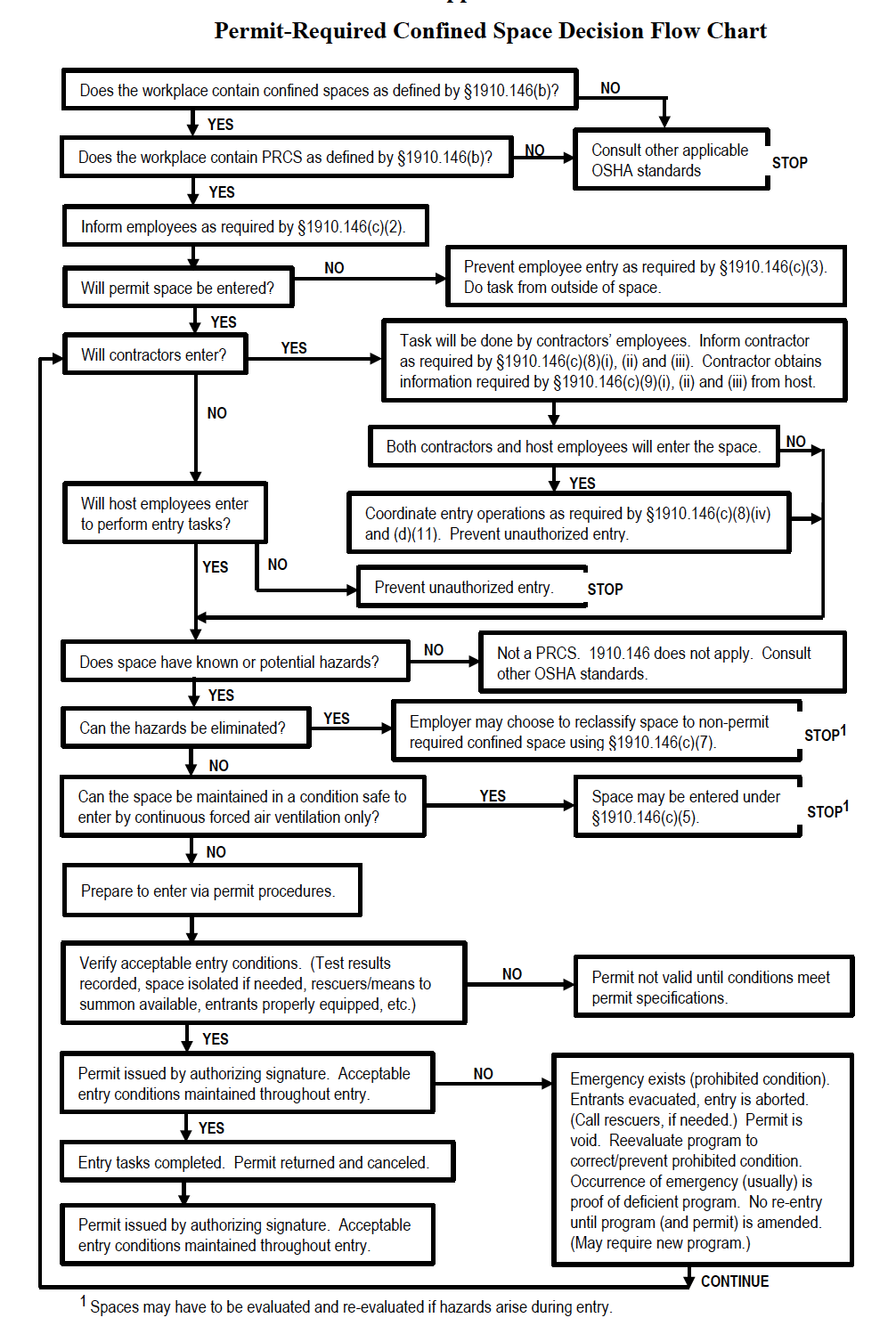
EVERY business that has workers entering Permit-Required Confined Spaces should seriously consider updating their written program to include this type of detail and specifications. COUPLED WITH OSHA’s 1910.146, these requirements regarding the means used to isolate the space and test the atmosphere are an EXCEPTIONAL improvement over OSHA’s basic definition of “isolation” and atmospheric testing.
Section 9.26(2) of the WorkSafe BC Occupational Health and Safety Regulation requires that the atmospheric tests mandated by section 9.25 be carried out by an “adequately trained worker.” The OHSR did not define what constitutes “adequate training” to perform the atmospheric testing required by section 9.25. This has caused confusion about who can and cannot be employed as a tester. Atmospheric testing is a complex process that involves:
- an understanding of sensors,
- the calibration of monitoring equipment,
- the setting of alarm levels, and
- the interpretation of test results.
The proposed amendment aims to ensure that the atmospheric testing of confined spaces is ONLY carried out by persons with the necessary training and experience to conduct the testing. The amendment clarifies that workers who carry out the atmospheric testing required by section 9.25 MUST have the necessary qualifications to perform that testing by removing the phrase “adequately trained worker” from section 9.26(2) and instead requiring that testers be QUALIFIED PERSONAL who have TRAINING and EXPERIENCE in
- the CALIBRATION, OPERATION and MONITORING of testing equipment and
- the INTERPRETATION of readings from testing equipment.
With respect to the calibration of testing equipment, the intention of the proposed amendment is not to require that the tester must always perform the calibration of equipment. Under the amendment, calibration of testing equipment can be performed by someone other than the tester; however, the tester MUST understand the calibration process and KNOW that the instrument has been calibrated accordingly. Testers are REQUIRED to have the training and experience to perform a field calibration, rather than a factory calibration.
Regardless, of the location of your workplace, it would be a wise move to incorporate these specifics into our own written CS Entry programs. With atmospheric hazards being the hazard that kills the vast majority of entrants, we need to make the testing of the atmosphere as ERROR FREE as we possibly can. We SAFTENG conducts one of our three-day LOTO/CS Entry program reviews, we are surprised of the VERY LIMITED training entry supervisors have received on their meters. Atmospheric testing and monitoring is the MOST CRITICAL path for a safe entry and having unqualified and/or poorly trained personnel doing this task is a recipe for disaster.
The WorkSafe BC CS Entry standard includes other Best Practices that many other CS Entry standards fall short on. Here are some other suggestions for our written programs:
9.18 Control of harmful substance in adjacent piping
(1) BEFORE a worker enters a confined space where adjacent piping contains a harmful substance that is:
- a liquid with sufficient volatility to produce a hazardous concentration of an air contaminant, or a gas or vapour, the harmful substance in the adjacent piping must be controlled by either:
- disconnecting the adjacent piping or
- isolating it using blanks or blinds that meet the requirements of section 9.20 below
(2) BEFORE a worker enters a confined space where adjacent piping contains a harmful substance that is
- neither a liquid with sufficient volatility to produce a hazardous concentration of an air contaminant, nor a gas or vapour, the harmful substance in the adjacent piping must be controlled by either:
- disconnecting the adjacent piping or
- isolating it using blanks or blinds that meet the requirements of section 9.20 or
- using a double block and bleed system that meets the requirements of section 9.21.
(3) Before a worker enters a confined space where adjacent piping contains a substance that is harmful only because of the temperature, pressure or quantity of the substance, the harmful substance must be controlled
- by either disconnecting the adjacent piping or
- isolating it using blanks or blinds that meet the requirements of section 9.20 or
- using a double block and bleed system that meets the requirements of section 9.21,
- by isolating the adjacent piping in a manner that a professional engineer has certified will make the confined space safe for a worker to carry out the intended work, or
- if there is no head pressure in the adjacent piping, by de-energizing and locking out each pressure source for the adjacent piping and depressurizing the adjacent piping.
(4) Where a confined space is
- subject to the ingress of gases from a gravity-flow municipal or domestic sanitary sewer system or storm sewer system, and
- protected from the ingress of gases by a p-trap,
a worker may enter the confined space ONLY if the atmosphere of the confined space has been tested IMMEDIATELY BEFORE entry and the test results confirm that the confined space contains clean respirable air.
(5) If a worker enters a confined space of the type referred to in subsection (4), the following must be undertaken:
- the operational integrity of the p-trap must be confirmed IMMEDIATELY on the entry of the worker;
- while the worker is inside the confined space, the atmosphere of the confined space MUST be CONTINUOUSLY monitored and confirmed to contain clean respirable air.
9.19 Isolation points
(1) The employer must keep a record which identifies the location of every isolation point.
(2) Every isolation point MUST be visually checked or otherwise verified to ensure that the confined space is effectively isolated BEFORE a worker enters the space.
9.20 Blanks and blinds
(1) Unless certified by a professional engineer, to provide adequate safety for the particular conditions of anticipated pressure, temperature and service, a blank or blind MUST be manufactured in accordance with the specifications of one of the following standards:
- ANSI Standard API 590-1985, Steel Line Blanks;
- ANSI Standard ASME/ANSI B16.5-1988, Pipe Flanges and Flanged Fittings;
- ANSI Standard ASME B31.1-1992, Power Piping;
- ANSI Standard ASME B31.3-1993, Chemical Plant and Petroleum Refinery Piping.
(2) If a blank or blind is certified by a professional engineer, the employer MUST keep a record of
- its certification,
- location and
- conditions of service.
(3) If required, an allowance for corrosion MUST be made in the design of a blank or a blind.
(4) A blank or blind MUST BE STAMPED with or otherwise indicate its pressure rating.
(5) If a line is to be opened for disconnection or to insert a blank or a blind, written safe work procedures MUST be prepared and followed to prevent hazardous exposure of workers to its contents.
(6) Visual indication that a blank or blind has been installed MUST be provided at the point of installation (Tag it out or Lock it out with a LOTO lock).
(7) If required to prevent leakage, gaskets must be installed on the pressure side of blanks or blinds and flanges must be tightened to make the blanks or blinds effective.
(8) If threaded lines are used, threaded plugs or caps must be used to blind the lines.
9.21 Double block and bleed
If a double block and bleed isolation system is used
- the diameter of the bleed line must be NO LESS THAN the diameter of the line being isolated, unless certified by a professional engineer,
- the bleed for a liquid system MUST BE AT A LOWER ELEVATION than the block valves,
- ALL valves MUST BE locked out in their proper/SAFE open or closed position,
- the downstream block valve MUST BE be checked to ensure that it is capable of safely withstanding the line pressure,
- the bleed MUST be checked to ensure that it remains clear of obstructions while the confined space is occupied, either by continuous automatic monitoring or by manually checking within 20 minutes BEFORE worker entry, or BEFORE re-entry after the confined space has been vacated for MORE THAN 20 minutes, and
- in the event of discharge from the bleed line resulting from failure of the upstream block valve, ALL workers MUST immediately exit the confined space and the space MUST be effectively re-isolated BEFORE a worker enters the space.
9.22 Alternative measures of control or isolation of adjacent piping
(1) Section 9.18 does not apply if
- a measure specified in section 9.18 to control or isolate harmful substances contained in adjacent piping from a confined space is not practicable, and
- the employer implements alternative measures of control or isolation that are acceptable to the Board.
(2) All workers affected by measures implemented under subsection (1) must be informed of the measures taken and instructed in any applicable work procedures.
9.23 Discharge area
The area of potential discharge from a disconnected line or from the bleed of a double block and bleed isolation system MUST BE CONTROLLED to ensure that any accidental discharge will not present a hazard to workers.
CLICK HERE to see the entire WorkSafe BC CS standard.
CLICK HERE to see the WorkSafe BC announcement of the revision.