
UPDATED on 7/21/2018
For SAFTENG Members – On Scene News Report Video from ABC13 Houston
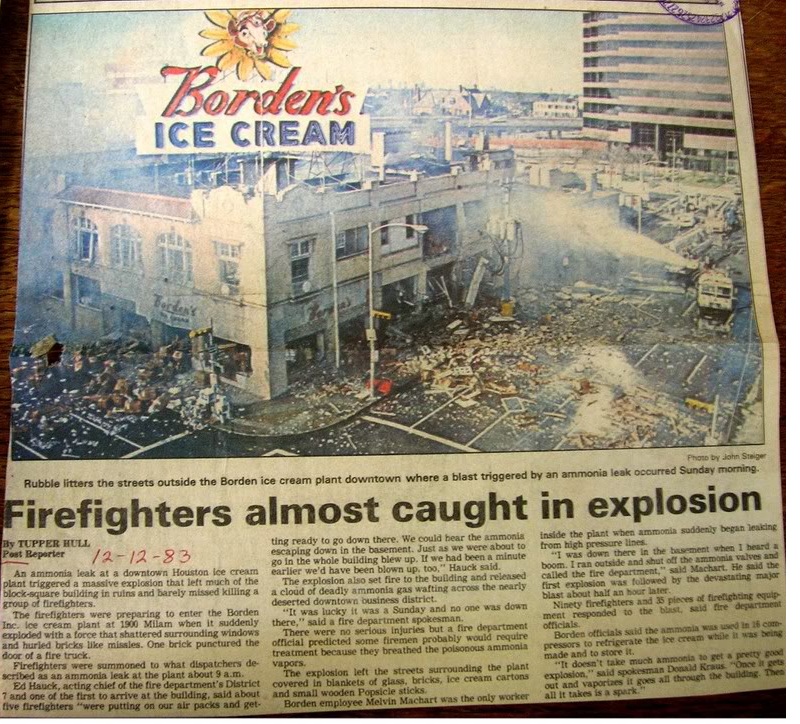
First arriving firefighters at the Borden’s Ice Cream plant at the edge of downtown Houston on December 11, 1983, barely escaped death or serious injury when the two-story plant blew apart from an anhydrous ammonia explosion. The explosion shattered a misconception that evolved over the years and changed procedures for handling ammonia releases.
It was early Sunday morning when the building engineer checked the refrigeration system that had been in a holding mode since production shut down Thursday. Only three of the 16 compressors in the basement were operating. The engineer proceeded to the other end of the basement when he heard a noise, turned quickly and saw a developing vapor cloud. He rushed up the rear stairs and closed the king valve on the liquid line, after which he escaped the building and notified the fire department.
When the first fire company arrived, the engineer offered to accompany the firefighters into the basement, pointing out a valve that may stop the leak. Firefighters loaned him some gear to wear and took a few minutes to instruct him to use self-contained breathing apparatus. This delay probably saved their lives because the building blew apart as they headed for an entrance. The brick veneer walls collapsed onto the street a short distance from the firefighters (pictured above).
A huge vapor cloud of ammonia poured from the building. Because it was Sunday, few businesses were open. The greatest threat was a downwind hotel which was advised to shut the fresh air intakes on the air conditioning system. Firefighters set up heavy water streams to absorb much of the vapors. What vapors got through the defensive lines dissipated in time because ammonia vapors are lighter than air.
The Hazardous Materials Response Team arrived in the meantime. The engineer briefed them before attempting to enter the basement to assess the damage. Both stairways were blocked with debris, and the team had to descend via an elevator shaft. The trip proved fruitless. Many of the ammonia pipes were broken, and the basement was filling with water from the broken sprinkler pipes. It was decided to flood the basement, and firefighters laid in more hose lines. The vapor cloud diminished as the water rose in the basement and began to cover the broken ammonia lines. The incident was concluded after the basement was completely full of water.
Surprise
Several firefighters at the scene expressed astonishment that ammonia would burn. After all, ammonia carries a green, nonflammable gas label and rates only 1 (on a scale of 0 to 4, with four being the maximum flammability hazard) in the 704 National Fire Protection Assn classification. A notation in 704 states ammonia is classified 1 flammability because “ammonia is hard to burn.”
The astonishment was not confined to the firefighters. An investigator of the incident, who had 45 years of experience with refrigeration, registered surprise. “It is hard to find any of the old, experienced ammonia refrigeration men who believe it possible for ammonia to explode,” the investigator wrote in his report.
Borden’s incident changed the procedures of the Hazardous Materials Response Team for handling ammonia leaks. No longer would they rush into a building to plug a leak or broken ammonia line. A building would be thoroughly vented first. One usually learns from a tragedy. This time, it did not cost a life to learn a valuable lesson on the explosive potential of anhydrous ammonia.
Firefighter Bob Parry was on the job that day. He described what happened next in this write-up on firefighternation.com.
A quick class on the air pack was given to Mr. Machart and we proceeded toward the building. We were in the cloud and just about to enter the building when Mr. Machart became a little restless (in the self-contained breathing apparatus) about his face piece. We went back to the staging area and assured him how the air pack would protect him from the fumes.
While walking back to the building, we felt the ground rumble and a fireball shoot across Calhoun. The force of the explosion sent bricks flying and crashing down on us in the street. In fact, popsicle sticks were found a mile away.
UPDATE on 7/21/2018
News Report Video from ABC13 Houston