
This is always a good discussion during our audits and training, and one where my team and I feel OSHA is technically wrong in their standard. Let me explain…
Here are a couple of key OSHA definitions that will help us in our discussion:
|
Energy isolating device. A mechanical device that physically prevents the transmission or release of energy, including but not limited to the following: A manually operated electrical circuit breaker; a disconnect switch; a manually operated switch by which the conductors of a circuit can be disconnected from all ungrounded supply conductors, and, in addition, no pole can be operated independently; a line valve; a block; and any similar device used to block or isolate energy. Lockout. The placement of a lockout device on an energy isolating device, in accordance with an established procedure, ensuring that the energy isolating device and the equipment being controlled cannot be operated until the lockout device is removed. Lockout device. A device that utilizes a positive means such as a lock, either key or combination type, to hold an energy isolating device in the safe position and prevent the energizing of a machine or equipment. Included are blank flanges and bolted slip blinds. Tagout. The placement of a tagout device on an energy isolating device, in accordance with an established procedure, to indicate that the energy isolating device and the equipment being controlled may not be operated until the tagout device is removed. Tagout device. A prominent warning device, such as a tag and a means of attachment, which can be securely fastened to an energy isolating device in accordance with an established procedure, to indicate that the energy isolating device and the equipment being controlled may not be operated until the tagout device is removed. |
First, let’s discuss what an energy isolation device is and its purpose. As OSHA’s definition states, it is a mechanical device that physically prevents the transmission or release of energy. A blind installed in a flange is an energy isolation device.
Second, to keep our energy isolation device(s) in a SAFE position while we work, we will either place a lockout device or a tagout device on the energy isolation device. The lockout device (e.g., a lock) physically secures our energy isolation device in the SAFE position. A tagout device is NOT a physical means of securing our device in the SAFE position, thus why OSHA is not a big fan of “tagout,” as evidenced by its limited legal use via the LOTO standard. But when it comes to using blinds in a pipe flange as our means of isolation, it is industry practice to “tag out” the blind(s).
OSHA defines a tagout device as a prominent warning device, such as a tag and a means of attachment, which can be securely fastened to an energy-isolating device in accordance with an established procedure to indicate that the energy-isolating device and the equipment being controlled may not be operated until the tagout device is removed. OSHA’s definition of tagout is the placement of a tagout device on an energy isolating device, in accordance with an established procedure, to indicate that the energy isolating device and the equipment being controlled may not be operated until the tagout device is removed.
So, placing a tag on a blind would certainly be called a “tagout”???? Well, not quite… If we look at the OSHA definition of a lockout device, we see that OSHA added a statement to the end of its definition. The statement is… “Included are blank flanges and bolted slip blinds.” Now I think this is an error in the standard, as, by definition, blank flanges and bolted slip blinds are energy isolation devices, as they are mechanical device that physically prevents the transmission or release of energy. But why did OSHA call these devices lockout devices instead of an energy isolation device?
If we look at this situation at the most basic levels of energy isolation, how do we ensure the blind remains in place while we are working or inside a confined space? I have seen some plants with serious issues with “tagout” and have gone to great lengths to ensure that “lockout” is the means to secure ALL energy isolation devices. For blinds, their practice is to leave one bolt out of the flange, and thru this opening, they thread “shark liter” through the opening and then around the blind handle. They then take a long shank lock and lock the shark liter in place by threading the lock shackle through the open bolt hole and locking the lock to lock the flange together, along with the two ends of the shark liter. They also have some in-house fabbed lockout devices that are large enough to lockout their larger flanges (e.g.12″ and larger pipes). Now, these facilities are doing LOCKOUT, as they apply a LOCKOUT DEVICE (e.g., lock) to secure an ENERGY ISOLATION DEVICE in the SAFE POSITION. But what if we do not go to these lengths and instead hang one of our traditional “DANGER – DO NOT OPERATE” tags on the blind? Is this not tagout by OSHA’s definition? Did OSHA really mean to include that statement at the end of their definition of Lockout Device that included blank flanges and bolted slip blinds?? By adding this statement, did OSHA essentially allow a facility to install blinds with no locks or tags to secure them in place???? Without a lockout device or tagout device in place, how will other workers know that the blind is being used as an energy control device to protect other workers?
If we look further into the standard, we come to a section that contradicts the practice of not locking out or tagging out a blind. 1910.147(c)(5)(ii)(D) states that “Lockout devices and tagout devices shall indicate the identity of the employee applying the device(s).” So if OSHA requires this and they call blind flanges and bolted slip blinds “lockout devices,” how is a facility going to meet (c)(5)(ii)(D) if they do not place a lockout or tagout device on them? Some facilities use specially colored and numbered blinds and an energy isolation worksheet to achieve this identification requirement. However, if we choose to go this route, it is IMPERATIVE that we train contractors and affected personnel on the COLOR(s) used for the specially colored blinds so that they RESPECT these blinds the same as our lockout device(s).
Bottom line… Every blind/blank used as an energy isolation device MUST BE IDENTIFIED! A lockout device (e.g., lock) is best, but if a lockout device can not be used due to the arrangement of the blind/blank, then we MUST use a tagout device (e.g., tag) on the blind. Not tagging or locking a blind with a lockout lock or a tagout tag merely because of a sentence in an OSHA definition is extremely risky behavior! Somehow I would like to think that those who read this article would never crawl into a confined space without having CONTROL over each isolation device protecting them. This leads me to my next concern: tagging blinds with traditional tagout tags!!
As I have stated above, tagging blinds is an industry practice in the chemical industry, where blinds are the most common and efficient means of separating hazardous energy sources. But with the use of these traditional tags comes MUCH HIGHER risks! In a traditional manufacturing plant, tagout is risky (in my opinion), but doing so during a confined space entry increases the risk exponentially. When workers are inside the space, they are more vulnerable to someone tampering with their isolation devices OUTSIDE the space as the isolations are almost always out of sight of the entrant(s) AND the attendant. So this makes the tagging method EXTREMELY IMPORTANT in my eyes (especially if I am one of the confined space entrants!). I have always liked the two-part tag with a coordinated numbering system.
This tag looks just like our traditional tagout tag, but the bottom 1/4 of the tag can be torn off (e.g., perforation is provided). The detached bottom 1/4 of the tag has a serial number that matches the serial number on the main part of the tag that will remain attached to the energy isolation device (e.g., blind). The idea behind this two-part tag is that the lower 1/4 of the tag acts like a “key” to the main part of the tag. The 1/4 part of the tag will be placed into a lockbox, and the ONLY way that blind can be removed from the line is when the worker has BOTH PORTIONS of the tag AND THE SERIAL NUMBERS MATCH. The ONLY way the worker can get the bottom 1/4 of the tag is when the owner of the equipment being serviced has determined it is ready to be returned to service and ALL PERSONAL LOCKOUT DEVICES have been removed from the lockbox. This safeguard may not seem like much to some workers, but trust me when I tell you that it has PREVENTED at least a dozen serious LOTO errors during my career. When we use the traditional one-piece Danger tags, workers CAN and HAVE removed blinds from lines BEFORE the maintenance/servicing work was completed. Luckily in the majority of my incidents, this resulted in an environmental incident, but had a worker been in the line of fire it would have been SERIOUS injuries and quite possibly a fatality or two!
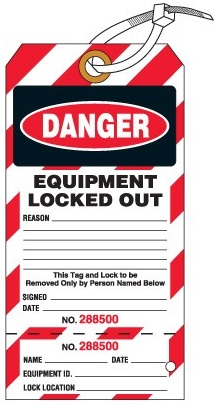
Now for those who don’t like Tagout, we have options for LOCKING our blinds in their safe position. One option is to leave the lockout used to install the blind in place so that the flange the blind is installed in is “dead.” This allows us to leave one of the bolts out of the flange, and we can use that opening to insert a LOTO lock or even some cable with a LOTO lock. This means we now have a key that we can place into the lock box rather than the tabs from the tags (as shown above). Some really nice devices can be purchased that will adapt to different types and sizes of flanges that are installed over the ends of the bolt and nut to prevent anyone from removing at least one of the bolts. These devices are lockable in place.
Lastly, OSHA will NOT cite you for tagging your blinds as long as the tags you use are part of your energy control program. Here is what OSHA says in the LOTO Preamble about this matter and their explanation as to why they included blinds in the definition of a “lockout device”…
| For example, many servicing operations involving process equipment utilize blinds and blank flanges as means of controlling hazardous energy in the process system. These blinds and flanges can be bolted in place, a method of securing which does not involve an actual lock, but which would be of comparable or greater difficulty to defeat either intentionally or inadvertently. OSHA believes that the bolting of blinds and flanges should be considered to be a “locking device” for the purposes of the standard, and has modified its proposed definition to reflect this determination. Since the standard requires that lockout and tagout devices identify the person that affixed (and is to be protected by) the device, the employer must develop and utilize a method to identify the persons that the bolted blinds and blank flanges are intended to protect. The use of individual tags or a group tag which provides for continuous individual accountability would meet this requirement. |
Please heed the last couple of sentences (highlighted in red)… The workers being protected by these blinds MUST be connected in some manner to these blinds. There are many options, but merely putting a tag on the blind – with those it is intended to protect having no means to ensure the blind is not pulled during their work is NOT acceptable!