
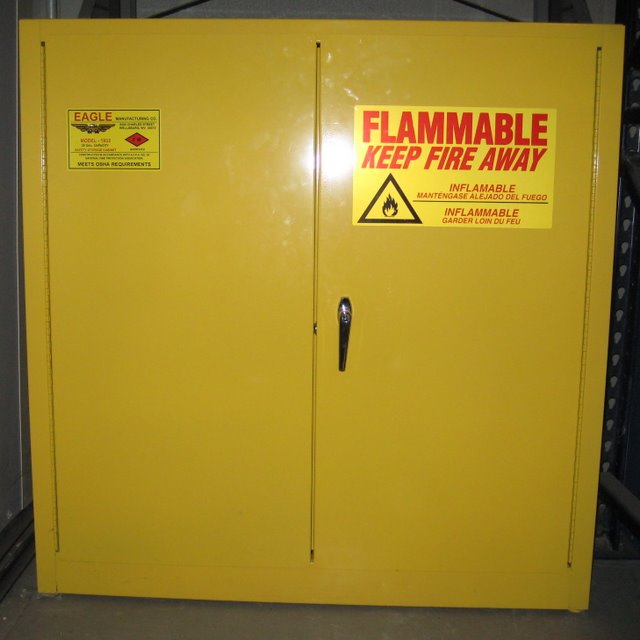
One of the most asked questions at SAFTENG.net and during our audits and project work! Are cabinets required to be vented? My short answer is NO… and I have yet to find a AHJ (auhtority having jurisdication) that requires this. I am pretty sure there is some obscure fire code on the books that may require this but I have asked dozens of fire marshals and inspectors and not one has yet to say it is required in their jurisdiction. The manufacturer’s make their cabinets so they can be vented should one of their cabinets end up in one of these jurisdiction, but here is the lowdown from NFPA on this topic.
NFPA Info
Q. Are flammable liquids storage cabinets required to have exhaust ventilation?
A. NFPA 30 does NOT require an exhaust ventilation system for storage cabinets, although most cabinets have plugged fittings that can be used for such purpose. Exhaust ventilation should only be provided when warranted by the materials in the cabinet, for example for particularly toxic or noxious materials. If provided the manufacturer’s instructions should be followed. Typically, this will involve small diameter steel duct or pipe leading directly and by the shortest route to the exterior of the building. Exhaust must be taken from the bottom of the cabinet.
NFPA 30: Annex A Explanatory Material
A.9.5.4
Venting of storage cabinets has not been demonstrated to be necessary for fire protection purposes. Additionally, venting a cabinet could compromise the ability of the cabinet to adequately protect its contents from involvement in a fire, because cabinets are not generally tested with any venting. Therefore, venting of storage cabinets is not recommended.
However, it is recognized that some jurisdictions might require storage cabinets to be vented and that venting can also be desirable for other reasons, such as health and safety. In such cases, the venting system should be installed so as to not affect substantially the desired performance of the cabinet during a fire. Means of accomplishing this can include thermally actuated dampers on the vent openings or sufficiently insulating the vent piping system to prevent the internal temperature of the cabinet from rising above that specified. Any make-up air to the cabinet should also be arranged in a similar manner.
If vented, the cabinet should be vented from the bottom with make-up air supplied to the top. Also, mechanical exhaust ventilation is preferred and should comply with NFPA 91, Standard for Exhaust Systems for Air Conveying of Vapors, Gases, Mists, and Noncombustible Particulate Solids. Manifolding the vents of multiple storage cabinets should be avoided.