
(UPDATED 10/20/12) –This is to aid facilities in assigning the critical role of a Respiratory Protection Program Administrator; an often overlooked role. OSHA requires this role to be filled by an “INDIVIDUAL” and not the “safety team”…
From OSHA’s Q&A on Respirators
Q: Why is a formal respirator program needed?
A: A respirator program increases the chances of using a respirator correctly. A respirator will only protect if it is used correctly. Also, OSHA requires a number of written elements for all respiratory protection programs.
Q: Who is in charge of the respirator program?
A: The program must be administered by a trained program administrator who is qualified and knowledgeable in respiratory protection to run all aspects of the program.
Q: What do employees need to know about the respirator program?
A: Employers must establish and implement a written respiratory protection program with worksite-specific procedures and elements for required respirator use. The provisions of the program include procedures for selection, medical evaluation, fit testing, training, use and care of respirators.
CLICK HERE for the full Q&A
From CPL 02-00-120 Inspection procedures for the Respiratory Protection Standard
(c)(3) Program Administrator: A “respiratory protection program administrator” is required to oversee and evaluate the respirator program. This individual must be suitably trained and have the appropriate accountability and responsibility to manage the full respiratory protection program.
Companies with multiple worksites may have a program administrator at each worksite, as long as this person is qualified and retains the accountability and responsibility for the day-to-day operation of the specific program for that site. Alternatively, a company may opt to have one program administrator for several sites and/or one program for several similar sites as long as the program contains the necessary elements and addresses the hazards at those sites.
Inspection Guidelines. The extent of training or experience required for the program administrator will vary based on the complexity of the respiratory hazards in the workplace. Where significant program deficiencies are discovered, compliance officers should discuss questions about the program with the program administrator to determine how familiar she or he is with respirators, the hazards in the workplace, respirator use in the facility, the respirator standard and the company’s respirator program.
… Fit testing procedures should be discussed with the program administrator. If fit testing is being performed, the CSHO should observe the company’s procedures and evaluate their adherence to the prescribed protocol.
Inspection Guidelines. The CSHO should evaluate how well the written respiratory program is being implemented in the workplace. Observed deficiencies in the program and evaluation procedures should be discussed with the program administrator to determine what previous efforts she or he may have made to evaluate how well their program was working. Deficiencies should also be discussed with employees to determine how long any deficiency has existed and what requests or complaints about the respirator program if any they have made to the program administrator. If the program administrator keeps a written assessment, implemented changes may be considered as efforts toward improvement. Recent changes in the workplace such as new processes should have been evaluated for necessary respiratory program changes.
From OSHA’s Small Entity Compliance
OSHA has prepared a Small Entity Compliance Guide that contains criteria for selection of a program administrator and a sample program.
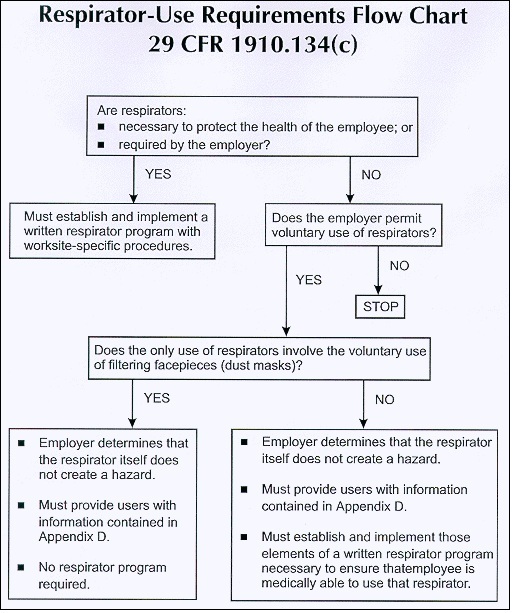
Two interesting positions from the NC-OSHA (state OSHA plan)…
Q. Can More Than One Person Serve as the Respirator Program Administrator?
A. Only one person can fulfill the primary responsibilities of running the program, unless your company has more than one worksite. Under that circumstance, you may have a program administrator for each site. Ordinarily, however, the responsibilities cannot be divided among several employees. Requiring an administrator with sole responsibility helps ensure the integrity of the program by maintaining continuous oversight by one person. Nonetheless, the administrator may rely on other employees to help run parts of the respiratory protection program (e.g., fit testing, medical evaluations).
Q. What Level of Training Is Required for the Program Administrator?
A. This training or experience is appropriate if it enables the program administrator to fulfill the minimum standard requirements of recognizing, evaluating and controlling the hazards in your workplace. For example, if your program requires air-supplying respirators for use in immediately dangerous to life or health (IDLH) environments, your program administrator must have training and experience pertaining to the use of this type of equipment. Similarly, if your company does not use air-supplying respirators and no significant respiratory hazards have been identified at your workplace, someone with less sophisticated experience or training might be able to effectively serve in this position.
Click Here to see the entire collection of OSHA’s Respirator Q&A’s.