As I have mentioned a few times, there is a substantial difference between a Safe Work Practice design to make OSHA happy and one that functions as a “management system” for the risk the “program” is trying to control. Far too many “safety programs” are simply regurgitating the OSHA standards they intend to comply with. Sometimes, we come across a cut-and-paste directly from the 1910 standard(s).
In this article, I hope to continue the discussion about building a “management system” to control risks rather than having a “compliance program” that is a cut and paste from the OSHA standard. In February, I explained how this is accomplished with Lockout/Tagout, What does it mean to comply with 1910.147 vs. having a “management system” for Energy Control? In this article, I will break down OSHA’s Confined Space Standard(s) (e.g., 1910.146 and 1926 versions).
The CS standard can be broken down into four (4) major elements:
1) Evaluate/Identify
2) Entry Method(s)
3) Training
4) Annual Evaluation
In each of these elements, we need to identify the OWNER(s) who are RESPONSIBLE for seeing that they get done and DONE CORRECTLY and who the professionals are that will perform these functions. Granted, the safety team is the subject matter expert in this effort, but a ton of actions need to be taken to ensure that PRCSs are entered safely repeatedly. We MUST be able to perform our duties within this function with high confidence so that entries and all the supporting functions are being carried “by the book” (e.g., very little deviation).
So, let’s start with the elements of the evaluation and Identification. Who on site is responsible for ensure each department/unit is evaluated to identify Confined Spaces (CS) and which of those CS would pose risks that would make them a Permit-Required Confined Space (PRCS). In the good old days when facilities had “safety teams,” this action typically fell on the safety team members. However, in today’s workplaces, there are many that no longer have a safety team, so this leaves the actions to someone else with the knowledge of the process/manufacturing equipment. Be very careful hiring a 3rd party to perform this evaluation as they will NOT be able to perform this 100% on their own, meaning someone from the facility will have to participate in this evaluation. This evaluation is CRITICALLY IMPORTANT, as any errors in this stage can set in motion a series of catastrophic failures.
What entry methods will the facility allow?
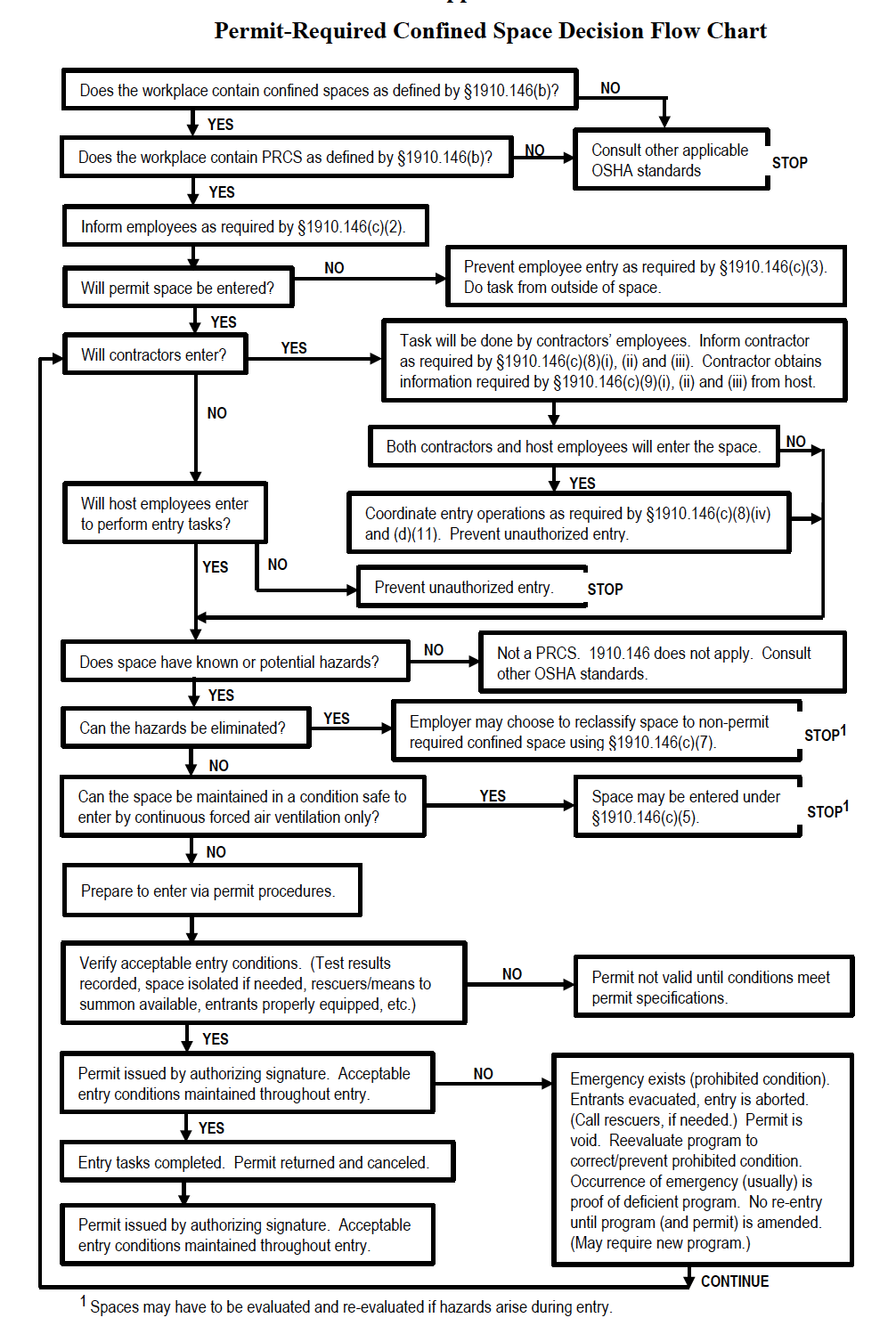
As we have discussed many times, there are THREE (3) acceptable entry options for PRCSs:
- .146(c)(5) for when the ONLY hazard is an atmospheric hazard, AND we can demonstrate that the atmospheric hazard can be CONTROLLED using forced air ventilation
- .146(c)(7) for when the PRCS has NO KNOWN or POTENTIAL atmospheric hazard(s) AND the physical hazards that made the space a PRCS can be ELIMINATED via engineering controls such as LOTO , and
- .146(d)-(k) Permit Entry, where the space does NOT qualify for (c)(5) or (c)(7), so ALL the requirements from section .146(d) thru (k) apply.
PLEASE NOTE: the same applies to the Construction Standard for Confined Spaces, found in 1926.1203.
Keep in mind that (c)(5) has very limited application in most industrial settings, but I have come across a couple of spaces where (c)(5) was applicable; however, the facility’s written program/practices and training did not cover this entry option, so it was NOT an option for them. Hence, management needs to establish which of the entry methods will be utilized so the program/practices and training content can meet these needs.
The next topic to tackle is training, and this can be a battle! My PRCS course is 8 hours for Entry Supervisors, as they have to stay for the entire course. For those needing to be trained to be Attendants, the course is 4 hours. For those who will only be entrants, the training is 2 hours. Everyone on site will get 30-minute AWARENESS training.
This is ONLY for entry; non-entry rescue training for attendants is another 3 hours. For those on the response team, they will attend a 24-hour course and participate in a mock rescue annually (6-8 hours).
I also need to mention that the LOTO training course has an additional rider for those who will be performing PRCS isolation. This additional rider is 2-3 hours. Remember, if we are using (c)(7) as our entry method there are ONLY THREE (3) acceptable means to isolate every pipe/duct/hose/tubing to the space:
1) Double Block and Bleed
2) Disconnect & Misalignment
3) Blinding/Blanking
So, space isolation plays an ABSOLUTELY CRITICAL function, and since these isolation methods may not be covered in traditional LOTO training, we cover them in this rider course.
Last but not least is the ANNUAL evaluation of the program/practices and closed entry permits. I always suggest that entries be heavily audited throughout the year and that these audit reports be formally part of the annual evaluation. But who is responsible for doing this/these evaluations? Does the site do a single evaluation or does each unit/department perform their own evaluation? Who sets the level of risk acceptance? Who generates the corrective action plans from this/these evaluation?
Taking this approach to our Confined Space management will take us to the next level in safety if that is where management wants to go. And there is no better program/practice to start with, based on the level of risks these entries pose to the larger percentage of the workforce.