
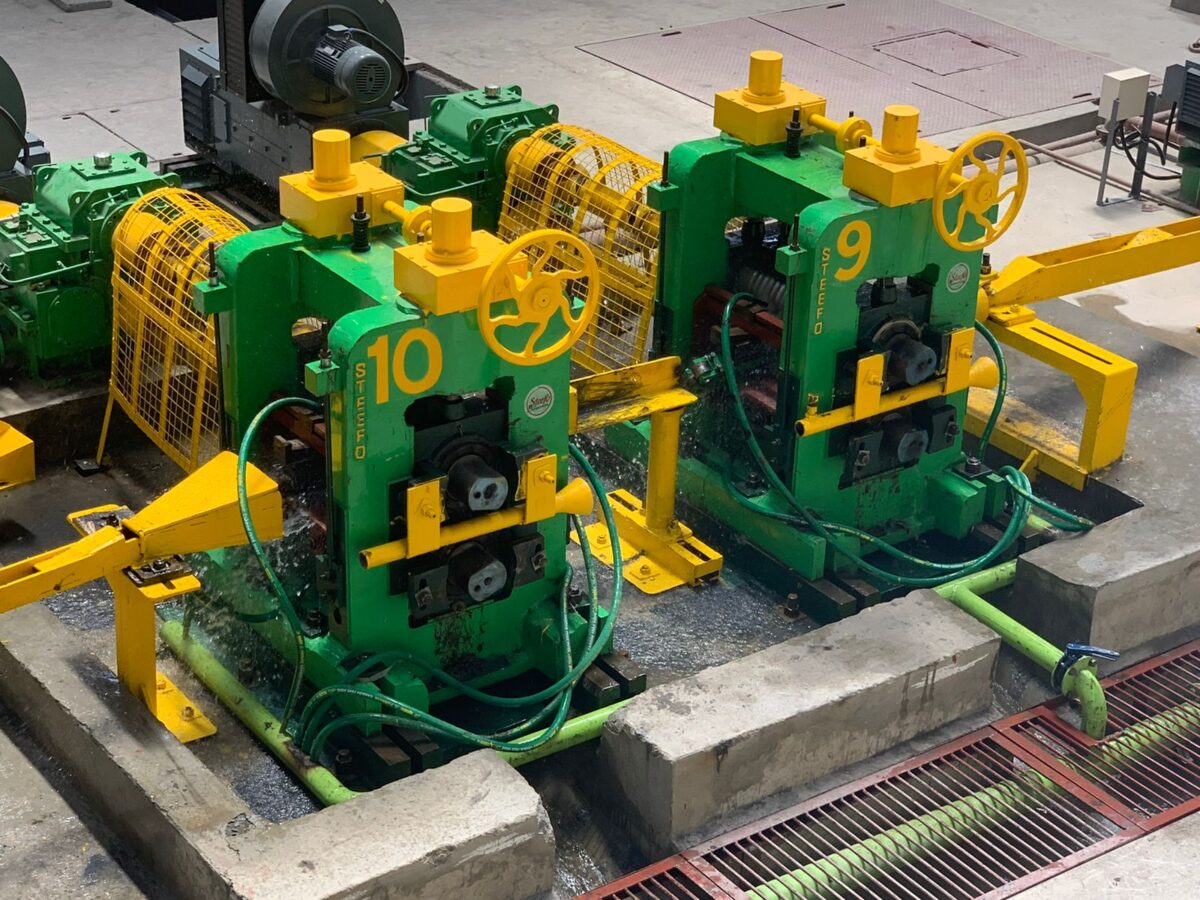
 This is a MUST READ for safety professionals engaged in developing, implementing, and managing a LOTO program. The facility was doing everything RIGHT in terms of program, procedures, and training; yet a worker violated LOTO in the presence of the Shift Supervisor who had only been in his role for 1-month. The OSHRC laid out this case in a very easy-to-follow/understand logic, such that I am betting most safety pros can envision these human failures occurring within their facility.
The business is engaged in the manufacturing of steel rebar at its facility in Sayreville, NJ. In the Sayreville facility’s Rolling Mill, CMC employed AR as an Assistant Roller. On May 30, 2022, AR was adjusting a stand jack located at the rear of Mill Stand #7 when the machine unexpectedly energized, and he was pulled into the machine’s spindles and crushed to death. Working at or near Mill Stand #7 before the incident and when the incident happened were Rolling Mill Shift Supervisor HH, Assistant Roller AR, and Mill Technicians CC and PH.
On May 31, 2022, the Occupational Safety and Health Administration (OSHA) opened an investigation related to the fatality. On November 30, 2022, OSHA issued a three-item serious Citation and a one-item willful-serious Citation and notification of penalty (Citation) alleging violations of OSHA standard § 1910.147 entitled The control of hazardous energy (lockout/tagout).
The Secretary filed its Complaint on February 23, 2023. The Citation was attached to and made a part of the Complaint. Respondent filed an Answer and affirmative defenses on March 30, 2023. Thereafter, the Complaint and Citation were amended to revise the classification of one alleged Citation item from serious to willful-serious, and to group the two items now classified as willful-serious for penalty purposes. The amended Complaint was received on January 25, 2024. Respondent’s amended Answer was filed on February 12, 2024.3. A three-day hearing was held in Newark, New Jersey from March 11-13, 2024. Both parties submitted post-hearing briefs and reply briefs.
In this decision, the three alleged violations at issue are a part of OSHA’s standard for the control of hazardous energy. The total proposed penalty for the three alleged violations is $159,529.00.
Citation 1, Item 1, alleged a serious violation of 29 C.F.R. § 1910.147(c)(4)(i), stating the specific procedures for the control of potentially hazardous energy that the facility developed were not utilized to protect the employees from the hazardous energy that is associated with making adjustments to the jacks of Mill Stand #7. The proposed penalty for Citation 1, Item 1 is $14,502.
Citation 2, Item 1(a) alleged a willful-serious violation of 29 C.F.R. § 1910.147(d)(2), stating the employer did not ensure equipment was shut down while making adjustments on Mill Stand #7.
Citation 2, Item 1(b) alleged a willful-serious violation of 29 C.F.R. § 1910.147(d)(4)(i), stating the facility did not ensure locks were affixed to isolate energy sources while employees were adjusting the jacks on Mill Stand #7. The combined proposed penalty for Citation 2, Items 1(a) and 1(b) is $145,027.
ISSUES
The key issues in dispute are:
1) whether the Secretary has proved knowledge of the alleged violations,
2) whether Mill Stand #7 was shut down as required by the lockout procedure, and
3) whether the Secretary has proved the willful characterization for Items 1(a) and 1(b) of Citation 2.
Based on the analysis that follows, the Secretary has met its burden of establishing all elements of the violations in the Citation Items by a preponderance of the evidence. The undersigned finds that knowledge has been established for all Citation Items, and that Mill Stand #7 was not shut down as required by the lockout procedure. All Citation Items are affirmed. Regarding Items 1(a) and 1(b), of Citation 2, the undersigned finds the instant record does not establish Respondent’s violations of 29 C.F.R. § 1910.147(d)(2) and 29 C.F.R. § 1910.147(d)(4)(i) were willful. The record evidence establishes these Citation Items were serious violations.
Any argument not specifically addressed below has been considered and determined to have no merit.
FINDINGS OF FACT
The business is a corporation organized in the state of Texas with its principal location in Irving, Texas. The facility manufactures steel rebar at its Sayreville, New Jersey facility (Facility).
Marc XXXXXXXX was the Safety Manager at all relevant times and had been in that position since 2018. His duties included evaluating PPE, hazard review, standard operating procedures review, training, accident investigations, and ensuring lockout/ tagout (LOTO) periodic reviews were done. Mr. Miele investigated the May 30, 2022 accident that resulted in AR’s death by interviewing employees, reviewing the lockout/tagout procedures, and watching footage from an in-house video camera that recorded the accident. Mr. Miele concluded the accident occurred because Mill Stand #7 had not been locked out before AR began working in the back of the stand.
The Crew(HH) was the Rolling Mill Shift Supervisor on May 30, 2022. At the time, HH had worked for the facility for about 10 years; he had been promoted to Rolling Mill Shift Supervisor the month prior, in April 2022. As the Shift Supervisor, HH was responsible for the safety of the crew he supervised (“C crew”). He could discipline employees who did not follow safety procedures. His crew was responsible for the Rolling Mill production operation, from the hot end to the cold end. Typically, there were fourteen employees on C crew.
Of that crew, Supervisor HH and three employees — AR, CC, and PH — were working at or near Mill Stand #7 at the time of the accident. AR was an Assistant Roller and had worked at the facility for about 27 years. The Assistant Roller works in the Rolling Mill hot end and is in charge of the integrity of the rebar going through the production area’s fourteen mill stands. The Assistant Roller might work at any of the fourteen mill stands. The Assistant Roller is responsible for ensuring the finished product does not have defects or abnormalities. When HH began working for the company as a crew member, AR trained him, and HH worked with AR for at least seven years after that.
On May 30, 2022, CC and PH were the Mill Technicians working at or near Mill Stand #7. Their daily work was directed by the Assistant Roller, AR. AR and the Mill Technicians reported to Shift Supervisor HH. At the time of the incident, Mill Technician PH had worked at CMC for a few months and Mill Technician CC had worked there for about a year.
Rebar manufacturing process
The steel rebar produced is made to each customer’s specifications. The rolling mill area, where the rebar is produced, is a large room with work areas based on function. There are no walls between the work areas. The rebar rolling area has a hot end and a cold end. The walk from the hot end to cold end is roughly two to three minutes.
Rebar production begins with melting scrap metal in the melt shop’s furnace, at the hot end, to form a steel rod that will be shaped into rebar as it is processed or passes through fourteen mill stands. The steel rod, or bar, is called a billet as it moves through the mill stands. The billet is a 60-foot long, 4-sided bar, which is 4 inches wide on each side. A smaller piece of the steel bar is called a bit.
The mill stands are positioned in a horizontal production line that the billet goes through starting at Mill Stand #1. Each mill stand modifies the steel billet in various ways to produce the rebar, such as shaping, turning, twisting, and compacting. Each mill stand reduces and elongates the billet in preparation for the next stand’s modification. Within each mill stand a specific billet size, dimension, and shape, is produced, such as flat, oval, square, and round. After the billet has been shaped into rebar by the mill stands, it emerges at the cold end’s cooling bed. At the cold end the rebar is cut and bundled to the customer’s specifications.
Within each mill stand, the billet of hot steel passes horizontally between the guide boxes that are on the upper roll and lower roll in each mill stand. In the record, the stand’s rolls also are referred to as stand rollers and stand wheels. Each stand has two spindles that power the rolls. These spindles extend from the back of the mill stand. A “pulpit operator,” who is located in a room about 15 feet above the mill floor, controls the speed of each mill stand’s spindles. The pulpit operator can turn the spindles on and off. During production, the top spindle turns counterclockwise, and the bottom spindle turns clockwise. If the spindles are turning, the rolls in the stand are turning. The wheels or rolls of the mill stands, through which the steel rods or billets pass, occasionally require tightening or loosening to ensure the steel rods for a particular run are shaped and sized correctly. Depending on the variation required, according to a customer’s specifications, a mill stand can be adjusted either by turning a large wheel on the front of the stand or by adjusting the stand’s screw jack located in the rear of the rolling stand using a 55mm long-handled open end jack wrench.
At the back of each mill stand, near the location of the spindles, is the stand jack that is used to increase or decrease the size of the gap between the rolls the billet passes through, to be shaped into rebar. The frequency of adjusting the stand jacks varies, at times the stand jacks are adjusted multiple times per day, at other times the stand jacks are not adjusted for several days. The adjustment to the stand jacks takes place in the area where the spindles move, are not covered by the stand’s housing, and there is stored energy. The business determined that the process of adjusting the mill stand screw jack while the stand was energized exposed employees to pinching or crushing hazards. Its policy required employees to deenergize the mill stand prior to tightening stand jacks.
Down Days
Each week, the Rolling Mill has a “down” day. The down day is generally scheduled over Sunday and Monday. Customer rebar orders are not produced on a down day. Rebar production generally resumes with Monday’s evening shift, which begins at 7:00 p.m. The purpose of the down day is to provide time for the maintenance crews to make repairs and do necessary preventive maintenance. For the operations crew in charge of rebar production, it is a time to work on the equipment and make any necessary changes, such as a pass change on a mill stand roll.
On a down day, the mill stands are operated in “jog” mode, as compared to “running” mode during production. When in jog mode, the mill stand is turned on. The spindle speed in jog mode is 80-100 rpm. When the machine is in running, or production, mode the speed is roughly 1,100 rpm.
The stand jacks, located at the back of a mill stand, are tightened or loosed to adjust the distance between the rolls on the mill stand. Adjustments are needed to keep the billets at a consistent size as they pass through that mill stand. The frequency of adjusting the mill stand jacks varies, at times the stand jacks are adjusted multiple times per day. Stand jacks are adjusted during rebar production and also on a down day to prepare for the next production run.
Crew C and the Down Day
May 30, 2022, was a down day and the work shift began around 7:15 a.m. The shift began with the electricians placing a group lockout on the mill stands. The C crew performed a couple of passes, and pass changes that day. The afternoon of May 30, 2022, the C crew ran a bit through Mill Stand #7. To run the bit, the group lockout on all the mill stands, placed earlier that day by the electricians, was removed. To run the bit, Mill Stand #7 was unlocked and placed in jog mode. A bit is a small piece of the steel bar that is the shape and size of the rebar produced by the previous mill stand. Because the C crew made a pass change on Mill Stand #7, they ran the bit to clean the rust off the pass, and to check the accurate dimension of the bar that would be produced by Mill Stand #7. The bit, which was about 2.5 feet long, was reheated in the furnace to be run through Mill Stand #7. Assistant Roller AR and Mill Technician CC were working at Mill Stand #7 and observed that the bit coming out of Mill Stand #7 was not sized properly and brought this issue to the attention of Supervisor HH.
Approximately two to three minutes after the bit was run, Assistant Roller AR went to the back of Mill Stand #7 to adjust the mill stand jacks. At that time, Supervisor HH was present at Mill Stand #7. Supervisor HH observed AR move to the back of Mill Stand #7. HH spoke to AR as he moved to the back of the mill stand. As AR moved to the back of Mill Stand #7, Supervisor HH did not see AR follow lockout procedures nor did he hear AR notify anyone he was going to lockout the stand, ask the pulpit operator to “try out,” attempt to start, the machine, nor did he hear the pulpit operator give the “all-clear signal” to proceed.
That day, Assistant Roller AR did not shut down and lockout Mill Stand #7 before he moved to the back of the mill stand to adjust the stand jacks. When AR was adjusting the stand jacks, Mill Stand #7 had been shut off by the pulpit operator, but Mill Stand #7 had not been shut down at the East Wall lockout switch as required by lockout procedure stated in the Tightening Stand Jacks After Pass Changes document. Had Mill Stand #7 been shut off with the Mill Stand #7 lockout switch, on the East Wall, the pulpit operator would not have been able to turn Mill Stand #7 back on.
AR’s fatal incident happened because the pulpit operator turned Mill Stand #7 back on, while AR was adjusting the stand jacks at the back of Mill Stand #7. When the mill stand was turned on, AR came into contact with the bottom spindle and was pulled in between the top and bottom spindles of Mill Stand #7.
An in-house video camera, located on the East Wall above and across from the row of mill stands, recorded video on May 30, 2022. The camera pointed to the west (the front of the mill stands). An eight-minute, thirty-second segment of that video was admitted into evidence. The video shows the work area with Mill Stand #6 on the left (south) of Mill Stand #7 and Mill Stand #8 to the right (north) of Mill Stand #7.
A second short segment of video was admitted into evidence, as confidential, under seal. This short video segment, which shows AR disappear from view as he is pulled into the back of Mill Stand #7, is a continuation of the eight-minute, thirty-second video admitted as JX-3.
The crew members, including the Shift Supervisor appear in the video. Supervisor HH is identified by the headlamp he is wearing on his hardhat. Crew member AR is identified by the top of his clean hardhat. Mill Technician CC is identified by the top of his hardhat, which is very scuffed, and he is wearing a blue bandana. Mill Technician PH is identified by a white bandana under his hardhat that drapes over his neck and ears.
During the first three minutes of the video, AR places a red-hot bar (bit) of steel approximately 2.5 feet long on the conveyor to the left of Mill Stand #7. The bit enters the rolls of the stand (entry side) and emerges on a conveyor to the right (the delivery side) of Mill Stand #7, appearing longer than when it entered Mill Stand #7. Three employees, AR, PH, and CC, measure the bit and examine the bit with a flashlight, looking for quality issues. The bit is then run through Mill Stand #8 and removed from the area. During the next minute, AR is at the front of Mill Stand #7, turning the adjustment wheel that is at the front of the stand.
At video mark 4:27, employees AR, CC, and Supervisor HH are standing close together, a few feet away from Mill Stand #7, in conversation about the adjustments to the bit. AR and HH continue talking until video mark 5:03. All four employees leave the view of the camera until video mark 5:20, when AR comes back into view to turn the front adjustment wheel on Mill Stand #7. At video mark 5:24 the other three, CC, PH, and HH, step back into the view of the camera, where Supervisor HH stands to the left and within arm’s reach of AR. AR continues turning the front wheel until video mark 5:55.
At video mark 5:58, AR walks away from Mill Stand #7 toward the north and is out of the camera’s view between video mark 6:02 to 6:14. At video mark 6:14, AR walks back into the camera’s view, from the north of Mill Stand #7. He carries a long-handled wrench as he approaches Mill Stand #7. This short segment of the video shows AR moving away from Mill Stand #7 in the direction opposite of the location of the East Wall lockout switch and then approaching Mill Stand #7 fourteen seconds later, from the north, which is in the opposite direction of the lockout switch on the East Wall, which is south of Mill Stand #7.
At video mark 6:19, Supervisor HH, who is still standing near Mill Stand #7, begins talking to AR and stands within arm’s length of AR until video mark 6:35. At video mark 6:29, PH hands AR a long-handled wrench. At video mark 6:34-35, AR steps up and begins to squeeze through the side of Mill Stand #7 to get into the back area, while carrying a long-handled jack wrench. At that moment, HH is watching AR move to the back of the stand. AR uses a long-handled wrench to adjust the mill stand’s jacks from video mark 6:49 to the end of the video at video mark 8:29.
Respondent’s Lockout/Tagout (LOTO) Policy
Safety Manager Miele knew that lockout was necessary because turning off a machine did not prevent that machine from accidentally being turned on (energized) while someone was working—that can only be accomplished by lockout. Three documents in evidence describe Respondent’s lockout policy:
Lockout/Tagout – Energy Control Program (LOTO Program);
Lock Out of Mill Stands for Operating Personnel ID 6200812-RP-100 (Mill Stand Lock Out); and
Tightening Stand Jacks After Pass Changes (Tightening Stand Jacks).
NOTE: For the short fourteen-second period when AR walked away from Mill Stand #7, HH testified at the hearing that he “assumed” AR went to lockout the mill stand. (Tr. 377-79). This hearing testimony is not credited. It is inconsistent with HH’s prior sworn deposition testimony and directly conflicts with HH’s testimony that he “did not pay attention” to where AR was walking when he left Mill Stand #7 during that short period. During his prehearing deposition HH testified “there was not a specific point that made [HH] think AR locked out.” This deposition testimony is given greater weight. HH’s deposition testimony is consistent with HH’s hearing testimony that on May 30, 2022, HH simply was “not thinking about” whether the mill stand was locked out, his mind was focused on other things. He was not paying attention.
HH’s failure to “pay attention” or “think about” the critical status of the shut down and lockout of Mill Stand #7, before AR moved to the back of the mill stand, is corroborated by HH’s admissions that he did not “pay attention” to any of the worksite safeguards in place to verify mill stand lockout. HH admitted that he did not look at the Stand Lights, he did not look at the East Wall lockout switch, he did not hear AR communicate with the pulpit operator requesting a “try out,” nor hear the pulpit operator give the “all clear” signal.
Safety Manager Miele was responsible for implementing the safety program, including training on the lockout procedures and making sure LOTO periodic reviews were done. With respect to the work process that is at the heart of this case, Assistant Roller AR was an authorized employee. Mill Technicians PH, CC, and Supervisor HH were affected employees. Respondent’s LOTO Program defines these roles as follows:
“Authorized employees” – those employees who utilize Lockout Tagout procedures on machines or equipment to perform repair, servicing or maintenance on that equipment. These employees will be trained in the recognition of hazardous energy sources, the type and magnitude of energy available and the methods to be used in isolating and locking and/or tagging out of machines and equipment.
“Affected employees” – those employees whose job requirements include the operation or use of a machine or equipment that is being repaired, serviced or maintained and is locked out/tagged out. These employees will be instructed in the purpose and use of lockout/tagout procedures and in preventing attempts to restart machines or equipment that is locked out or tagged out by others.
These definitions parallel the requirements set forth in OSHA’s lockout/tagout standard at 29 C.F.R. § 1910.147(b) (definitions) and § 1910.147(c)(7) (training and communications).
In that same exhibit, LOTO Program, it is noted that, “The Authorized employee who locked out the equipment will be responsible for notifying all of the ‘affected employees’ when their machine is to be locked out.” This parallels the requirements at 29 C.F.R. § 1910.147(c)(9) (notification of employees).
Under the section titled “Verify Isolation of Energy,” the LOTO Program states: “Before starting work on the machine or equipment, try the ‘start’ or ‘run’ switch or other operating control to be sure that all energy has been isolated from the machine or equipment and that it will not operate.” (JX-4, p. 5). This parallels the requirements at 29 C.F.R. § 1910.147(c)(4)(ii)(D) (specific requirements for testing a machine) and § 1910.147(d)(6) (verification of isolation).
The LOTO Program also includes requirements for training and for periodic reviews to ensure the program’s requirements are being followed. This parallels the requirements of 29 C.F.R. § 1910.147(c)(6) (periodic inspection) and § 1910.147(c)(7) (training and communications).
The Mill Stand Lock Out procedures document provides instructions with the tools needed, safety equipment required, warnings, and steps for the lockout of a mill stand. It also includes photographs that show the location of the lockout switches on the East Wall and an example of a switch that has been locked out.
When adjusting the stand jacks an employee is exposed to moving parts and stored energy. Respondent’s Tightening Stand Jacks document is specific to the task of adjusting the stand jacks at the back of the mill stand and refers directly to the procedures set forth in Mill Stand Lock Out procedures. The activity that AR was engaged in when he was pulled into the back of the mill stand on May 30, 2022, is covered by the Tightening Stand Jacks procedure.
Locking out mill stands on the East Wall
The steps to lock out a mill stand on the East Wall were described at the hearing. On a production day, as the first step in the procedure for locking out a mill stand, the authorized employee notifies the production manager and maintenance manager that a mill stand is being locked out. The notice to the production supervisor does not occur on down days. On a production day, the second step in the mill stand lockout procedure is for the authorized employee to contact the pulpit operator to shut down the mill stand. Normally, when the mill stand is in jog mode, such as during a down day, the employee will not ask the pulpit operator to turn off the mill stand. On a down day, and the third step on a production day, the authorized employee goes to the East Wall to turn off and lock out the specific mill stand. The mill stand’s lockout switch, also known as a butterfly switch, is located on the East Wall. The authorized employee places a blue equipment key lock on that specific mill stand’s lockout switch. Each lockout switch has an on/off switch. The on/off switch must be turned to the off position before the blue equipment lock can be placed on the lockout switch. Each authorized employee carries a red personal key lock. Next, the authorized employee places the key to the blue equipment lock in the lock box that is then locked with the authorized employee’s red personal key lock. The authorized employee keeps the red personal key lock on his person, to ensure no one opens the lock box to retrieve the blue equipment lock key, which can unlock and re-energize the mill stand.
The next step in the mill stand lockout procedure is the authorized employee contacts the pulpit operator to request a mill stand “tryout,” to verify the mill stand is locked out, by attempting to start up the mill stand. The authorized employee will contact the pulpit operator by radio or over the mill FEMCO (internal loudspeaker) system. When it is verified that the mill stand will not start, the pulpit operator will broadcast the “all-clear signal” to proceed. This may be done over the FEMCO system and over radios worn by employees. Supervisor HH stated that the best way to determine if a mill stand is locked out is to look at the East Wall to see if the blue lock is in place. Supervisor HH testified that when an employee is working at Mill Stand #7, a blue equipment lock on Mill Stand #7’s lockout switch is visible to an employee, except when working at the delivery side of Mill Stand #7.
May 30, 2022, the day of AR’s fatal incident, was a down day in the Rolling Mill; it was not a production day. Whether the Rolling Mill is in production, operating in running mode, or on a down day, operating in jog mode, when employees adjust the mill stand jacks, behind the mill stand, lockout/tagout is required.
Stand Lights
The Rolling Mill’s Stand Lights, a series of lights on the upper west wall behind the mill stands, indicated whether a particular mill stand was currently locked out. A Stand Light is an approximately 18-inch x 18-inch light that displays the number of its affiliated mill stand. Safety Manager Miele stated that the purpose of the Stand Lights was to indicate whether a machine was in a locked-out status. A Stand Light displays one of six color codes to indicate that machine’s status. The large, full-color sign that described the six color codes was prominently located just below the lockout switch area on the East Wall. When a mill stand is de-energized and locked out, the affiliated Stand Light displays as the color green.
Supervisor HH testified that the Stand Lights were used to give guidance to employees about whether a mill stand was locked out. Supervisor HH knew there were six color schemes to the lights but stated he had not been trained on the meaning of the Stand Lights and did not know which color indicated that a machine was locked out. Supervisor HH testified that to supervise the Rolling Mill employees, he was not required to know the meaning of the Stand Lights’ colors. He testified that he didn’t look at the Stand Lights “very often.”
The Stand Light for Mill Stand #7 was generally visible to the employees working around Mill Stand #7 on May 30, 2022. Supervisor HH agreed, on May 30, 2022, before AR’s fatal incident, he could have looked at the Stand Light for Mill Stand #7 to see if the mill stand was locked out. Supervisor HH testified that as AR moved to the back of the mill stand that day, he did not look at the Stand Light for Mill Stand #7 but said, “I definitely wish I did.” HH’s comment that he regretted not looking at the Stand Light, and his further discussion of the Stand Lights’ colors, discloses HH’s general awareness of the guidance provided by the Stand Lights’ colors. Further, given the prominence of the large, full-color sign next to the East Wall lockout switches, it is not credible HH was not aware of the meaning of the Stand Lights.
Lockout/tagout periodic review
Safety Manager Miele described the LOTO periodic review procedure. Mr. Miele is responsible for making sure the LOTO periodic reviews are done. The purpose of the LOTO periodic review is to evaluate the specific LOTO procedures for effectiveness, to ensure that the LOTO procedure is consistent with the work being performed, and to verify that the LOTO procedures are being used and followed by the employees. Mr. Miele testified that most periodic reviews of LOTO procedures are done on down days, on average weekly. The Rolling Mill employees know when a LOTO periodic review is being performed; however, they do not receive advance notice of the LOTO review.
Prior to the May 30, 2022 Mill Stand #7 fatal incident, a LOTO periodic review of Mill Stand #7 had been conducted on May 29, 2022, the day prior. The Mill Stand #7 periodic review was physically conducted at the location where the mill stand locks are placed, to verify the locks were there.
Training & Discipline
In addition to the lockout safety policies discussed above, the facility also has a written document that sets forth the company’s “5 Cardinal Safety Rules.” Each employee receives a copy of the document that sets forth the Cardinal Rules. The Cardinal Safety Rules are posted in the Facility. The first rule is the requirement to properly lockout any machine that is being worked on and specifically states, “[y]ou must follow procedures to properly LOCK OUT any machine you are going to work on, TAG OUT the breaker and TRY OUT the machine for any possible energy still being present in that machine.” (emphasis in original).
The Cardinal Rules document includes a warning to employees – written in capital letters: “Any willful violation of the rules will result in disciplinary action which may include suspension or termination.” Shift Supervisor HH had the responsibility to ensure employees followed the safety rules and he had the authority to discipline employees who did not follow safety procedures.
Before working on the plant floor, each employee is required to have mill-stand-specific LOTO training. This initial week of training includes the lockout procedures for the mill stands, as well as other safety topics, including the Cardinal Rules. All members of the crew working on May 30, 2022, had received this training, including Shift Supervisor HH.
Annual refresher LOTO training is held for all employees each February. Training on various safety topics takes place monthly for all employees.
Training for all employees is provided by the safety department. Supervisor HH relied on the safety department for information about the type of training an employee had received, including LOTO training.
HH did not receive any additional training when he was promoted to the position of shift supervisor.
HH received no training regarding the meaning of the Stand Lights’ colors.
The only LOTO-related discipline in the 12 months prior to May 30, 2022, that Safety Manager Miele could recall, was for an employee in the facility’s melt shop. The employee, an electrician, entered an electrical panel that was not locked out and was burned by an arc flash. The employee was terminated. The lack of lockout became known to the safety department because of the injury. During the OSHA inspection, Supervisor HH and the Rolling Mill cold end manager stated they had never disciplined an employee for a LOTO violation. At the time HH was interviewed by the CO during the inspection, HH had been a supervisor for approximately one month.
The Inspection
On May 31, 2022, OSHA opened an investigation at the facility due to the death of AR the prior day. AR died after he was pulled into the spindles of Mill Stand #7. CO Christine Sertil, from OSHA’s Avenel, New Jersey office, visited the Facility on May 31, 2022. CO Sertil held an opening conference with Safety Manager Miele and walked around the Rolling Mill area taking pictures. She spoke to Shift Supervisor HH, the cold end manager, and the hot end manager.
During OSHA’s investigation, the facility provided the video of Mill Stand #7 recorded on May 30, 2022, by a camera in the Rolling Mill area. During the investigation, CO Sertil received and reviewed documentation of the LOTO procedures for Mill Stand #7, LOTO training records, including training records for AR, the LOTO audit program, and documentation of regular LOTO audits. CO Sertil reviewed documentation of the LOTO audit of Mill Stand #7 that was conducted on May 29, 2022, the day before the May 30, 2022, fatal incident that resulted in the OSHA investigation.
CITATIONS
To establish a violation of an OSHA standard, the Secretary must prove by a preponderance of the evidence: (1) the cited standard applies;
(2) there was noncompliance with the terms of the cited standard;
(3) one or more employees had access to the cited condition; and
(4) the employer knew, or with the exercise of reasonable diligence could have known, of the violative condition.
Citation 1, Item 1
Citation 1, Item 1 alleges a serious violation of 29 C.F.R. § 1910.147(c)(4)(i), which sets
(c) General . . . (4) Energy control procedure.
(i) Procedures shall be developed, documented and utilized for the control of potentially hazardous energy when employees are engaged in the activities covered by this section.
The alleged violation description in the Citation stated that “[t]he specific procedures that the employer developed were not utilized to protect the employees from the hazardous energy that is associated with making adjustments to the jacks of Stand #7.”
The Secretary asserts that Respondent, through its Supervisor HH, had actual knowledge or, alternatively, constructive knowledge of the violative conditions alleged in this Citation Item, the failure to utilize the employer’s specific lockout procedures to protect employees from hazardous energy when adjusting the stand jacks of Mill Stand #7.
In defense, Respondent asserts the Secretary cannot prove that the employer knew or should have known that AR failed to use the lockout procedure for Stand #7.
Applicability & Exposure
Respondent stipulates that the cited standard applies to the work AR was doing at the time of the incident on May 30, 2022. The undersigned finds the standard applies.
Employee exposure is established “either by showing actual exposure or that access to the hazard was reasonably predictable.”
Here, the zone of danger, the back of Mill Stand #7, is an area the Respondent recognized was a hazard when employees were required to adjust the mill stand’s jacks. Four employees— Shift Supervisor Hernandez, Assistant Roller AR, and Mill Technicians CC, and PH—worked at Mill Stand #7 where the pass change required an adjustment to the stand jacks at the back of Mill Stand #7. Thus, it was reasonably predictable one of those employees would make the needed adjustment which would expose them to the hazard. AR was actually exposed to the hazard of unexpected energization when he adjusted the stand’s jacks on May 30, 2022. Exposure is proved.
Violation of Standard
Respondent developed a general lockout policy along with specific procedures dedicated to the adjustment of the mill stand jacks. The LOTO Program document states, this procedure establishes the minimum requirements for controlling hazardous energy whenever maintenance or repair is done on machinery or equipment. It is used to ensure that the machine or equipment is stopped, isolated from all potentially hazardous energy sources, locked out and tested before anyone performs any servicing or maintenance on the machine or equipment. This parallels the requirements at 29 C.F.R. § 1910.147(a)(1)(i) (scope) and § 1910.147(c)(1) (energy control program). Further, the Respondent’s LOTO Program, Mill Stand Lock Out, and Tightening Stand Jacks documents included steps for the lockout of a mill stand.
AR was adjusting the jacks at the back of Mill Stand #7 without using the lockout procedures developed by the employer. Several procedural steps were not used, such as when
AR, the authorized employee, did not notify the affected employees the machine was to be locked out,
there was no attempt to try to start the machine to verify energy was isolated,
the switch on the East Wall was not turned off, and
a lock was not affixed to keep the switch in the off position.
The cited standard was violated.
Knowledge
As described in the scope of Subpart J, “[t]his standard covers the servicing and maintenance of machines and equipment in which the unexpected energization or start up of the machines or equipment, or release of stored energy could cause injury to employees.” 29 C.F.R. § 1910.147(a)(1)(i) (emphasis in original). The purpose of a lockout policy is for employers to “establish a program and utilize procedures for affixing appropriate lockout devices or tagout devices to energy isolating devices, and to otherwise disable machines or equipment to prevent unexpected energization, start-up or release of stored energy in order to prevent injury to employees.” 29 C.F.R. § 1910.147(a)(3)(i). The hazardous condition is unexpected energization when working near moving parts where the procedures developed to lockout equipment to control hazardous energy are not used.
To establish knowledge, the Secretary must show that the employer knew or with the exercise of reasonable diligence could have known of a hazardous condition. It is not necessary to show the employer knew or understood the condition was hazardous. To establish constructive knowledge, the Secretary must show that the employer could have known of the physical conditions that were violative, with the exercise of reasonable diligence.
Reasonable diligence requires the formulation and implementation of adequate work rules and training programs to ensure that work is safe, as well as adequate supervision of employees. Reasonable diligence also requires an employer to inspect the work areas, anticipate hazards to which employees may be exposed, and take measures to prevent the occurrence of violations.
“The actual or constructive knowledge of a supervisor can be imputed to the employer.” Here, the Secretary established Supervisor HH’s actual and constructive knowledge of the violative condition. Supervisor HH’s knowledge is imputed to the employer.
Shift Supervisor HH had actual knowledge of the physical condition that constitutes the violation. Supervisor HH was present while the crew was working at Mill Stand #7. As Shift Supervisor, HH was responsible for the safety of his crew and for disciplining the crew when they were not in compliance with CMC’s safety policy. HH knew that adjustments to the mill stand jacks were routine on a down day and he had been trained on the policy that requires the lockout (shut down and application of a lock) of a mill stand before adjustments are made. HH knew that the bit, which had been run through Mill Stand #7, was not sized properly so adjustments to the stand would be needed. HH knew Mill Stand #7 was energized, in jog mode, in order to run the bit. HH knew when the mill stand, on a down day, was operating in jog mode, lockout was required before employees adjust the mill stand jacks at the back of the mill stand.
The video shows HH watching as AR, with the long-handled wrench in hand, lifts some cables to squeeze through the side of the mill stand to get to the back of Mill Stand #7. HH admits that he saw AR walking to the back of the Mill Stand #7. HH admits talking with AR as AR moved to the back of Mill Stand #7. HH knew Mill Stand #7 had been energized to run the bit and that he had not received confirmation that the mill stand was shut down and locked out before AR moved to the back of the mill stand to adjust the stand jacks.
Supervisor HH had actual knowledge that the Mill Stand #7 jacks needed adjustment, which required an employee to work at the back of the mill stand. HH had actual knowledge that the mill stand must be shut down and locked out to adjust the mill stand jacks. HH had actual knowledge Mill Stand #7 had been energized to run the bit. HH had actual knowledge that Assistant Roller AR moved to the back to Mill Stand #7 to adjust the stand jacks. HH knew that he had not received confirmation that the mill stand was shut down and locked out before AR moved to the back of the mill stand to adjust the stand jacks. HH observed and spoke to AR as he moved to the back of the mill stand.
HH’s actual knowledge of the conditions and work done at Mill Stand #7 on May 30, 2022, are imputed to Respondent.
Further, Supervisor HH had constructive knowledge of the hazardous condition present on May 30, 2022, when AR moved to the back of Mill Stand #7 to adjust the stand jacks, when the mill stand had not been shut down and locked out. The Secretary contends that Supervisor HH could have known of the hazardous condition, that Mill Stand #7 was not shut down and locked out, with the exercise of reasonable diligence. The Secretary correctly asserts that the violative conditions, the failure of Mill Stand # 7 to be shut down and locked out before AR moved to the back to adjust the stand jacks were in plain view. Respondent concedes that Supervisor HH’s actions on May 30, 2022, demonstrate a lack of diligence, as AR moved to the back of the mill stand to adjust the stand jacks.
Supervisor HH admits he made no effort to verify whether Mill Stand #7 was shut down and locked out before an employee moved to the hazard zone at the back of the mill stand. The conditions revealing that Mill Stand #7 was not locked out were in plain view. On May 30, 2022, Supervisor HH did not look at the Stand Light for Mill Stand #7 to see if the mill stand was locked out. Supervisor HH did not look at the East Wall to see if the Mill Stand #7 lockout switch had a blue equipment lock confirming that the mill stand was shut down and locked out. Supervisor HH did not ask Assistant Roller AR, the authorized employee, if Mill Stand #7 had been shut down and locked out. As AR moved to the back of Mill Stand #7, Supervisor HH did not observe AR following the lockout procedures nor did he hear AR notify anyone he was going to lockout the stand, nor ask the pulpit operator to “try out,” attempt to start the machine, nor did he hear the pulpit operator give the “all-clear signal” to proceed.
Supervisor HH’s failure to take readily available steps to verify that the lockout policy was followed—that Mill Stand #7 was shut down and locked out—before an employee moved to the back of the stand to adjust the stand jack, discloses negligent, inadequate supervision, and a lack of reasonable diligence.
HH’s inadequate supervision, including his failure to enforce the specific lockout procedures for adjusting the mill stand jacks, and failure to anticipate the hazards to which employee AR was exposed when adjusting the stand jacks on the mill stand that was not locked out, was foreseeable. Inadequate supervision constitutes a lack of reasonable diligence.
HH, as a new supervisor, received no additional training when he assumed responsibility as the shift supervisor. HH’s testimony reveals his incomplete knowledge regarding the function and guidance provided by the Stand Lights in the Rolling Mill. His testimony also discloses his mistaken understanding that safety responsibility could be delegated to an employee on his crew and that he could simply rely on his personal feeling that AR was a safe employee.
Had Supervisor HH exercised reasonable diligence he could have known of the hazardous condition created by Mill Stand #7 not being shut down and locked out on the East Wall. Supervisor HH’s failure to exercise reasonable diligence reveals his constructive knowledge that the mill stand was not shut down and locked out when an employee worked in the hazardous location at the back of Mill Stand #7. HH’s constructive knowledge that Mill Stand #7 was not shut down and locked out on May 30, 2022, when AR worked at the back of the mill stand to adjust the stand jacks, is imputed to Respondent.
Respondent asserts that AR was exposed for too short of a time (two minutes) to prove knowledge and that a supervisor is not required to constantly watch an employee. These assertions are meritless. HH was standing next to AR and watched him go to the back of the mill stand where AR was exposed to the hazard. Because HH witnessed AR’s initial point of exposure, the length of time AR worked at the back of the mill before the accident occurred is not relevant. Actual and constructive knowledge are established.
Serious Characterization
The Secretary alleged the violation was serious in nature. A violation is classified as serious under section 17(k) of the Act if “there is a substantial probability that death or serious physical harm could result.” “The Secretary must show that death or serious physical harm is a probable consequence if an accident results from the violative condition—he is not required to show that an accident is itself likely.”
The Secretary asserted the violation was serious in nature due to the potential for severe injury, permanent disability, and death if lockout procedures were not utilized. Here, the specific procedures the facility developed for the control of potentially hazardous energy were not utilized; Mill Stand #7 was not de-energized and locked out when AR adjusted the mill stand jacks. When Mill Stand #7 unexpectedly energized, AR was pulled into the mill stand and fatally injured. Thus, a serious characterization is merited for Citation 1, Item 1.
Citation 2, Item 1(a)
Citation 2, Item 1(a) alleges a willful – serious violation of 29 C.F.R. § 1910.147(d)(2), which requires:
(d) Application of control. The established procedures for the application of energy control (the lockout or tagout procedures) shall cover the following elements and actions and shall be done in the following sequence: . . .
(2) Machine or equipment shutdown. The machine or equipment shall be turned off or shut down using the procedures established for the machine or equipment. An orderly shutdown must be utilized to avoid any additional or increased hazard(s) to employees as a result of the equipment stoppage.
The Secretary alleges in Citation 2, Item 1(a) that Respondent “did not ensure equipment was shut down while making adjustments on Stand #7” on May 30, 2022.
For this Citation Item, the Secretary asserts that Respondent, through its Supervisor HH, had actual or, alternatively, constructive knowledge of the violative conditions alleged in this Citation Item, that equipment was not shut down while adjustments were made on Mill Stand #7.
In defense, Respondent asserts the Secretary cannot prove that the employer knew or should have known that AR failed to follow the procedure to lockout Mill Stand #7. Further, Respondent asserts this citation item must be vacated because the evidence is undisputed that Mill Stand #7 was shut down, as depicted at mark 5:54 of the video in evidence. Finally, Respondent asserts that the Secretary cannot support the willful characterization for Citation 2, Item 1(a).
Applicability, Exposure, and Knowledge
Respondent stipulates that the cited standard applies to the work AR was engaged in at the time of the accident on May 30, 2022. The undersigned finds the standard applies. Exposure is also proved.
The hazardous condition is unexpected energization when adjusting a mill stand’s jacks. All four crew members—Supervisor HH, Assistant Roller AR, and Mill Technicians CC and PH—worked at Mill Stand #7 where it was necessary to adjust the stand jacks. It was reasonably predictable at least one of those employees would work in the hazard zone at the back of the machine, where the mill stand’s jacks were located. AR was actually exposed when Mill Stand #7 energized as he was adjusting the stand jacks at the back of the mill stand.
Actual and constructive knowledge are proved for Citation 2, Item 1(a) for the reasons set forth above in Citation 1, Item 1. Shift Supervisor HH had actual knowledge that the mill stand must be shut down and locked out at the East Wall to adjust the mill stand jacks. HH had actual knowledge Mill Stand #7 had been energized to run the bit. HH watched AR move to the back of Mill Stand #7 to make those adjustments. HH knew that he had not received confirmation that the mill stand was shut down and locked out before AR moved to the back of the mill stand to adjust the stand jacks. HH made no reasonably diligent effort to determine whether the mill stand had been locked out and shut down, using any of the several methods available, including simply looking at the East Wall to verify the blue equipment lock was in place for Mill Stand #7. Knowledge is proved and imputed to Respondent through Shift Supervisor HH.
The standard was violated
Respondent violated the requirements of the cited standard. The cited standard requires the employer to conduct an orderly shutdown “using the procedures established for the machine or equipment.” 29 C.F.R. § 1910.147(d)(2).
Respondent did not follow its own procedures for the shutdown of the machine in the lockout procedure. Step 4 of the procedure outlined in Mill Stand Lockout, states, “On the East Wall of the Rolling Mill, turn off the Lock Out Switch for the designated Mill Stand.” AR moved to the back of Mill Stand #7 without implementing the step that requires the lockout switch for Mill Stand #7 to be turned off at the Rolling Mill East Wall.
Respondent asserts the mill stand had been shut down at video mark 5:50-54, where Mill Technician CC is shown using his radio. Respondent claims this footage demonstrates CC told the pulpit operator to shut down Mill Stand #7. However, this assertion is not supported by the record. CC testified that he did not recall what he was saying at that moment. There is no other evidence in the record that CC communicated with the pulpit operator to shut down Mill Stand #7. Importantly, the procedure specifies the shutdown must be done at the mill stand’s switch on the East Wall, not by the pulpit operator.
The evidence shows that the machine was not shut down in accordance with procedures. The Secretary has proved the elements of applicability, employee exposure, violation of the standard, and employer knowledge. Citation 2, Item 1(a) is affirmed.
Citation 2, Item 1(b)
Citation 2, Item 1(b) alleges a willful – serious violation of 29 C.F.R. § 1910.147(d)(4)(i), which requires:
(d) Application of control. The established procedures for the application of energy control (the lockout or tagout procedures) shall cover the following elements and actions and shall be done in the following sequence: . . . .
(4) Lockout or tagout device application. (i) Lockout or tagout devices shall be affixed to each energy isolating device by authorized employees.
The Secretary alleges in Citation 2, Item 1(b) that Respondent “did not ensure locks were affixed to isolate energy sources while employees were adjusting the jacks on Stand #7.”
For this Citation Item, the Secretary asserts that Respondent, through its Supervisor HH, had actual knowledge or, alternatively, constructive knowledge of the violative conditions alleged in this Citation Item, that Respondent did not ensure that locks were affixed to isolate energy sources while the Mill Stand #7 jacks were adjusted. In defense, Respondent asserts the Secretary cannot prove that the employer knew or should have known that AR failed to follow the lockout procedure for Stand #7. Further, Respondent asserts that the Secretary cannot support the willful characterization for Citation 2, Item 1(b).
Applicability, Violation of the Standard, Exposure, and Knowledge
Respondent stipulates that the cited standard is applicable to the work AR was engaged in on May 30, 2022, at the time of the incident. It is undisputed that a lock was not affixed to Mill Stand #7’s lockout switch, and AR was not protected against unexpected energization. The undersigned finds the standard applies and was violated.
Exposure is also proved. All four crew members worked at Mill Stand #7 where it was necessary to adjust the mill stand jacks that day. It was reasonably predictable at least one of those employees would work in the hazard zone at the back of the machine, where the mill stand jacks were located. AR was actually exposed when Mill Stand #7 unexpectedly energized as he was adjusting the stand jacks of the mill stand.
For the same reasons that apply to Citation 1, Item 1, actual and constructive knowledge are proved for Citation 2, Item 1(b). Shift Supervisor HH had actual knowledge that the mill stand must be shut down and locked out at the East Wall to adjust the mill stand jacks. HH had actual knowledge Mill Stand #7 had been energized to run the bit. HH watched AR move to the back of Mill Stand #7 to make those adjustments. HH knew that he had not received confirmation that the mill stand was shut down and locked out before AR moved to the back of the mill stand to adjust the stand jacks. HH made no reasonably diligent effort to determine whether the mill stand had been locked out and shut down, using any of the several methods available, including simply looking at the East Wall to verify the blue equipment lock was in place for Mill Stand #7. Knowledge is proved and imputed to Respondent through Shift Supervisor HH.
The Secretary has proved the elements of applicability, violation of the standard, employee exposure, and employer knowledge. Citation 2, Item 1(b) is affirmed.
Willful Characterization
The Secretary asserts Citation 2, Items 1(a) and 1(b) are willful-serious. The undersigned finds the record does not support a willful characterization.
“A willful violation is differentiated by heightened awareness of the illegality of the conduct or conditions and by a state of mind of conscious disregard or plain indifference.” Further, The Commission and courts make a distinction between mere negligence and willfulness, holding that the former is sufficient for affirming a non-willful violation, but that willfulness is characterized by an intentional, knowing failure to comply with a legal duty.
The undersigned finds the employer had a heightened awareness of the standard’s requirements through its own safety policy. The facility’s written lockout policy paralleled the OSHA requirements and included specific instructions to lockout a mill stand prior to adjusting the mill stand jacks. The facility’s weekly periodic audits of the lockout policy also demonstrate a heightened awareness of the standard’s requirements. Further, Supervisor HH received training regarding the lockout policy and procedures.
While the evidence shows that the employer had a heightened awareness of the standard’s requirements for lockout, evidence does not show that it had the requisite state of mind to support a willful characterization either through intentional disregard or plain indifference. Viewed in context, the record as a whole discloses, on May 30, 2022 before AR began adjusting the mill stand jacks, Supervisor HH’s inattention to the fact that the necessary audio and visual signals were absent (signals that would have confirmed Mill Stand #7 was locked out), demonstrates HH’s negligence and a lack of diligence, not intentional disregard or plain indifference for employee safety.
First, there is no evidence that Respondent exhibited plain indifference to employee safety. Respondent had a written safety policy that paralleled the requirements of the OSHA standard and trained its employees on the policy. Further, Respondent conducted periodic inspections of the lockout procedures weekly, even thought it was only required to do so annually. Finally, Respondent identified the hazard associated with the adjustment of a mill stand jacks and developed a specific procedure for that task.
Second, there is no evidence of intentional disregard of the standard’s requirements. To prove intentional disregard, the Secretary must show that the employer
(1) had a heightened awareness of the ‘applicable standard or provision prohibiting the conduct or condition’ and
(2) consciously disregarded the standard.
The Secretary asks the undersigned to draw the inference that the Shift Supervisor HH consciously made the decision to have AR work on the energized stand, in violation of policy. Further, the Secretary asserts that because the Shift Supervisor was inattentive and did not verify that AR followed the lockout procedure a finding of intentional disregard is supported. The undersigned disagrees. Here, the supervisor’s inattention to whether AR followed the lockout policy reflects carelessness or a lack of diligence, not an intentional disregard of the requirement to lockout Mill Stand #7.
The Secretary did not prove that Respondent was more than negligent. The Secretary does
In summary, Respondent had a heightened awareness of OSHA’s standards that require the lockout of a hazardous area that could be unexpectedly energized. However, the record does not support a finding that Respondent was either plainly indifferent to employee safety or had a conscious disregard of the standard. Thus, the willful characterization is not supported for Citation 2, Item 1(a) and Item 1(b).
The Secretary also characterized these violations as serious in nature. As set forth above, a violation is classified as serious under section 17(k) of the Act if “there is a substantial probability that death or serious physical harm could result.” 29 U.S.C. § 666(k). “[T]he Secretary must show that death or serious physical harm is a probable consequence if an accident results from the violative condition—he is not required to show that an accident is itself likely.” Here, Mill Stand #7 was not shut down, de-energized, and locks were not affixed to isolate energy sources, before AR adjusted the mill stand jacks. When Mill Stand #7 unexpectedly energized, AR was pulled into the mill stand and fatally injured. Thus, a serious characterization is merited for Citation 2, Item 1(a) and Item 1(b).
FINDINGS OF FACT AND CONCLUSIONS OF LAW
All findings of fact and conclusions of law relevant and necessary to a determination of the contested issues have been made above. See Commission Rule 90(a). 29 C.F.R. § 2200.90(a). All proposed findings of fact and conclusions of law inconsistent with this decision are denied.
ORDER
Based upon the foregoing Findings of Fact and Conclusions of Law, it is ORDERED that:
- Citation 1, Item 1 alleging a Serious violation of 29 C.F.R. § 1910.147(c)(4)(i) is affirmed with a penalty of $14,502.
- Citation 1, Item 3, alleging a serious violation of 29 C.F.R. § 1910.147(f)(3), withdrawn by the Secretary, is dismissed.
- Citation 2, Item 1(a) alleging a violation of 29 C.F.R. § 1910.147(d)(2) and 1(b) alleging a violation of 29 C.F.R. § 1910.147(d)(4)(i) are affirmed as Serious violations for a combined penalty of $14,502.
SO ORDERED.
CLICK HERE for the decision