
B31.3 requires that each piping system be leak-tested to ensure tightness prior to initial operation [¶345.1]. B31 imposes certain restrictions on the types of leak tests which may be used, some general requirements for conducting leak tests, some preparation requirements for leak tests, some specific requirements for each type of leak test, and some record keeping requirements.
The following six types of leak tests are described in B31.3:
a) Hydrostatic Leak Test [345.4]
b) Pneumatic Leak Test [345.5]
c) Hydrostatic-Pneumatic Leak Test [345.6]
d) Initial Service Leak Test [345.7]
e) Sensitive Leak Test [345.8]
f) Alternative Leak Test [345.9]
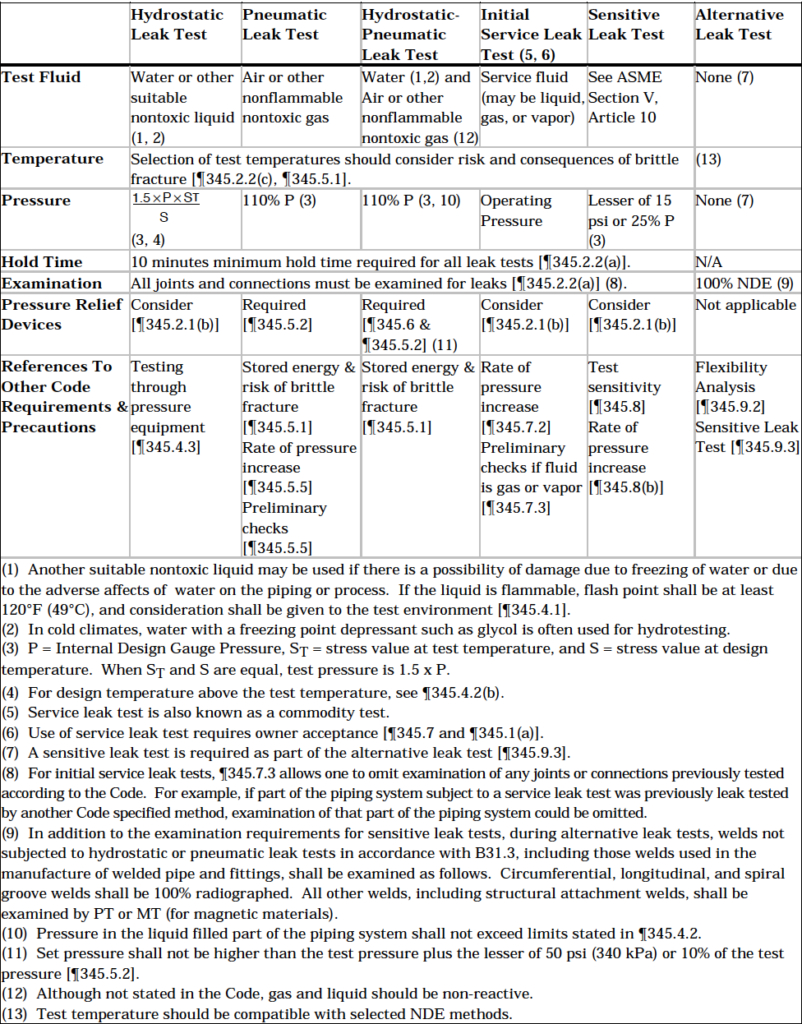
The table below compares and contrasts several characteristics of the six leak tests listed in B31.3. Note that the sensitive leak test is not applied as a stand-alone test. Rather, it fulfills part of the requirement for an alternative leak test.
Although six types of leak tests are listed in the Code, a hydrostatic leak test is normally required [345.1] unless the following conditions are satisfied:
a) An initial service test may be used for a Category D fluid system at the owner’s option [345.1(a)]. Typical candidates for initial service test include plant air systems and cooling water systems.
b) A pneumatic or hydrostatic-pneumatic leak test may be used where the owner considers a hydrostatic leak test impractical and the hazards associated with use of a compressible fluid are recognized [345.1(b)].
c) An alternative leak test may be used where the owner considers both hydrostatic and pneumatic leak tests to be impractical [345.1 (c)] and the conditions of 345.1(c)(1) and 345.1(c)(2) are satisfied.
Below are some general requirements for leak tests. For a complete description of each requirement, readers should refer to the current version of B31.3.
a) If the pressure used during a leak test will produce a stress exceeding the yield stress at test temperature, the test pressure may be reduced to the maximum pressure that will not exceed the yield strength at the test temperature [345.2.1(a), 345.4.2(c)].
b) Precautions shall be taken to avoid excessive pressure due to thermal expansion of the test fluid [345.2.1(b)].
c) A preliminary pneumatic test with air at a maximum pressure of 25 psig may be used to locate major leaks [345.2.1(c)]. Note that some owners frown on this practice on the basis that use of the test may lead to sloppy construction work.
d) Leak tests shall be maintained for at least 10 minutes, and all joints and connections shall be examined for leaks [345.2.2(a)]. This means that the hold time may easily exceed 10 minutes so that all joints and connections may be examined.
e) Leak tests shall be conducted after any heat treatment has been completed [345.2.2(b)]. This reduces the risk of brittle fracture due to low ductility microstructures existing prior to heat treatment and increases the probability of detection of defects formed during heat treatment (e.g., reheat cracks).
f) B31.3 requires that the possibility of brittle fracture be considered when leak tests are conducted near the ductile-brittle transition temperature [¶345.2.2(c)]. Unfortunately, B31.3 does not define the term ductile-brittle transition temperature in a practical way, and transition curves from which the transition temperature may be obtained are rarely available. In lieu of such data, the lowest test temperature could be considered as the lowest temperature for which impact tests would be required according to B31.3 rules.
g) B31.3 allows piping subassemblies to be tested separately or as assembled piping [345.2.3(a)]. This means, for example, that it is not mandatory to leak test piping spools in the fabrication shop and then again in the field. Of course, some owners require both shop and field leak tests to ensure that the shop fabricator has fulfilled contractual requirements and they are prepared to pay the cost of testing.
h) For practical reasons, a flanged joint at which a blank has been inserted to isolate other equipment during a test need not be tested [¶345.2.3(b)].
In preparing for a leak test, B31.3 imposes the following requirements, which are only a few of the elements of a leak testing plan:
a) All joints, including welds and bonds, are to be left uninsulated and exposed for examination during leak testing, except that joints previously tested according to B31.3 may be insulated or covered. For sensitive leak tests, all joints shall be unprimed and unpainted [345.3.1].
b) Temporary supports may be necessary to accommodate the weight of the test fluid used for leak testing of vapor or gas lines [345.3.2].
c) Expansion joints represent a special testing situation. Refer to B31.3 for additional information [345.3.3, 345.4.2(c), Appendix X, Para. X3.2.3(a)].
d) At the limits of tested piping, equipment that is not included in the test shall be disconnected from the piping or isolated by blinds or other means. Valves may be used at the limits of tested piping, provided that the valve is suitable for the test pressure [345.3.4].
Although six types of leak tests are listed in the Code, a hydrostatic leak test is normally required [345.1] unless the following conditions are satisfied:
a) An initial service test may be used for a Category D fluid system at the owner’s option [345.1(a)]. Typical candidates for initial service test include plant air systems and cooling water systems.
b) A pneumatic or hydrostatic-pneumatic leak test may be used where the owner considers a hydrostatic leak test impractical and the hazards associated with use of a compressible fluid are recognized [345.1(b)].
c) An alternative leak test may be used where the owner considers both hydrostatic and pneumatic leak tests to be impractical [345.1 (c)] and the conditions of 345.1(c)(1) and 345.1(c)(2) are satisfied.
Some general requirements for leak tests are outlined below. For a complete description of each requirement, readers should refer to the current version of B31.3.
a) If the pressure used during a leak test will produce a stress exceeding the yield stress at test temperature, the test pressure may be reduced to the maximum pressure that will not exceed the yield strength at the test temperature [345.2.1(a), 345.4.2(c)].
b) Precautions shall be taken to avoid excessive pressure due to thermal expansion of the test fluid [345.2.1(b)].
c) A preliminary pneumatic test with air at a maximum pressure of 25 psig may be used to locate major leaks [345.2.1(c)]. Note that some owners frown on this practice on the basis that use of the test may lead to sloppy construction work.
d) Leak tests shall be maintained for at least 10 minutes, and all joints and connections shall be examined for leaks [345.2.2(a)]. This means that the hold time may easily exceed 10 minutes, so that all joints and connections may be examined.
e) Leak tests shall be conducted after any heat treatment has been completed [345.2.2(b)]. This reduces the risk of brittle fracture due to low ductility microstructures existing prior to heat treatment and increases the probability of detection of defects formed during heat treatment (e.g., reheat cracks).
f) B31.3 requires that the possibility of brittle fracture be considered when leak tests are conducted near the ductile-brittle transition temperature [345.2.2(c)]. Unfortunately, B31.3 does not define the term ductile-brittle transition temperature in a practical way, and transition curves from which the transition temperature may be obtained are rarely available. In lieu of such data, lowest test temperature could be considered as the lowest temperature for which impact tests would be required according to B31.3 rules.
g) B31.3 allows piping subassemblies to be tested separately or as assembled piping [345.2.3(a)]. This means, for example, that it is not mandatory to leak test piping spools in the fabrication shop and then again in the field. Of course, some owners require both shop and field leak tests to ensure that the shop fabricator has fulfilled contractual requirements, and they are prepared to pay the cost of testing.
h) For practical reasons, a flanged joint at which a blank has been inserted to isolate other equipment during a test need not be tested [345.2.3(b)].