
The CSB has released an UPDATE into its ongoing investigation into the fatal November 12, 2024, explosion in Louisville, Kentucky. The incident killed two employees and seriously injured three others. The explosion caused significant property damage to the facility and nearby homes and businesses. Debris was ejected outside the facility’s fence line, flying up to 400 feet into the nearby neighborhood, and local authorities issued a shelter-in-place order for a one-mile radius around the facility.
Batch Reactor Six was a 2,500-gallon vessel constructed of 316 stainless steel with a maximum allowable working pressure (MAWP) of 75 psig and a maximum allowable working temperature (MAWT) of 355°F.
IMPORTANT NOTE: In this event, BOTH the MAWP & MAWT were exceeded simultaneously.
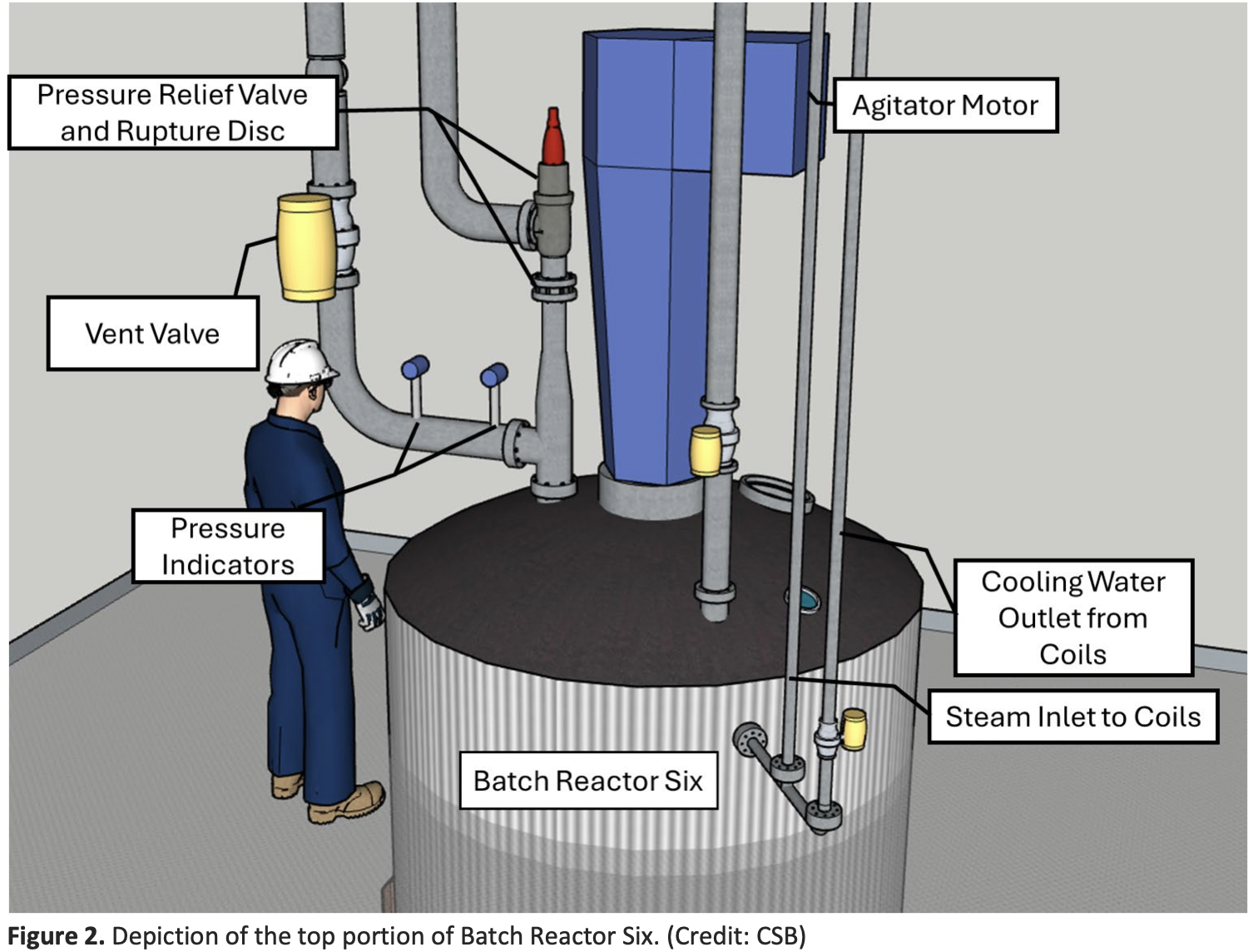
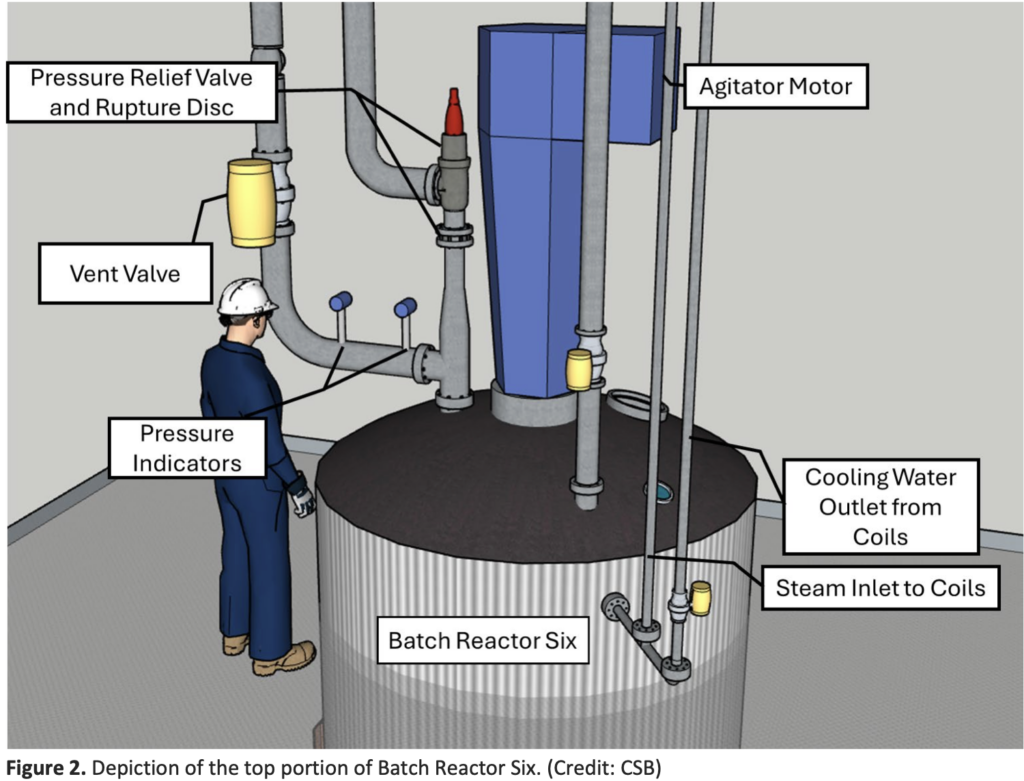
The batch reactor was equipped with a rupture disc with a burst pressure of 75 pounds per square inch gauge (psig) and a pressure relief valve with a 75 psig set pressure.
IMPORTANT NOTE 2: Although, the CSB does not point this out, when we have a Dual Relief System Set Up (e.g. a RD below a PRV or after the PRV), the RD and PSV set points can NOT be the same. See UG-127 NONRECLOSING PRESSURE RELIEF DEVICES, (a)(3)
IMPORTANT NOTE 3: As shown in the CSB’s figure below, it appears the Pressure Relief System was on the same nozzle as the “VENT VALVE”, meaning the Pressure Relief System was NOT INDEPENDENT of the “Operational Vent”. Meaning that if there was “fouling” involved that impacted the proper operation of the “Vent Valve”, that fouling could also negatively impact the Pressure Relief System.
At 10:22 a.m. on the day of the incident, operators at the facility began a process to produce caramel coloring for a food product in a batch reactor. Operations were normal initially. At 2:17 p.m., the pressure setpoint for the batch reactor was adjusted to 12 pounds per square inch gauge (psig), and the temperature setpoint was set to 300 degrees Fahrenheit (°F), as specified in the batch instruction. By 2:39 p.m., however, the pressure in the reactor exceeded the setpoint, and despite attempts to reduce it, the pressure continued to rise. After the pressure relief valve opened at 2:54 p.m., the pressure initially decreased, but then it continued to climb. The temperature also increased far above the setpoint, reaching 385°F, which was 85 degrees above the setpoint and fully 30 degrees above the reactor’s allowable limit of 355°F. A few minutes later, at 2:57 p.m., the reactor catastrophically ruptured when the pressure in the reactor reached 237 psig, over three times the reactor’s maximum allowable pressure.
After the incident, it was discovered that the reactor vessel’s automated vent valve was almost fully closed. The vent valve was supposed to automatically open to relieve pressure in the vessel to maintain the pressure at the 12 psig setpoint. As part of its ongoing investigation, the CSB will further inspect the recovered vent valve and actuator.
- The CSB’s update outlines the investigation’s path forward, which will include:
- Testing the raw materials to identify potential reactive hazards
- Analyzing the batch reactor relief system
- Reviewing process data and process conditions leading to the incident
- Further analyzing the recovered vent valve and actuator
- Evaluating emergency response efforts
Source: https://www.csb.gov/assets/1/6/givaudan_investigation_update_-_final.pdf