
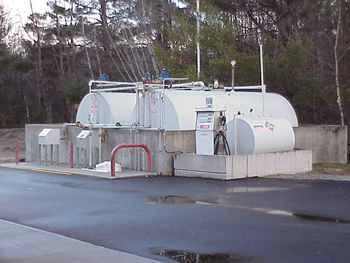
I think most EHS professionals will agree that bulk tanks of hazardous materials need some means of “secondary containment”. This practice has been in place for my entire career and rarely gets challenged. However, in recent years I have come across several scenarios where either the facility/unit designed the process to function this way or operations have learned how they can operate the process this way. In a lot of the cases, staffing cuts have led to these results.
The design basis for secondary containment comes from several sources. The two that I will reference are IFC and OSHA:
1910.106 states…
1910.106(b)(2)(vii)(a) Drainage and diked areas.
The area surrounding a tank or a group of tanks shall be provided with drainage as in subdivision (b) of this subdivision, or shall be diked as provided in subdivision (c) of this subdivision, to prevent accidental discharge of liquid from endangering adjoining property or reaching waterways.
1910.106(b)(2)(vii)(c) Diked areas
Where protection of adjoining property or waterways is accomplished by retaining the liquid around the tank by means of a dike, the volume of the diked area shall comply with the following requirements:
1910.106(b)(2)(vii)(c)(1)
Except as provided in subdivision (2) of this subdivision, the volumetric capacity of the diked area shall not be less than the greatest amount of liquid that can be released from the largest tank within the diked area, assuming a full tank. The capacity of the diked area enclosing more than one tank shall be calculated by deducting the volume of the tanks other than the largest tank below the height of the dike.
1910.106(b)(2)(vii)(c)(2)
For a tank or group of tanks with fixed roofs containing crude petroleum with boilover characteristics, the volumetric capacity of the diked area shall be not less than the capacity of the largest tank served by the enclosure, assuming a full tank. The capacity of the diked enclosure shall be calculated by deducting the volume below the height of the dike of all tanks within the enclosure.
1910.106(b)(2)(vii)(c)(3)
Walls of the diked area shall be of earth, steel, concrete or solid masonry designed to be liquidtight and to withstand a full hydrostatic head. Earthen walls 3 feet or more in height shall have a flat section at the top not less than 2 feet wide. The slope of an earthen wall shall be consistent with the angle of repose of the material of which the wall is constructed.
1910.106(b)(2)(vii)(c)(4)
The walls of the diked area shall be restricted to an average height of 6 feet above interior grade.
1910.106(b)(2)(vii)(c)(5) [Reserved]
1910.106(b)(2)(vii)(c)(6)
No loose combustible material, empty or full drum or barrel, shall be permitted within the diked area.
1910.106(d)(6)(iii) Spill containment
The storage area shall be graded in a manner to divert possible spills away from buildings or other exposures or shall be surrounded by a curb at least 6 inches high. When curbs are used, provisions shall be made for draining of accumulations of ground or rain water or spills of flammable liquids. Drains shall terminate at a safe location and shall be accessible to operation under fire conditions.
IFC 5004.2.2.4 Outdoor design, which states…
Secondary containment for outdoor storage areas shall be designed to contain a spill from the largest individual vessel. If the area is open to rainfall, secondary containment shall be designed to include the volume of a 24-hour rainfall as determined by a 25-year storm and provisions shall be made to drain accumulations of groundwater and rainwater.
So as we can see, secondary containment is designed to contain a spill from the largest individual vessel PLUS the rainwater that could have accumulated over 24 hours. This used to be the 110% volume of the largest storage tank. What happens when we “equalize” multiple storage tanks inside the secondary containment, which was designed to hold the single largest tank PLUS the rainwater?
Essentially, we have two identical tanks, each one with a capacity of 10,000 gallons. So the dike is designed to have a capacity of 11,000 gallons. But then we equalize these two (2) 10,000-gallon tanks with a pipe that comes off the bottom of both tanks so they operate as a “single vessel”. Should there be a leak on this equalization line, we could drain BOTH tanks to the secondary containment, resulting in a failure of the secondary containment. And I do not mean a physical failure of the containment; I mean we would overflow the containment.
There have been countless events, many catastrophic, where a leak occurred and the secondary containment failed to “contain” the release, allowing a much larger surface area and more vapors liberated from this larger surface area. We can install an engineering control that would recognize a leak and CLOSE each tank so that the tank(s) can not be drained through this common equalization line. This may satisfy Process Safety Risk, but be sure to check with your Environmental Group to ensure this would be allowed under Environmental Rules.