
Although it may be possible to accept that errors are neither as numerous nor as varied as they might first appear, the idea of a predictable error is a much harder one to swallow. If errors were indeed predictable, we would surely take steps to avoid them. Yet, they still occur. So, what is a predictable error?
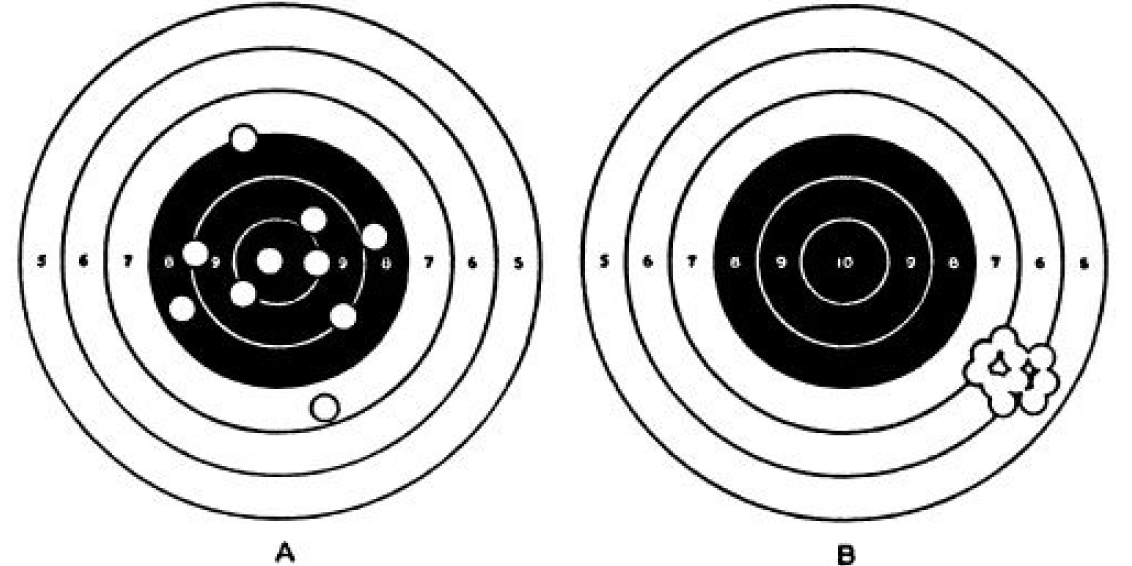
Consider the two targets shown in Figure 1.1 (taken from Chapanis, 1951). Each shows a pattern of ten shots, one fired by rifleman A, the other by rifleman B.
- A placed his shots around the bull’s eye, but the grouping is poor.
- B’s shots fell into a tight cluster, but at some distance from the bull’s eye.
These patterns allow us to distinguish between two types of error:
- variable and
- constant errors
A’s pattern exhibits no constant error, only a rather large amount of variable error. B shows the reverse: a large constant error, but small variable error.
In this example, the variability is revealed by the spread of the individual shots, and provides an indication of the rifleman’s consistency of shooting. The constant error, on the other hand, is given by the distance between the group average and the centre of the target.
What do these patterns tell us about the relative merits of these two individuals?
If we should rely only on their respective scores, then A would appear the better shot, achieving a total of 88 to B’s 61. However, it is obvious from the groupings that this is not the case. A more acceptable view would be that A is a rather unsteady shot with accurately aligned sights, while B is an expert marksman whose sights are out of true.
It is also evident that the errors of these two marksmen differ considerably in their degree of predictability. Given another ten shots each, with B still aiming at the target’s center and his sights still unadjusted, we could say with a high degree of confidence whereabouts his shots would fall; but the variability of A’s shooting makes such a confident forecast impossible.
The difference is very clear:
in B’s case, we have a theory that will account for the precise nature of his constant error, namely, that he is an excellent shot with biased sights. But our theory in A’s case, that he has accurate sights but a shaky hand, is not one that would permit a precise prediction of where his shots will fall. We can anticipate the poor grouping and have some idea of its spread, but that is all.
The lesson of this simple example is that the accuracy of error prediction depends very largely on the extent to which the factors giving rise to the errors are understood. This requires a theory which relates the three major elements in the production of an error:
- the nature of the task and its environmental circumstances,
- the mechanisms governing performance and
- the nature of the individual
An adequate theory, therefore, is one that enables us to forecast both the conditions under which an error will occur and the particular form that it will take.
Source: Human Error, James Reason, 1990