
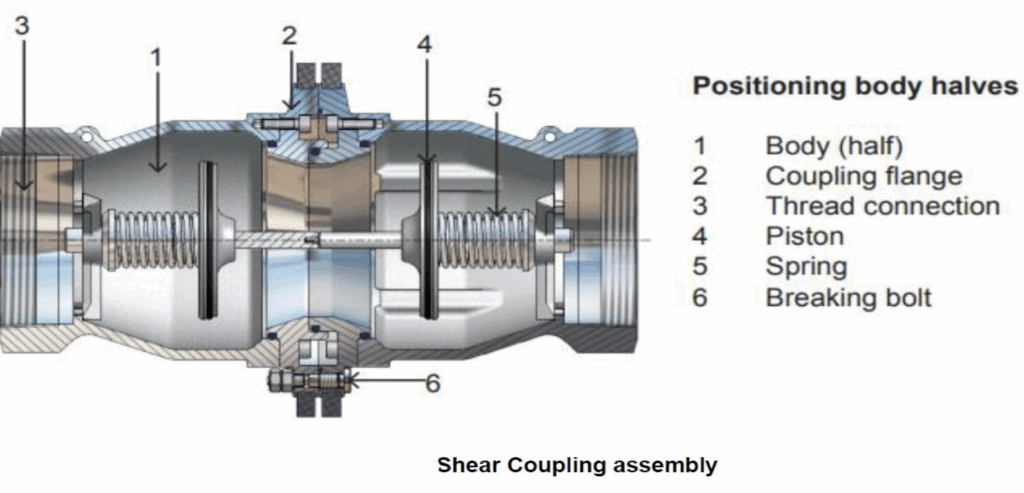
In August 2024, while loading anhydrous ammonia into a railcar at a manufacturing site, a shear coupling on the loadout arm failed to function. Two out of three bolts failed, causing the coupling to open and resulting in a loss of primary containment (LOPC) of pressurized liquefied ammonia, which formed an ammonia vapor cloud.
A proximity sensor adjacent to the shear coupling was not actuated. Consequently, release of the toxic gas continued until other gas detection activated a safety instrumented system (SIS) shutdown of the NH3 flow.
As the first responder, the operator escalated their risk by entering the rapidly forming toxic vapour cloud without respiratory protection, increasing their exposure potential to an acutely hazardous atmosphere.
Shear or breakaway couplings are emergency release protective systems
The bulk transfer of dangerous goods fluids should have safe systems in place that can reliably ‘fail-to-safe’ when forces outside the standard operating conditions are exerted upon the loading circuit. Transfer interfaces in Western Australia relying upon emergency release couplings include:
- marine loading arms for export of fuels and liquefied gases
- terminal gantries for tanker trucks and railcar filling
- distribution networks for LPG and LNG transfer to power utilities, mine site power stations and commercial storage tanks.
Shear couplings are designed to interrupt the flow of fluids and seal each side of the pipework or loading hose, and as such, they provide a risk reduction to operational workers by limiting the dangerous goods released. An inherent safety in design (ISD) feature relies on an energised spring-loaded piston assembly that slams shut upon shearing of the connecting bolts across the juncture. In major hazard facilities, these features are often incorporated into shutdown interlocks either via gas detection, a proximity sensor, or actuated solenoid circuits.
Investigation findings
- Shear coupling failure to unsafe state: several instances over recent years where coupling bolts had failed post-loading had not triggered a review of the coupling’s integrity status.
- Loading arm remained in service: recent concerns over the allowable flexure of loading arm assemblage had not resulted in its removal from ammonia loading of rail tank wagons.
- Respiratory protection choice of first responders: donning of self-contained breathing apparatus was not conducted as operators perceived the shear
coupling was functioning as intended with an expected minor release.
Key corrective actions by site operator
- Adopted enhanced emergency release coupling design.
- Inclusion of shear coupling into preventative maintenance program.
Response to LOC:
− learning objectives embedded in training
− repetition of response practice
Industry learnings
- This incident had a high potential for serious harm considering the operating conditions for transferring liquefied ammonia gas (toxic and corrosive hazards) to railcars. Failure of the proximity switch to activate an SIS designed closure of flow and initial operator response were causes for concern.
Failure of shear coupling that was a critical control preventing ammonia LOC:
- Mechanism of shear coupling failure rendered the proximity switch ineffective.
- Ensure the failure modes for safety critical equipment are interrogated to avoid a scenario that negates the detecting element initiating a protective shutdown.