
SAFTENG NOTE: The fatal H2S event in Deer Park last year that claimed two (2) contractor lives was the result of contractors opening the WRONG flange!
Now we have a similar event that led to a fire that burned for three (3) days.
A report regarding a 2025 Refinery Fire in CA found that two (2) contractors “mistakenly loosened the bolts on a flange full of hot hydrocarbons during a routine but hazardous procedure.” The report went on to state the problems stemmed from “inadequate” supervision and training of contract workers“.
At approximately 1:35PM on February 1, 2025, two (2) contract workers began opening a flange to install isolation blind #816 to prepare for planned maintenance on one of the process units (Cat Feed Hydrotreater, CFH). The CFH had been shut down for maintenance on January 30, 2025.
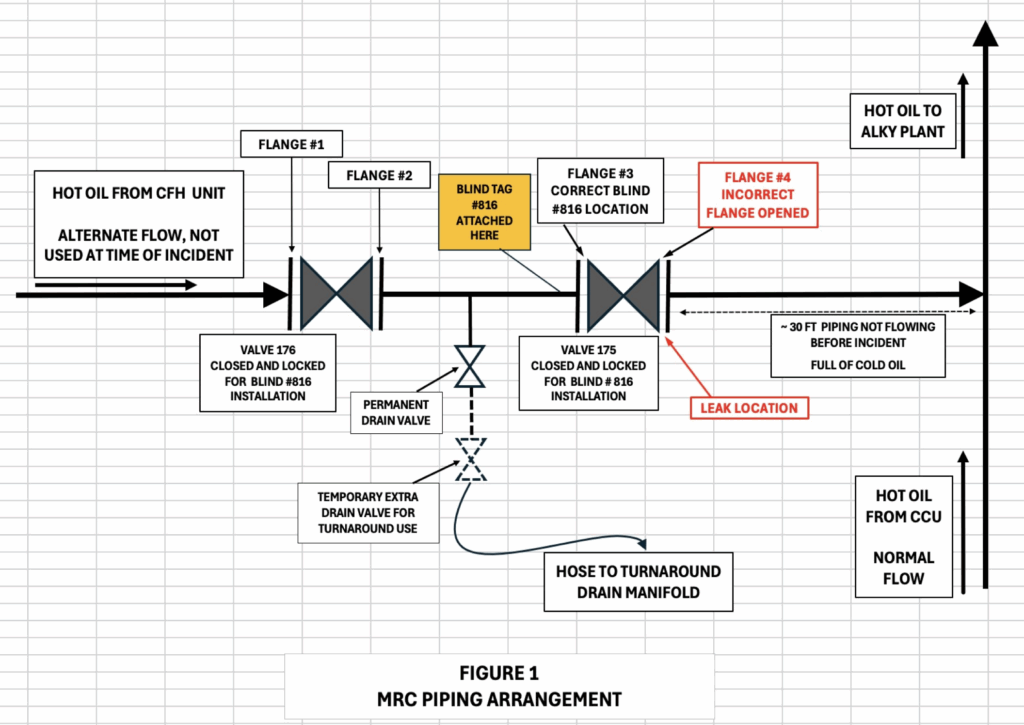
The flange tagged as #816 was within two (2) isolation valves, which had been closed and locked to remain closed. A drain valve within this double isolation valve installation had been previously opened, rodded out to confirm no drain valve plugging, and witnessed to confirm there was no pressure or valve leakage (confirmation of “zero energy”). However, the flange on the outside of the isolation valve was mistakenly opened by the contract workers. When opening the flange, hydrocarbon material started to leak. The two workers evacuated the area after seeing the leak, and the hydrocarbon material ignited within a minute of the initial release, resulting in a large fire in the CFH and the Cat Cracker Unit Gas Plant (CCUGP) units.
The investigation concluded that MRC procedures to positively identify work locations and to verify isolation and “zero energy” were not effective for the current Maintenance Contractor organizational capability, resulting in the workers opening a flange on the wrong side of the isolation valve, resulting in the loss of containment.
MRC cut out the double isolation valve assembly and sent to a mechanical and metallurgical laboratory for testing. A summary of breakaway torque measurement data from that testing was provided to JEM by MRC. Based on this preliminary information, JEM concluded the four bottom stud bolts on the incorrect flange (Flange #4 on Figure 1) and all of the stud bolts on the correct flange (Flange #3 on Figure 1) for blind #816 installation were loosened prior to the loss of containment and fire, indicating the workers started work on the correct flange and then began opening the wrong flange.
The investigation found the root cause is Operations Monitoring and Control of Work was inadequate for current Maintenance Contractor Organizational Capability. Four contributing causes were identified as well. Recommendations are developed to address all causal factors and prevent recurrence of such an incident.
The investigation team reviewed the conclusions and recommendations with the MRC Leadership Team on April 11, 2025.
CLICK HERE for the FULL REPORT