
Have you ever wondered how relaible your relief devices actually are? Ever wondered why five years is the mximum baseline timeframe for testing and replacement? As a result of years of testing, The National Board has accumulated a good deal of data that helps us analyze the quality and reliability of relief valves. We can use the data to determine what industry can expect when they receive a certified pressure relief device, pressure relief valve, or rupture disk device.
Two samples were selected every six years and tested at an ASME-certified lab. All test requirements come from the ASME Boiler and Pressure Vessel Code. Through the code, the National Board has been designated the responsibility to manage and run that certification program using the ASME boiler code rules. National Board inspectors travel to the manufacturers’ sites and deal with valve assemblers and rupture disk manufacturers. A big part of their responsibility when visiting the manufacturing site is to look at the manufacturing, assembly, and test procedures, and make sure they get a good representative sample of what that manufacturer is capable of doing. In some cases inspectors will actually take valves right from shelf stock, particularly from manufacturers that mass produce their product and have large quantities of valves in stock. One selection technique is to go into the warehouse and randomly select a RD from the shelf. Sometimes they will dust off the box, but they are trying to get an accurate sample. Sometimes they are testing a valve they are building for the inspector while he’s there, but in that case they are looking at the assembly and test procedures and trying to see if it’s a good representative sample.
This testing program for individual design is not meant to be statistical in nature, so the Board is not testing a certain percentage of devices: just those two products every six years. It may be more than two if a test failure occurs. If there is a failure, the manufacturer has to test two additional samples. If they get past that test and still have a problem, a formal corrective action program is implemented. They have to analyze their failure, report on what happened (the cause), and explain what corrective actions they will take. And potentially, a manufacturer could actually lose the ability to put the code stamp on their product, so it’s an important test. The manufacturers have a lot riding on it because if the product passes, they can produce that valve for a six-year period of time. The tests are conducted at ASME/National Board-certified test labs, which include the National Board Testing Lab in Columbus, Ohio, but there are also about 10 other laboratories that are operated by valve manufacturers and rupture disk manufacturers.
The Board is involved in an ASME certification process. The labs all compare to one another to show that they can essentially attain the same results; they get the same measured capacity. And when any certification test is done at those labs, a Board authorized inspector goes to witness the test and ensure it meets the Board requirements and procedures; so all tests are considered on the same basis.
The total number of tests included in the Board’s review was 21,825 tests. Based on the data, we can make some conclusions on how good these products are overall. The Board analyzed information starting with the year 2000. That year was chosen because it provided a lot of tests, but also the code rules for rupture disk certification went into effect in the ’98 code, and by the year 2000, rupture disks were a well-certified device under ASME Code Section 8, and manufacturers had started to certify those devices. So it gave them a wider variety of equipment than had been seen before, because until then the testing was solely on pressure relief valves, and the non-reclosing devices were not well represented in the formal testing.
Breakdown of numbers by ASME Code Section:
Section I – 13.6%
Section III – 12 tests (These Section III valves were likely nuclear valves that got repaired as part of a repair demonstration. We don’t normally test many nuclear valves. They are the same physical equipment as you see in either Section 1 or Section 8.)
Section IV – 3.4 % (Hot water heater temperature and pressure relief valves are included.)
Section VIII– 83%.
This is the bulk of the work the Board does; a wide variety of all different types of Section 8 pressure relief devices. In regards to test medium used: steam is about 25 percent and air is almost half. Air represents all the industrial gases. And then water tests are at about 25 percent. That represents valves for liquid service.
Section VIII covers a wide variety of applications, so we did end up with about 10% of Section VIII steam applications. Almost 60% was air, another 31% was water.
The test outcomes are based on the criteria the Board puts in its database. After the test is run, the board gives it a designation as to the outcome of the test. 85% of the valves passed. The biggest failures were set pressure failures and failures of capacity.
Here are the raw results.
|
Test outcomes |
% |
Amount |
|
Pass |
84.9 |
18,538 |
|
Fail Set Pressure |
7.1 |
1,541 |
|
Fail Blowdown |
1.8 |
383 |
|
Fail Capacity |
5.4 |
1,186 |
|
Fail Operation |
0.2 |
43 |
|
Incorrect Lift |
0.1 |
19 |
|
N/A |
0.5 |
113 |
This distribution is the measured set pressure over the nameplate set pressure.
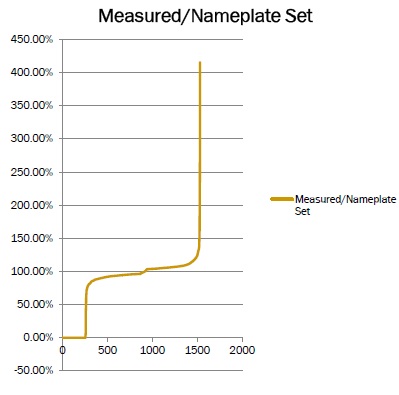
The numbers below the 100% line are valves that opened underneath the nameplate set pressure requirement. The little tilted spot in the middle is all the valves that passed. And then as we go up on the right-hand side, those are the valves that failed but where the set pressure was actually high. And that is a real concern. A valve that opens low indicates an operational issue. But what we don’t want are valves that open high.
NOTE: 0.3% were above 116% of nameplate set pressure
One glitch that was discovered were a few valves that showed up at 400% above the set pressure. Normally a test is stopped essentially at one and a half times the set pressure of the valve. Occasionally the data had some valves where set pressure was in bars, the test pressure was in psi, and if you tried to compare those numbers you didn’t necessarily get the right answer.
Presented by: Joseph F. Ball, P. E. Director, Pressure Relief Department