
A process worker and colleague were preparing for a scheduled maintenance task in the ammonia storage area of a processing plant.
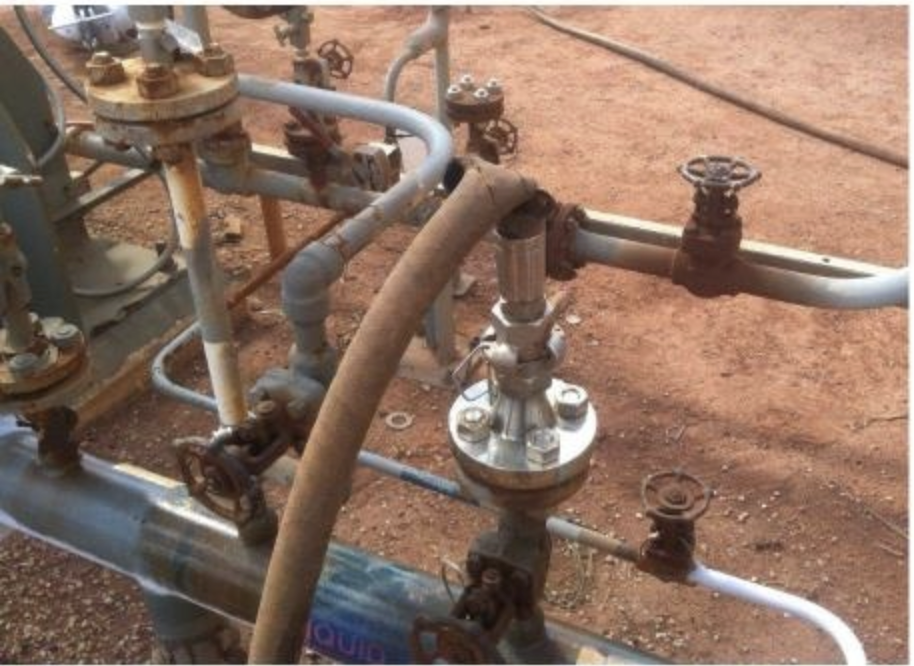
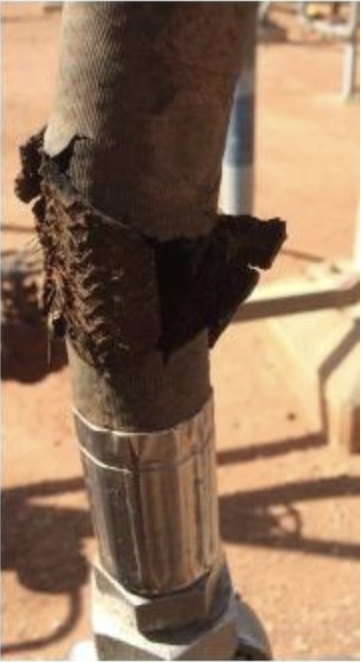
As part of a routine purging operation, the process worker connected a flexible rubber hose via a coupling to a purge connection point. The purge hose was charged with nitrogen, and the valve was being opened slowly, allowing nitrogen to flow into the system, when the hose ruptured above the connection point.
The worker was exposed below the waist to pressurized anhydrous ammonia at approximately -28°F and was enveloped in the ensuing ammonia cloud. His colleague was able to get the worker to a nearby safety shower before contacting the site’s emergency services. The worker was air-lifted to a city hospital and treated for severe chemical burns.
Flexible rubber hose and assembly connected to anhydrous ammonia purge point.
Close-up (right) shows rupture in the hose above the connection point
Direct Causes
- The purge hose failed as the valve was opened.
- The worker was next to the hose when it failed.
Contributory Causes
It appears that the hose was not in a serviceable condition, with factors including:
- lack of information about its recommended use, either visible on the hose or provided by the site
- repeated bending of the hose to less than its minimum design radius during routine use, damaging the steel braiding and inner rubber lining
- loss of structural integrity can be difficult to identify from visual examination
Although several procedures covered flexible hose safety and integrity, these procedures were either past their review date or under review, and most operators were unaware of their availability.
The processing plant had experienced other hose failures over the previous 12 months and had implemented a training program for all workers covering:
- Specific requirements for flexible hose use
- Pre-start or pre-use checks for hose integrity
- How to confirm that a hose is fit for its intended purpose
- Removal from service of old or degraded hoses
- Removal from service of unidentified hoses.
In this incident, it appears that not all aspects relating to flexible hose safety and integrity were followed when the hose was selected for the task.