
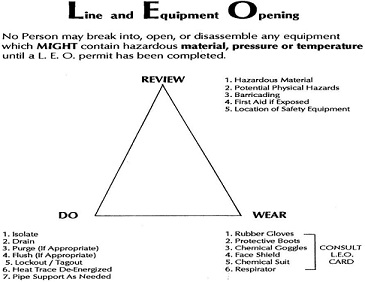
Those of you working in a PSM/RMP facility should have heard of the term “line break” and many have most likely participated in a “line break”. Although the term “line break” implies it only applies to opening a line/pipe, it is intended to cover ALL non-routine process openings. This task is one of the higher risk tasks for workers in a covered process; these risks encompass even those workers who are not directly involved in the task of opening the process. Hence why OSHA list this task specifically in 1910.119(f)(4) as one that REQUIRES an SOP/SWP! This article will discuss what a “Line Break” procedure should include, look like, sound like, and smell like!!!
First off, here is what OSHA says about “line break”…
The employer shall develop and implement safe work practices to provide for the control of hazards during operations such as lockout/tagout; confined space entry; opening process equipment or piping; and control over entrance into a facility by maintenance, contractor, laboratory, or other support personnel. These safe work practices shall apply to employees and contractor employees.
Appendix C (Non-Mandatory), 10. Nonroutine Work Authorizations states…
Nonroutine work which is conducted in process areas needs to be controlled by the employer in a consistent manner. The hazards identified involving the work that is to be accomplished must be communicated to those doing the work, but also to those operating personnel whose work could affect the safety of the process. A work authorization notice or permit must have a procedure that describes the steps the maintenance supervisor, contractor representative or other person needs to follow to obtain the necessary clearance to get the job started. The work authorization procedures need to reference and coordinate, as applicable, lockout/tagout procedures, line breaking procedures, confined space entry procedures and hot work authorizations. This procedure also needs to provide clear steps to follow once the job is completed in order to provide closure for those that need to know the job is now completed and equipment can be returned to normal.
Notice the use of the term “non-routine” in the OSHA language. This term is used on purpose, as it is an accepted practice to do the “routine openings” under Standard Operating Procedures (SOP) that are annually certified and trained at least every three (3) years. The rationale is that those “openings” that are done on a “routine” basis can have a lesser risk profile through proper design and planning, and as such, they can be safely managed using a well-written and established SOP. Those “openings” that are “non-routine” often cannot be controlled through planning and design, thus increasing risks beyond that which sole administrative control is adequate. Thus we have to resort to additional administrative controls (i.e., line break permit process) and PPE.
What would be considered a “routine opening” that could be managed via an SOP?
Tasks such as catching samples, cleaning strainers, changing filters, etc., are activities done on a routine basis. Now keep in mind different businesses will have different definitions of “routine.” Personally, I have always defined routine, in the realm of process openings, as those that are done on at least a quarterly basis. So this means I can write a task-specific SOP for each routine opening rather than requiring a Safe Work Permit (or line break permit) to be issued for each time the task is needed. The flip side is that those tasks defined as “non-routine” have to have a Safe Work Permit (or line break permit) issued for these tasks.
What line/equipment would be considered an “opening” requiring an SOP or Permit?
We have to look at this question from a couple of different angles: 1) hazards to the worker doing the work and 2) hazards to the process. Let’s discuss the openings that are hazardous to the worker doing the work. There are no OSHA HHCs or EPA EHSs that do not significantly threaten worker safety! Therefore, the worker(s) doing the task is placed in a higher risk profile while opening the process – no way around it! The pipe has to be opened to replace the leaking valve – until we have robots that we can use to do this work, it will be a human worker doing the work. The hazards presented by the opening can be toxic, flammable, asphyxiation, or a combination of the hazards. The SOP or permitting is intended to use the hierarchy of controls (engineering controls, administrative controls, and PPE) to protect the worker. A general rule that needs to be incorporated into ALL line break/opening practices is that we ALWAYS ASSUME the HHC/EHS is still present in the line/equipment at elevated temperatures and pressures. We prepare for the worst and we hope for the best.
NOTE: if you have not yet viewed the HF Fatality video, please do so now so as to provide some perspective of what can happen when there is an unexpected release of an HHC/EHS.
It should be clear that anytime we wish to open a process line or equipment that contains a Highly Hazardous Chemical (HHC) or Extremely Hazardous Substance (EHS) that this opening would be covered under the PSM/RMP requirements. Although some would argue with this approach, I do not understand the basis of their argument. Opening a pipe or piece of equipment that once held (and could possibly still hold) our HHC/EHS is EXTREMELY DANGEROUS work, and because of this, OSHA and EPA intended to cover this task when the line is involved in a PSM/RMP covered process. Maybe an argument could be made on water lines or compressed air lines, but don’t think for one second these lines present no hazard to the worker and/or the process. Let me explain how TIGHT this discipline must be for a successful “process opening” procedure.
A worker needs to open a drain/vent valve as part of the Lockout/Tagout procedure to verify no energy accumulated between the two valves. BEFORE he/she can open this valve to the atmosphere, he/she would be required to obtain a line break/process opening permit or if opening this vent/drain valve is covered in an SOP (w/ PPE requirements), they may choose to use the SOP rather than obtain a permit. So even when a worker needs to open a drain/vent valve in the “name of safety” (i.e., LOTO), a permit or SOP is still required as this action is OPENING the process. BOTTOM LINE, the process does NOT get opened without an SOP covering that specific task/location or a safe work permit for that specific opening is used.
And one last item to consider is how many openings can be done under a single permit. Let’s say we have an entire storage tank isolated for a turn-around. Contractors are going to be installing fire safety valves at all four outlet lines as a “safety improvement” project. All of the “openings” will be done within the isolation for the vessel so only one permit is needed. Yes, that is a TRICK QUESTION and one that I could write another 20 pages on; because EACH situation is different, EACH of the four “openings” would need to be EVALUATED INDEPENDENTLY, even though they will be done under the same energy isolation plan. NEVER ASSUME that once the first discharge line is opened without incident, the next three will be energy-free and incident-free – TRUST ME ON THIS!
Hazard to the process
In the process safety world, upsets have occurred because a critical utility was removed from service unexpectedly and/or unknowingly to the operator running the process. At some point, while the utility is out of service, a process condition is met that requires the utility. Without the utility, the process deviation cannot be controlled, and thus we end up with a process incident. So there MUST BE COORDINATION with the maintenance group or contractors and operations group to ensure that any of the process openings will NOT have an impact on the process safety. And this may include “simple every day” utilities such as plant air!
We also have to consider hazards to the process (and personnel), like what happens when we open a process/line and have a spill of flammable materials in an area that is NOT designed to see flammable liquids and gases. For example, some businesses do not classify areas where the flammable liquid/gas pipe is traveling through, meaning that there is no attempt to control ignition sources in these areas. But when we need to do a line opening in this area, our risks now go off the chart, as a spill in the area has ample ignition sources and no ventilation designed to remove the vapors/gas from the area.
Line Break is a TWO PERSON task
Another accepted practice regarding those non-routine line breaks and process openings is that there is one worker doing the high-risk tasks, with another worker providing “stand-by duties” should something go wrong. Of course, it should go without saying that the stand-by person is OUT OF THE LINE OF FIRE of the hazards associated with the opening. Not only are they out of the line of fire but they are also donned in at least the same level of PPE and with some hazardous materials that present an IDLH potential. The stand-by person must be donned in a positive pressure SAR such as an SCBA or an air-line respirator equipped with a 10-minute supply of backup air (required for the use of an airline within an IDLH atm). This simple requirement has partially defined the training needs of our stand-by person and excluded many workers who are not medically qualified, fit tested, and trained on these types of respiratory protection. Not that OSHA would hold you to this, but they may, I use 1910.134(g)(3) as my model for the function of the stand-by person. 1910.134(g)(3) states…
1910.134(g)(3) Procedures for IDLH atmospheres. For all IDLH atmospheres, the employer shall ensure that:
- 1910.134(g)(3)(i) One employee or, when needed, more than one employee is located outside the IDLH atmosphere;
- 1910.134(g)(3)(ii) Visual, voice, or signal line communication is maintained between the employee(s) in the IDLH atmosphere and the employee(s) located outside the IDLH atmosphere;
- 1910.134(g)(3)(iii) The employee(s) located outside the IDLH atmosphere are trained and equipped to provide effective emergency rescue;
- 1910.134(g)(3)(iv) The employer or designee is notified before the employee(s) located outside the IDLH atmosphere enter the IDLH atmosphere to provide emergency rescue;
- 1910.134(g)(3)(v) The employer or designee authorized to do so by the employer, once notified, provides necessary assistance appropriate to the situation;
- 1910.134(g)(3)(vi) Employee(s) located outside the IDLH atmospheres are equipped with:
- 1910.134(g)(3)(vi)(A) Pressure demand or other positive pressure SCBAs, or a pressure demand or other positive pressure supplied-air respirator with auxiliary SCBA; and either
- 1910.134(g)(3)(vi)(B) Appropriate retrieval equipment for removing the employee(s) who enter(s) these hazardous atmospheres where retrieval equipment would contribute to the rescue of the employee(s) and would not increase the overall risk resulting from entry; or
- 1910.134(g)(3)(vi)(C) Equivalent means for rescue where retrieval equipment is not required under paragraph (g)(3)(vi)(B).
Other than being respirator qualified (1910.134), the stand-by person should have other skills and training based on the HHC/EHS involved in the opening. Here are some of the basics:
- trained in the hazards of the specific HHC/EHS and this training is well BEYOND the basic hazcom training all employees get (1910.1200),
- trained in the facility emergency action plan (1910.38),
- trained in the use and limitations of their PPE as it applies to the specific chemicals requring a stand-by person (1910.132),
- trained in energy isolation (LOTO)
- use of the calibrated direct reading instrument;I like to add one, that OSHA may not hold you to,
- trained in first aid specific to the HHC/EHS involved
A couple of other items that we may want to consider for the stand-by person:
- Firefighting with fire extinguishers
- Firefighting with fixed monitor nozzles
- Applying foam blankets
In all of my plants, we allowed people from different departments who met ALL the qualifications to be a “standby” to serve in these roles outside their normally assigned work areas. In other words, we could have a worker who normally works outside of Chem-Ops (e.g., warehouse) but who has completed all of the qualifications and training needed to fill the role of a stand-by inside a Chem-Ops unit. This comes in handy during shutdowns/turnarounds when hundreds of breaks/openings are being made. We must not lessen our safety during heavy workloads but instead increase our intent, passion, and focus on safety during these times! Having an adequately trained group of stand-by workers is CRITICAL to meet this demand.
But please do not take this stand-by role lightly! We should view this role much like the role of the Confined Space Attendant and treat it as a “safety critical role”. This person has ONE JOB to do and does it with 100% focus. These employees need to UNDERSTAND that they may be expected to risk exposure to the HHC/EHS to rescue the contaminated worker (who may be a contractor in some facilities). So this job MUST NOT be viewed as “an easy way to get overtime hours,” and we should have some screening protocol so that those employees who struggle to do their normal jobs well should be EXCLUDED from filling such a critical position. PLEASE NOTE: It is ABSOLUTELY CRITICAL that ALL of the requirements of 1910.134(g)(3) be met if the release/spill could create an IDLH atmosphere! Not having done so makes the stand-by person nothing but a statue! Because if they are NOT trained, equipped, and have a backup plan to protect them, they are in NO WAY permitted to enter the hazard area to affect a rescue of the worker in need. Rather, he/she would only be capable of sounding the alarm to call in rescuers from outside the immediate release area, which then brings into play 1910.120(q) (e.g., emergency response under HAZWOPER).
First Breaks are the most dangerous
I know of some facilities that allow contractors to make first breaks/openings; however, I caution against this practice. This has nothing to do with OSHA compliance but everything to do with the safety of the worker(s). By having our own workers, who we know are trained well and equipped well, making the first break, we are putting those workers who we know are qualified and experienced working the HHC/EHS and know the layout of the emergency systems (e.g., fire extinguishers, deluge trips, e-stops, safety showers, etc.) like the back of their hand in the position to succeed in a dangerous task. Sure, we cover this info during the permitting process with contractors, but having someone who spends 12 hours a day in the unit vs. someone who just showed up 30 minutes before the actual work has HUGE advantages. We need to take advantage of this as often as we can!
Energy Isolation
What is acceptable energy isolation for a line break to replace a valve in a line that is an HHC/EHS line? Single valve isolation on both sides of the break? Double Block and Bleed arrangement on both sides? Slip blinds? We see this requirement landing all over the map, and really it is hard to establish a specific requirement, but not so hard to establish an absolute minimum. My programs (which can be downloaded in the members’ library) always base the isolation methods on the hazards posed by the “break/opening” to the worker. But the one thing I want to mention about isolation is to ENSURE the stand-by person is part of the isolation. Many argue with me on this point, and I understand their argument from an OSHA compliance aspect, as the stand-by person would not be exposed to the unexpected release if they are positioned properly (as necessary). Isolation would do nothing to help them should there be a release incident where they have to enter the danger zone to affect a rescue. My position is it will NOT hurt them and will take ONLY several minutes to become part of the isolation. There may be an occasion where the stand-by person would have to enter the work area to affect rescue other than from a release from the opening tasks (e.g., medical-related assistance due to heat stress, aggravated medical issues such as heart problems, etc.).
PPE
LAYER, LAYERS, LAYERS! Be prepared for the worst and hope for the best. When the opening is made, expect the HHC/EHS to spray, flash, burn, etc.. Besides the isolation, the PPE is all the worker has between them and the HHC/EHS. We need to ensure that we do not underestimate the amount of material that may be released and the size of the danger zone. I always required the area to be barricaded off, and anyone inside the barricade had to be on the permit (or trained in and following the SOP) and meeting ALL the requirements of the permit or SOP. The size of barricaded area could have a diameter as small as 5’ and as large as 100′, depending on the material and the state it gets processed in (e.g., the pressure it could be under, temperature, etc.). In the case of a flammable liquid that operates under a nitrogen blanket at temperatures well above its boiling point, we need to consider vapor travel distance and speed and base our barricaded area on these considerations as well as the toxic considerations.
The standby person will need to be donned in at least the same level, if not one level higher, than the worker(s) doing the opening. I always had the stand-by person in an SCBA if the chemical had any kind of inhalation hazard.
So hopefully, this has given you some ideas on how to manage your non-routine openings and to do so in ways that will do more than just comply with OSHA/EPA. I am hoping that this brief article has raised the awareness of those who took the time to read it. Opening a process, even something as small as opening a 1/4 vent valve, can be disastrous to a worker and even an entire facility or family, so we MUST NOT take this task lightly. There may not be a more dangerous operation within a PSM/RMP-covered process!