
 Does your facility use Ultra Low Sulphur Diesel (ULSD) fuel? Are you using the same diesel tank for the ULDS fuel as you were with the diesel fuel from the old days? Should you be? Do you have a fuel storage tank that is “switch loaded” with gasoline and ULSD?
Well, the debate rages on regarding the safety of ULSD fuel. The fact is, ULSD fuel is NOT the same as our old diesel fuels! With the removal of the sulfur, we have created a fuel that is less conductive. Diesel fuel has never been a great conductor of electricity. Still, with the removal of the sulfur, the conductivity has fallen considerably and thus raises the hazards when handling cleaner diesel fuel. What does this mean?
Many people think diesel fuel is much less hazardous than gasoline; however, they would be WRONG. The ONLY thing gasoline has over diesel fuel is its much lower flashpoint. But once both materials have achieved their flashpoint, the Lower Explosive Limit (LEL) of diesel fuel is almost 50% of gasoline (of course, this depends on whose MSDS you are reading!).
Most have seen what happens at fuel dispensers with gasoline and static, and I am NOT saying that the ULSD will pose that kind of risk to drivers fueling their vehicles (flow rates are much lower when filling your car or truck). But the driver of the delivery truck who is filling the storage tank(s) IS AT AN INCREASED RISK, as their flows from their truck to the storage tank(s) is at a much higher rate, AND many diesel storage tanks were designed to receive the old diesel fuels and NOT this ULSD.
But we have to stay grounded in this debate as one fact still holds true… diesel fuel has a relatively high flash point that MUST be reached BEFORE diesel becomes an issue, UNLESS… Switch Loading!
Switch Loading is defined as loading a low vapor pressure (high flash point) product, such as diesel fuel, into a compartment in which the previous load was a high vapor pressure (low flash point) product, such as gasoline. With the conductivity problems with the ULSD fuels, their ability to provide the ignition source for the leftover gasoline vapors is something that MUST BE addressed!
There are a lot of “recommendations” from refiners in methods to manage this static risk, but none have come out and said this…
Manage ULSD fuels like gasoline! From tank design, bonding/grounding, flow rates, and FRC for personnel making large transfers should be taken as SERIOUS considerations. Anything else would fall short and would be a “band-aid” approach!
Most of the major refiners of ULSD are now adding static dissipating additives (SDA) to their ULSD fuels. All ULSD fuel in the United States and Canada is mandated to have a minimum conductivity of 25 pS/m according to ASTM D975 and CGSB-3.517-2007 standards. (NOTE: The United Kingdom Petroleum Industry Associate (UKPIA) has set a 150 pS/m minimum conductivity level in the UK.) Since ULSD fuels have nearly zero conductivity, the only way to meet this requirement is by using an SDA.
Tips from API 2003…
In June 2006, API modified Recommended Practice (RP) 2003 to safely load low-conductivity fuels. The revised RP changed the definition of conductivity levels as:
- High Conductivity – measured conductivity above 50 pS/m.
- Low Conductivity – measured conductivity between 5 pS/m and 50 pS/m.
- Ultra-Low Conductivity – measured conductivity less than 5 pS/m.
The API RP 2003 recommends that if conductivity is maintained in the High Conductivity range, issues related to controlling flow speed and relaxation intervals are not as serious a concern for the fuel transfer system. Below 50 pS/m the handler must be concerned that the RP for velocity and relaxation time are “always” observed under all operating conditions of the loading system. When handling fuels below 50 pS/m, the operator is always at risk, as any subtle change in the system operating conditions could result in operations outside API RP 2003, leaving the operator liable if an incident occurs. The operator can avoid such a situation if they can “demonstrate” that safe loading “always” occurs as all fuel loaded have a “documented” conductivity > 50 pS/m.
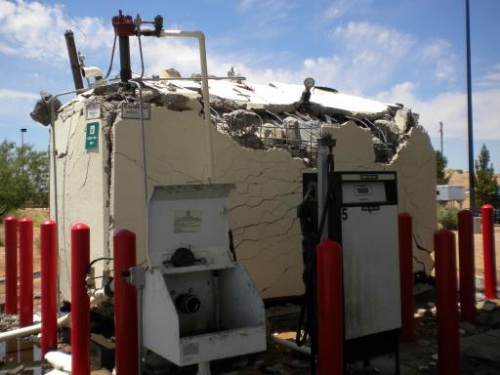
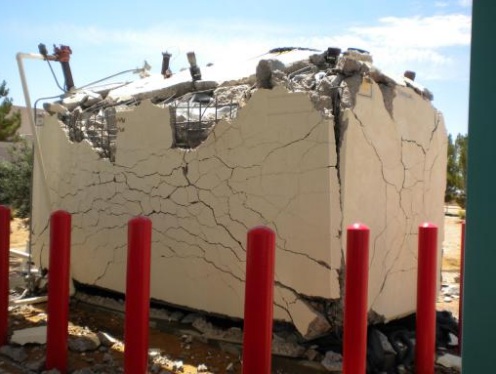
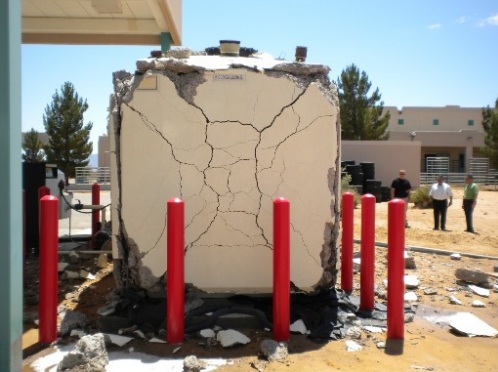
Here is one of the better-documented tank explosions involving ULSD fuel.
On June 28, 2010, an internal explosion occurred in a 6,000-gallon aboveground fuel storage tank (AST) containing Ultra Low Sulfur Diesel (ULSD). This was the summer’s third internal tank explosion of Ultra Low Sulfur Diesel in New Mexico. There are also unconfirmed reports of internal explosions of tanks storing ULSD in other parts of the United States. The incident took place around 9:13 a.m. when a diesel fuel delivery truck brought a load of fuel to refill the AST. About 6 inches of diesel remained in the AST when the fill began. The tank did have a drop tube, but the tube was constructed of non-conductive fiberglass and it ended approximately 10 inches from the bottom of the tank, leaving a 4” air gap. At this particular installation, the fuel is gravity fed from the delivery truck to an on-site pump, which pumps the fuel into the top of the tank. There have been some reports that temperatures at the site were over 100° F, but this is incorrect as the incident occurred while it was still cool in the morning. The temperature of the fuel in the AST shortly before the fill began was recorded as 84° F.
The procedure for this particular fuel delivery was:
- the transfer hose was connected,
- the valve between the transfer pump and the AST was opened,
- the transfer pump was turned on and
- the truck valve was opened
The explosion happened seconds after opening the truck valve. The delivery driver and a site representative were both standing by the tank at the time of the explosion. One received a minor injury, and the other person was not injured at all other than ringing in his ears caused by the concussion. The Fire Inspector, Captain Kellen Tarkington, stated that “The concrete really did its job because if it had been a plain steel tank, they would probably both be dead.”
In the Incident Report, Captain Tarkington concluded that the “explosion was accidental in nature.” However, in his observations, he made the following points, one or a combination of which could have contributed to the accident:
- The fuel tanker hooked up to the pump used a fill hose that may not have been properly grounded and bonded. (Grounding of the AST was also not confirmed prior to the removal of the tank from the site.)
- The pump connected to the AST was running before opening the fuel tanker’s fuel valve. The pump may have pumped air inside the AST before it started pumping fuel. This may have helped in forming an explosive mixture in the AST.
- The drop tube material was fiberglass instead of metal. Fire codes allow fiberglass drop tube for class II and III petroleum products. The tank was used to store diesel fuel on this site, which is a class II product. However, the diesel fuel was Ultra Low Sulfur Diesel which has created controversial issues and may have also contributed to the problem. No one is sure of this phenomenon, but it is a subject for discussion by many different groups.
- Drop tube ending 10 inches above the tank bottom. Fire codes require the drop to be a minimum of 6 inches from the tank bottom for gasoline fuels, but it is not a requirement for class II, and III fuels such as diesel. Again the Ultra Low Sulfur Diesel contents of the fuel might have changed the circumstances.
- Spark could have resulted from static electricity generated as a result of the fuel dropping down from the fill pipe into the tank.
Taking into consideration the above observations we make the following recommendations to prevent a similar incident in the future:
- Make sure the tank is properly grounded per NFPA 780.
- Make sure there is proper grounding between the delivery truck and the tank.
- If there is a ground-mounted pump, it must be properly grounded.
- Use a conductive drop tube that reaches within 6” of the bottom of the tank for all Ultra Low Sulfur Diesel fuel, just as is required for gasoline tanks.
- If an external pump is used to pump fuel from a tanker into the AST, the fuel valve of the tanker should be opened first, prior to turning on the pump.
You may wonder why the regular type of diesel is not being used, so there would be less chance of static electricity sparked the explosion. To improve air quality EPA has reduced the allowable sulfur content for diesel engines. The allowable sulfur content for ULSD in the US is now 15 ppm: much lower than the previous 500 ppm U.S. on-highway standard for low-sulfur diesel (LSD). This in turn was down from regular diesel at about 3000 ppm. The reduction of sulfur in diesel fuel not only reduces emissions of sulfur compounds (a cause of acid rain), but also allows advanced emission control systems to be fitted that would otherwise be poisoned by these compounds. By December 1, 2010, all highway diesel fuel will be ULSD; by December 1, 2014, all diesel fuel, including locomotive and marine diesel fuel, will be ULSD.
A copy of the official Incident Report is available from Dona Ana County Fire and Emergency Services.
MANY THANKS to ConVault, Inc for providing the facts about this incident!