
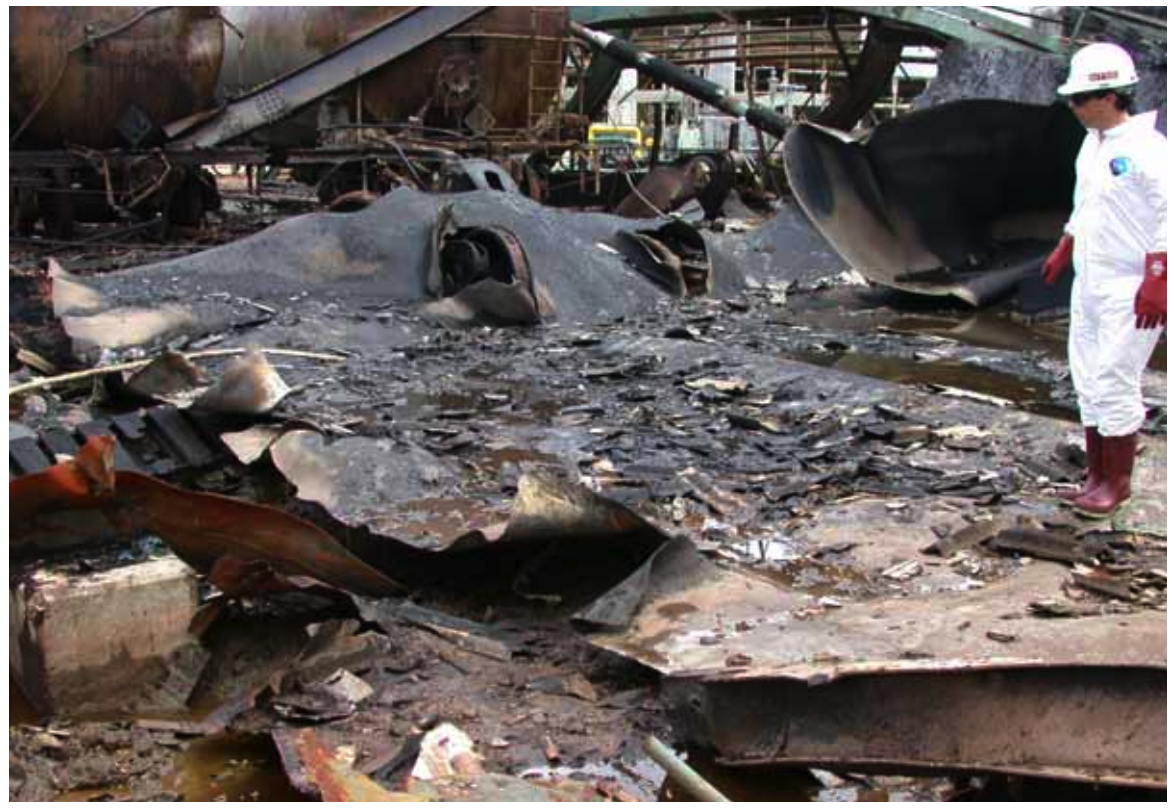
 Steaming railcars and tanker trucks is a very common practice in many industries; however, the hazards of doing so it not widely known nor understood. Much like we cover “TOO MUCH TEMP” in our process hazards analysis, a similar analysis may be called for to analyze the practice of applying a heat source (e.g. steam or hot oil) to a railcar and/or tank truck. We should consider the transportation container in the same light as we see our process vessels. This article will demonstrate the hazards and potential outcome of applying a heat source to transportation container. The shear magnitude of destruction from an OVERPRESSURED railcar will surprise many, but if you have railcars on your property, the hazard EXIST so take heed and learn from these mistakes. The NTSB determined that the probable cause of the rupture of the railcar was overpressurization resulting from a runaway exothermic decomposition reaction initiated by excessive heating of a hazardous waste material.
PLEASE NOTE I have highlighted areas of this article in BOLD RED font that I feel are critical points to be made regarding this unloading accident. This material is only about half of the data in the FULL NTSB Accident Report, but I have NOT attempted to slant the arguement in my favor, as this was not necessary! But for the sake of time, I did filter out some portions of the official report, which can be downloaded from the NTSB at the link above.
Although this accident was not associated with a PSM/RMP Covered Process, I encourage you to put on your process safety cap as you read through this report. We can put our finger on a number of process safety errors made, from PSI to Training. This is also an EXCELLENT example of how a “Material and Energy Balance” comes into play in process safety! LEARN from the mistakes of others…
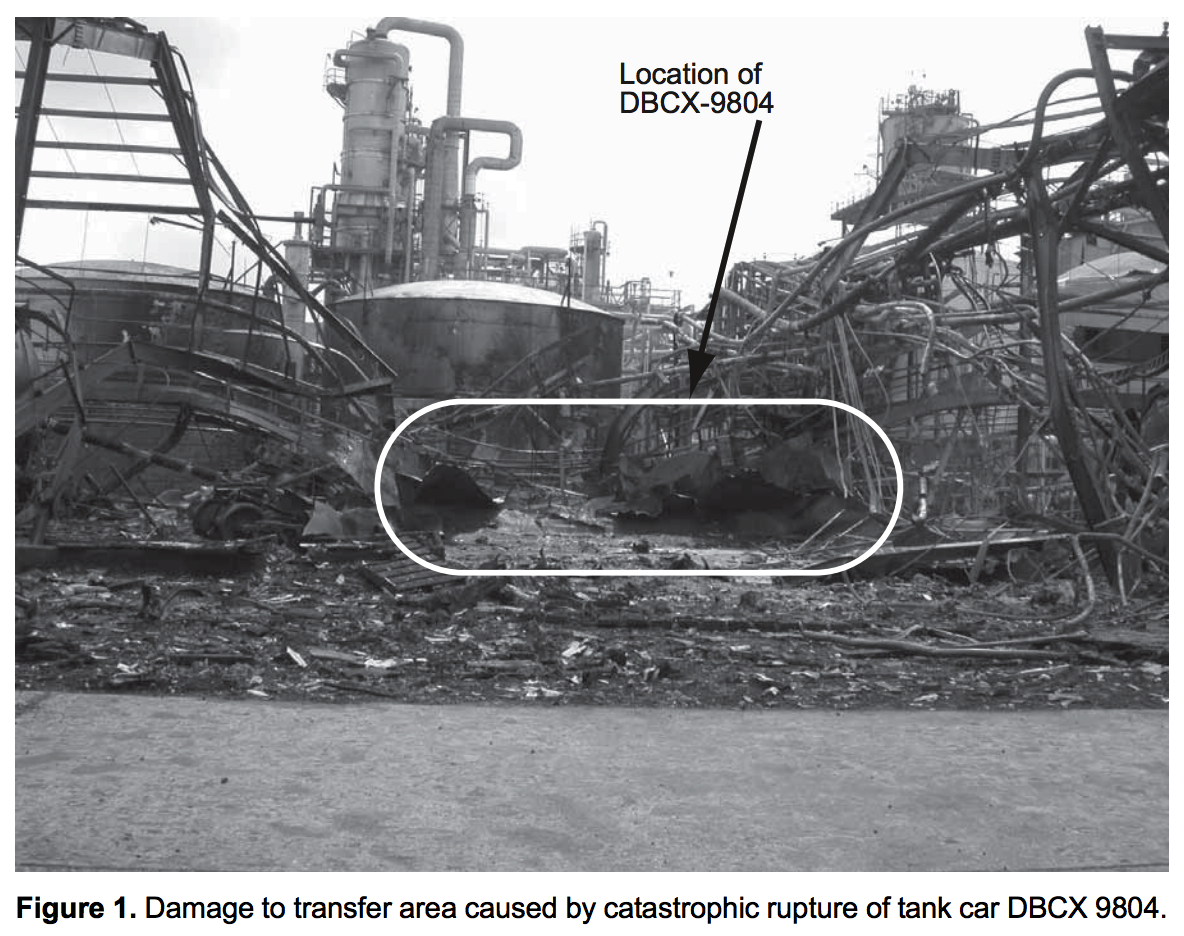
About 9:30 a.m. CST on September 13, 2002, a 24,000-gallon-capacity rail car containing about 52,450 pounds (6,500 gallons) of hazardous waste, catastrophically ruptured at a chemical facility in Freeport, Texas. The tank car had been undergoing steam-heating to permit the transfer of the waste to a tanker truck for subsequent disposal. The waste was a combination of cyclohexanone oxime, water, and cyclohexanone. The rail car, the tanker truck, and the transfer station were all destroyed. (See figure 1 below for a postaccident photo of the transfer area.) Two nearby storage tanks containing oleum (fuming sulfuric acid and sulfur trioxide) were damaged and released about 10,650 pounds (660 gallons) of material. Twenty-eight people received minor injuries, and residents living within 1 mile of the accident site had to shelter in place for 5 1/2 hours.
Generation and Initial Storage of the Waste
On June 1, 2001, a process upset occurred at the caprolactam II process of the facility in Freeport. On June 5, 2001, as a result of the upset, about 90,875 pounds (11,261 gallons) of material, consisting of about 94 percent cyclohexanone oxime, 4 percent water, and 2 percent cyclohexanone, was temporarily transferred to four highway cargo tanks. On June 11, 2001, the material was to be transferred to railroad tank car DBCX 9804, but it had solidified within the highway cargo tanks. (The material would solidify at temperatures below 194°F) The facility applied steam heat from a facility boiler to the four highway cargo tanks to liquefy the material for transfer. On June 12, 2001, facility personnel transferred the contents of the four highway cargo tanks to tank car DBCX 9804.
Heating and Unloading the Waste in Hannibal
On the morning of July 7, 2002, tank car DBCX 9804 arrived at the waste facility in Hannibal, MO. The waste facility procures hazardous wastes as supplemental fuels for the cement production process at the facility. Each year, the waste facility unloads about 350 railroad tank car loads of such waste at the Hannibal plant. The waste facility had never before heated or unloaded the waste material contained in DBCX 9804. On July 8, the waste facility began preparing DBCX 9804 for unloading by moving the tank car to a boiler station, where the waste material within the tank car was to be heated to liquefy it. A waste facility liquid fuel supervisor who oversaw most of the unloading stated that when the tank car arrived at the boiler station, he looked through a 6-inch-diameter access opening in one of the two dome housings on the top of the tank car. The liquid fuel supervisor said he saw a white, solid material in the tank car. He attempted to take a sample using a 7-foot-long sampling tube but was unable to do so because the material was too hard. He said the material’s hardness was comparable to steel. The liquid fuel supervisor decided to try to take a sample from a different location. After inserting the sampling tube through a 3-inch-diameter eduction (liquid or product) line valve, the liquid fuel supervisor extracted a sample through the eduction line, which extended almost to the bottom of the tank car. The liquid fuel supervisor described the sample material extracted as “flaky, gooey, very thick, black, and the consistency of oatmeal.”
On the morning of July 9, the waste facility began to steam-heat DBCX 9804 using a natural gas boiler to generate steam. The steam was applied to the tank car at a pressure of 115 pounds per square inch, gauge (psig). The waste facility inserted a pressure/temperature gauge (attached to a 4-foot probe) into the 3-inch valve opening on top of the tank car. The gauge was connected to an automatic shutdown mechanism on the boiler that would stop the heating if the pressure within the tank car exceeded 15 psig. The waste facility employees documented heating, unloading, and other daily activities in an operations logbook. According to the logbook, at 9:00 a.m. on July 9, the temperature of the material in the tank car was 107°F. At 2:00 p.m., the temperature was 119°F and the pressure within the tank car was 3.5 psig. The heating continued until the boiler was shut off at 9:30 p.m. on July 9.
According to the logbook, when the boiler was shut off, the temperature of the material was 131°F and the pressure within the tank car was 0.3 psig. At 5:00 a.m. on July 10, the waste facility restarted the boiler and resumed the heating process. According to logbook notes, at 9:00 a.m., the temperature of the material was 146°F, and the material was “still chunky.” At 12:00 p.m., the temperature of the material was 150°F. At 1:00 p.m., the liquid fuel supervisor, finding that the 4-foot probe attached to the gauging device did not extend to the bottom of the tank car and so was not providing an accurate reading of the material’s overall temperature, temporarily removed the probe and replaced it with a 10-foot metal rod.
The liquid fuel supervisor stated that, after leaving the rod in place for about 5 minutes, the rod’s temperature was 129°F (21°F lower than the most recent reading obtained using the 4-foot probe attached to the gauging device). When the liquid fuel supervisor removed the rod, he could see the material was less viscous, but he also noted that the material hardened very quickly when exposed to the ambient temperature. The pressure/temperature gauge was reinserted into the tank car, and the heating continued until 11:00 p.m. on July 10, when the heating was discontinued for the night. At this time, the temperature of the material was 195°F. At 5:00 a.m. on July 11, the temperature of the material in the tank car was 215°F. The liquid fuel supervisor visually checked the material’s viscosity and determined that the material could be unloaded.
The waste facility moved the tank car to a transfer station about 200 yards from the boiler station. When the tank car arrived at the transfer station, waste facility employees used a vacuum truck to prime the pump to start the flow of product from the tank car to a tanker truck. The transfer continued until the tanker truck was full, at which time it was weighed. The tanker truck contained about 57,840 pounds (7,167 gallons) of waste material.
The tanker truck was moved to another area where its contents were unloaded into a storage tank; then it was returned to the transfer station, and the transfer of material from the rail car resumed. The liquid fuel supervisor stated that while material was being unloaded from the rail car to the tanker truck for the second time, the pump began to “suck air,” which indicated to him that all the material that could be pumped from the rail car had been removed. The vacuum truck was used to suck out any additional material in the transfer hoses. Then, the pump was turned off, the hoses were disconnected, and the transfer process was terminated.
The tanker truck and the vacuum truck were driven to the storage tank area, where they were weighed, and the waste was transferred to the storage tank. The second load in the tanker truck contained about 36,540 pounds (4,528 gallons) of waste, and the vacuum truck contained about 6,220 pounds (771 gallons) of waste. According to the load receipt, the waste facility unloaded 100,600 pounds (12,466 gallons) of material from DBCX 9804. The unloading procedure was completed about 4:00 p.m. on July 11. According to the secondary liquid fuel supervisor, shortly after 4:00 p.m., he closed all the valves and access ways on DBCX 9804 and applied new security seals to the tank car’s two dome housings.
DBCX 9804 left Hannibal on July 12. While traveling from Hannibal to Freeport, DBCX 9804 encountered no unusual delays or routing. When the facility sent rail car DBCX 9804 to the waste facility for unloading, it had provided the waste facility a State of Missouri hazardous waste manifest for the shipment. The manifest from the facility did not record the total quantity of material sent in the tank car. When the waste facility returned the manifest to the facility, it was signed by a waste facility secondary liquid fuel supervisor and dated July 11, 2002. The manifest returned from the waste facility stated that 91,013 pounds (11,278 gallons) of material had been in the tank car when they received it. Neither the primary nor secondary liquid fuel supervisor, nor any other waste facility employee, could tell investigators how the waste faclity had derived the figure for total quantity received from the facility that appeared on the manifest. The manifest also stated that the waste facility had unloaded 90,973 pounds (11,273 gallons) of material at Hannibal.
Heating and Unloading the Waste in Freeport
Rail car DBCX 9804 arrived at the Freeport facility on July 22. Facility personnel conducted a routine inspection of the car and found no security seals on the dome housings or anywhere else on the car. Aside from the missing seals, they found no indications of tampering with the car or its contents. Also as part of the inspection, they removed the 6-inch access plate and examined the interior of the car. A contract employee who looked into the car observed that it was still about one-third full of material. The facility accepted the rail car. The facility did not contact the waste facility concerning the material remaining in the tank car or the absence of security seals. Facility personnel determined that the rail car could not be cleaned (in the typical manner) because it contained too much material. They decided to transfer the material remaining in DBCX 9804 to tanker trucks for disposal. Between July 22 and September 11, no action was taken to unload the rail car. At some time during this interval, a facility employee and a contractor looked into the car through the 6-inch access opening and found that the car was about one-third full of material. Both employees stated that they saw liquid in the tank. On September 11, DBCX 9804 was moved to the caprolactam II process area so it could be prepared for heating and unloading. A 7,000-gallon-capacity tanker truck was brought to serve as a receiving vehicle for the waste. The tanker truck was already about half full of a similar waste material.
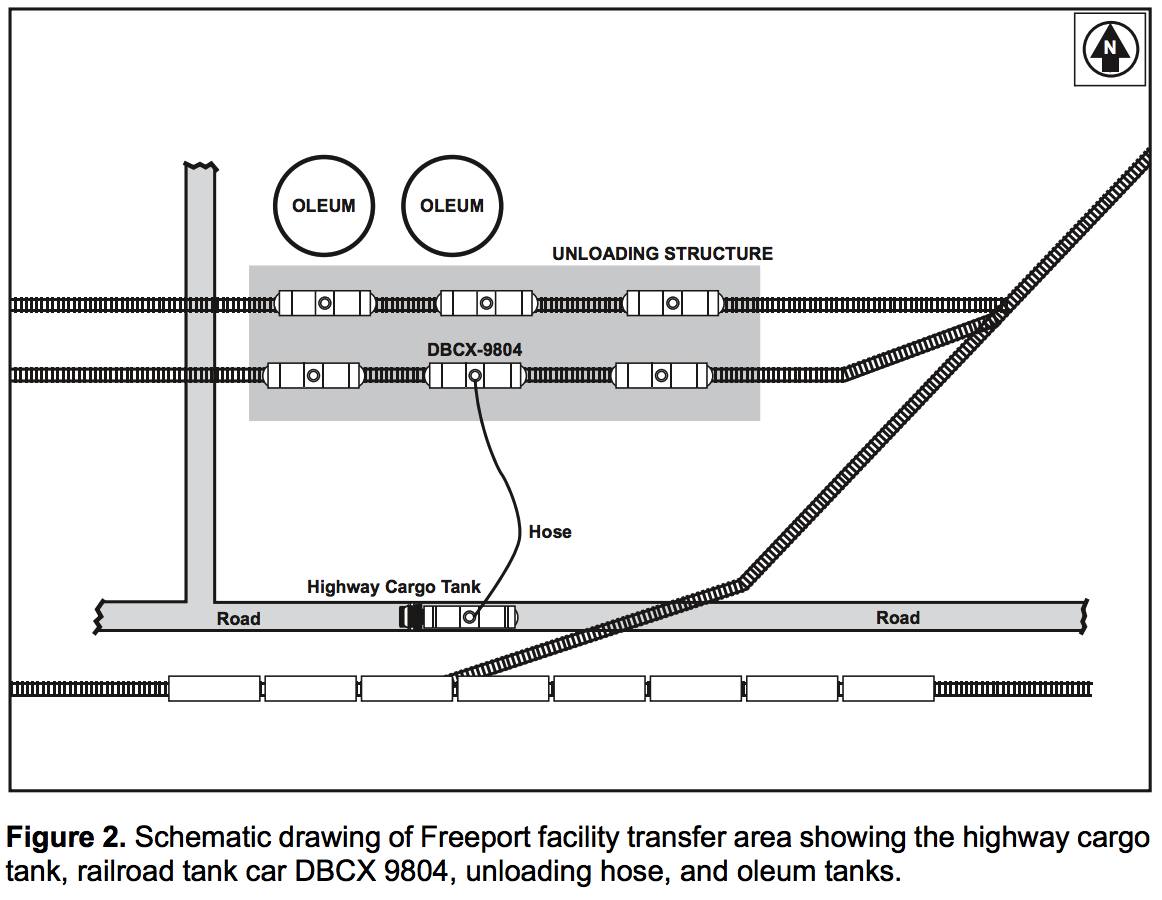
In the afternoon of September 11, two contractors, a primary unloader and a secondary unloader, connected the heating and unloading hoses to the rail car. They threaded one end of a 3-inch-diameter hose into the 3-inch eduction line valve on top of the car; they inserted the other (open) end of the hose into the manway opening on the top of the tanker truck. They connected a second hose from a facility nitrogen supply to a 2-inch-diameter vapor line valve on top of the rail car. The nitrogen was available to provide additional pressure to the car, if needed, to assist in unloading the waste. The nitrogen was not turned on; the eduction and vapor line valves on the rail car were not opened. Unloaders ran a steam hose between a facility boiler and the inlet for the rail car’s heating coil. They placed no pressure or temperature gauges in the rail car to monitor the interior conditions, nor did they employ any automatic shutdown mechanism. Later in the afternoon of September 11, steam was applied to the rail car at 60 psig. After about 1 hour of heating, facility personnel decided to adjust the car’s position. They disconnected the unloading and heating lines, repositioned the car, and reconnected the unloading and heating lines. They did not resume heating the tank that day. (See figure 2 for a diagram showing the layout of the transfer area.)
On September 12, about 7:00 a.m., unloaders again applied 60-psig steam to the tank car. The steam-heating continued until 12:00 p.m., when a transfer was attempted. The material did not transfer. All transfer hose connections were left in place. The primary unloader told a facility operations coordinator that the product was too thick to unload and suggested continuing the application of steam heat until the next morning. The operations coordinator agreed. According to the primary unloader, about 2:00 p.m., a steam trap was added to the rail car’s outlet coil, and the steam pressure was reduced to about 20 psig. The heating of the tank car continued uninterrupted for 17 hours, until 7:00 a.m. the following morning. No one monitored the temperature of the material or the pressure within the tank car during the overnight heating, although workers were in the area through the night.
On September 13, about 7:00 a.m., the primary unloader stopped heating the tank car. He was able to transfer product from the rail car to the tanker truck at this time. About 7 minutes after the transfer began, the primary unloader saw a splash from the tanker truck’s manway opening, indicating that the level of the material in the tanker truck had reached the transfer hose. The transfer was stopped, and the 3-inch valve on top of the rail car was closed. The facility operations coordinator climbed on top of the tanker truck, looked in its manway opening, and decided that the tanker truck was full.
Tank Car Rupture
About 7:45 a.m., the primary unloader and a secondary unloader (who had been present during the unloading) left the area to do other tasks. About 8:40 a.m., the secondary unloader returned to the unloading area. He noticed that the tank car’s pressure relief valve had opened and then reset itself. He called the primary unloader and asked what should be done. The primary unloader said the tank car just needed to vent and that it should be left alone.
According to the secondary unloader, the pressure relief valve opened and reset one or two more times. The first time, the valve opened for 3 or 4 minutes and then closed for about 5 minutes. The following time(s), the valve closed for several minutes between openings. Numerous workers noticed an ammonia smell coming from the car. About 9:00 a.m., the tank car’s pressure relief valve began to continuously vent white vapor. (The continuous venting persisted until the tank rupture occurred.) Facility personnel called the Dow Chemicals fire department for assistance.
Witnesses reported hearing a high-pitched whistle sound coming from the relief valve around this time. The facility activated a “seek shelter” horn in an adjacent process. At 9:05 a.m., facility personnel began to apply water to the tank car to knock down the venting vapors and to cool the tank car. At 9:10 a.m., evacuation horns within the caprolactam II process sounded, and all nonessential employees were ordered to evacuate the area. At 9:15 a.m., Dow Chemicals fire department personnel arrived and began applying water to the tank car using their fire truck. At 9:25 a.m., unmanned fire hoses were positioned to apply water to the tank car while on-scene personnel moved away from the area to discuss further actions. About 9:30 a.m., while water was being applied, the tank car catastrophically ruptured.
Emergency Response
Eleven emergency response agencies responded to the accident, including local fire departments, law enforcement agencies, emergency medical services organizations, a public safety agency, and an emergency management department. After the accident, residents living within 1 mile of the accident site were ordered to shelter in place. About 5 1/2 hours later, the shelter-in-place order was lifted. The area immediately surrounding the accident site (including several facility processes) at the facility remained evacuated, except for essential emergency responders, for about 10 days after the accident due to a continuing leak of the hazardous material oleum from damaged storage tanks and the danger from structural damage to the transfer station.
Injuries
No fatalities were caused by the accident. According to a nurse from the Freeport facility, 28 people reported minor injuries and all these individuals were treated and released from medical supervision.
Damage
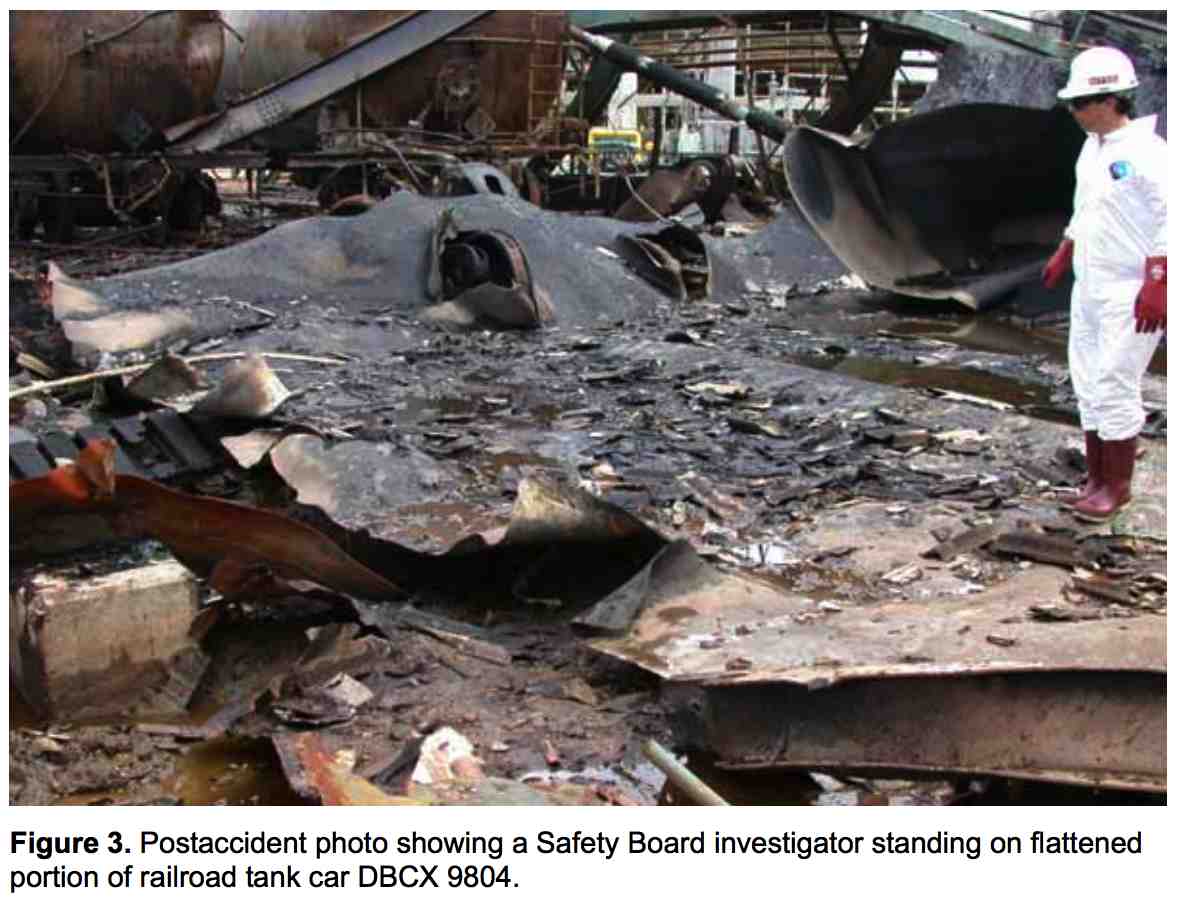
Tank car DBCX 9804 split longitudinally near its top. The split ran the length of the tank car. Two circumferential tears on opposite sides of the car ran from the area where the dome housings had been to about halfway down the sides of the tank car. The tank’s fracture surfaces were consistent with overstress fracturing. The sides of the tank car had unfolded into a flattened position. (See figure 3.) The pressure relief valve was not found. One dome housing (without the cover) that contained the valves and fittings was found on the adjacent Dow Chemicals facility property about 1/3 mile south of the accident site. The second dome housing (containing the 6-inch access opening) was not found. Both tank car heads were separated from the tank car shell. The B-end head was found about 25 feet west of the flattened tank car, and the A-end head was found about 125 feet to the east.
The transfer station where DBCX 9804 had been, the tanker truck that had been receiving the waste, and a second rail car in the vicinity were destroyed. The station structure east and west of the blast site was severely damaged. Two storage tanks containing oleum immediately to the north/northwest of the accident scene were damaged by flying debris, leading to the oleum release.
Hazardous Materials Information
The waste material in DBCX 9804 was a combination of cyclohexanone oxime (oxime), water, and cyclohexanone. The majority of the waste material (94 percent) was Figure 6. Housing of second dome on tank car comparable to DBCX 9804. The facility typically referred to this material as “oxime,” so from this point onward, this report will generally use this term to refer to cyclohexanone oxime. Factual Information 13 Hazardous Materials Accident Report oxime, which is a white, solid material under normal atmospheric conditions at temperatures below 194° F. When solid, oxime is not classified as a hazardous material by the DOT but, when liquid, oxime is flammable. The material safety data sheet for oxime produced by BASF in 1994 describes the material as stable under normal temperatures and pressures but states that temperatures above 212° F should be avoided. About 4 percent of the waste material was water. About 2 percent of the waste material was cyclohexanone, which is a flammable liquid with a flashpoint of 111° F. Its flammable limits are 1.1 percent to 8.1 percent in air. The BASF material safety data sheet for cyclohexanone describes the material as stable. Oxime and cyclohexanone are maintained between 180°F and 204°F within the caprolactam production process. The process operates at atmospheric pressure.
Postaccident
The facilities postaccident analysis of the material from the tank car showed that its chemical constituents were consistent with the oxime waste material from the Freeport process upsets. The facility found no additional constituents in the material. Because the events preceding the accident (the heating of the tank car and the continuous venting of the tank car’s pressure relief valve) suggested that overpressurization from a chemical reaction might have brought about the accident, the facility conducted postaccident Automatic Pressure Tracking Adiabatic Calorimeter tests on residual oxime material from the accident scene to determine why the tank car ruptured. For comparison purposes, the facility ran the same tests on pure oxime from several different sources. The tests measured changes in the oxime’s temperature and pressure as it was heated. The facility test results showed that untempered oxime had a significantly higher onset temperature and a longer induction time than tempered oxime. In effect, the facility found that tempering oxime reduced its stability.
The facility tested one sample of untempered oxime obtained from a common chemical supplier. Water was added to bring the percentage of water in the sample to 4.5 percent. When the sample was heated, exothermic reactions were first observed at 338°F, about 590 minutes into the experiment. A second spike in exothermic reactions was recorded after 895 minutes. The facility also tested a sample of tempered oxime material (containing about 2.8 percent water) recovered from the highway cargo tank at the accident scene. When heated, the sample first showed exothermic reaction at 282°F, about 503 minutes into the experiment. More exothermic activity was recorded after about 665 minutes. To confirm the lower onset temperature for tempered oxime, the facility conducted a further test. The facility took a sample of oxime from the caprolactam process at the Freeport facility, tempered the material at 230° F for 840 minutes, and then allowed it to cool. When this sample was heated as the previous two samples had been, BASF recorded two episodes of exothermic activity–the first at 258°F and the second starting at 381°F. On the basis of its testing, BASF determined that the following reactions occurred when oxime was heated:
1) Cyclohexanone Oxime + Heat + H2O —–→ Cyclohexanone + NH2OH (hydroxylamine)
Then,
2) 4NH2OH + Heat —–→ N2O (nitrous oxide gas) + 2NH3 (ammonia gas) + 3H2O
The facility further determined that the second reaction is essentially irreversible because two of the products of the reaction are gases and a state of equilibrium is never attained. BASF found that once the first reaction started, both reactions would continue until the reactants were consumed. The facility also conducted five analyses of the gases that evolved during the heating of the oxime. The results of all five tests showed the presence of ammonia and nitrous oxide.
Procedures for Heating and Unloading Hazardous Materials at Freeport
According to BASF officials, the Freeport facility had no written procedures for heating and unloading the specific waste material contained in tank car DBCX 9804. The oxime mixture is an intermediate material in the production process for caprolactam, and it is not typically removed from the process or shipped for disposal from the Freeport facility. Consequently, the Freeport unloaders did not routinely handle this material.
According to the facility, the last shipment of oxime from Freeport had taken place more than 10 years before the accident, and the material had never before been shipped from the facility in a railroad tank car. The facility had general operating procedures for transferring material from a highway cargo tank to a railroad tank car and for using pressure to transfer material from a tank car to a plant receiving tank. The facility also provided product-specific unloading and heating procedures for the two materials that are routinely steam-heated in tank cars at the Freeport facility⎯caprolactam and formaldehyde. Of the written procedures provided by the BASF Freeport facility, only the general operating procedure for transferring material from a tank car to a receiving tank required that the material be sampled and tested by lab personnel before the transfer could begin. Only the product-specific procedures for steam-heating formaldehyde required that the pressure within the tank car be monitored during the steam-heating process. Those procedures specified that the pressure within the tank car be checked every 30 minutes. Neither the procedures for steam-heating formaldehyde nor those for steam-heating caprolactam specified the pressure or temperature of the steam to be applied. The Freeport facility did not provide the unloaders with additional or specific procedures for unloading DBCX 9804.
The Accident
Although the pressure relief valve for DBCX 9804 was not recovered after the accident, the events described by the witnesses at the scene on September 13, 2002, indicate that the pressure relief valve was functioning and venting vapors up to the time the tank car ruptured. Witnesses recalled that the pressure relief valve opened and reset itself two or three times between about 8:40 a.m. and 9:00 a.m., began to constantly vent about 9:00 a.m., and continued to constantly vent until the rupture occurred about 9:30 a.m. Witnesses also reported hearing a high-pitched whistle around 9:00 a.m. and seeing a stream of white vapor come from the pressure relief valve as it constantly vented. During postaccident inspection of the tank car, investigators found a longitudinal tear along the top of the tank car and circumferential tears near the dome housings. The initial cycling of the pressure relief valve’s opening and closing, followed by its continuous venting up to the time the tank car ruptured, indicates that the gas within the tank car was being produced more rapidly than it could be vented. Further, this activity of the pressure relief valve and the postaccident condition of the tank car—including the flattened and torn tank shell, the damage to the tank heads, and the projection of one dome housing a substantial distance from the tank car—strongly indicate that an overpressureAnalysis 18 Hazardous Materials Accident Report condition developed due to the rapid generation of gas or vapor within the tank from a chemical reaction involving the hazardous waste in the tank car. The DOT hazardous materials regulations (49 CFR, Subchapter C) require that tank car tanks have a pressure relief device with a sufficient flow capacity to prevent pressure in the tank from exceeding a maximum pressure under specified fire conditions.
The regulations do not specifically require that pressure relief devices have the flow capacity to relieve pressure generated from a chemical reaction within the tank. Rather, the regulations include requirements that are intended to prevent chemical reactions from occurring. For example, all components of a tank car must be chemically compatible with the chemical cargoes authorized for carriage. Hazardous materials that self-react or are highly reactive must have chemical stabilizers added to prevent these adverse reactions from occurring during transportation. The Safety Board considers that this approach is reasonable, and it has proven to be effective. Therefore, the Safety Board concludes that the pressure relief valve on tank car DBCX 9804 functioned as designed and vented vapors continuously once it activated, but the rapid generation of gas within the tank exceeded the valve’s capacity to relieve the tank’s internal pressure sufficiently to prevent the catastrophic rupture of the tank car.
Overpressure Condition
The Safety Board considered several possible causes for the overpressurization that led to the tank car’s rupture, including
- instability of the waste material,
- introduction of chemically incompatible material to the waste material within the tank, and
- an adverse reaction resulting from the heating of the waste in the tank car.
Instability of the Waste Material
The company’s material safety data sheets for oxime and cyclohexanone state that both materials are stable. In addition, the waste had been in the tank car for more than a year—experiencing significant changes in ambient temperatures and humidity—and had arrived at the waste facility in Hannibal, Missouri, without any reported abnormalities, such as elevated tank pressure or material temperature. Further, the tank car was shipped back from Hannibal to Freeport without incident, and it remained in Freeport without unusual developments for 2 months before the accident. Thus, instability of the material did not appear to be the cause of the overpressurization.
Introduction of Incompatible Material
Another possible cause of the overpressurization in the tank was the introduction of a chemically incompatible material, either intentionally or unintentionally, which caused the reaction in the tank that led to the overpressurization. Given that the tank car arrived in Freeport without the security seals that the waste facility said it had applied in Hannibal, the introduction of an incompatible material during the transport period may have been possible. However, the routing of the tank car from Hannibal to Freeport was traced, and no unusual delays were found. Further, no indications of product tampering were found. The waste mixture was not reactive with steels or metals, and postaccident analysis of the material from the tank car showed that the chemical constituents were
consistent with the waste material from the process upsets in Freeport. Therefore, it appears that the overpressurization was not caused by the introduction of incompatible chemical contaminants.
Heating the Tank Car
The facility’s postaccident tests of oxime materials showed that heat-tempered oxime like the material in DBCX 9804 has a lower onset temperature than untempered oxime. Consequently, less heat would have been needed to initiate an exothermic (heat-releasing) reaction of the tempered material in DBCX 9804 than would have been necessary for untempered material. Specifically, the tests showed that untempered oxime required heating to about 338° F to show the first signs of exothermic reaction. In contrast, the tempered oxime from the accident scene, as well as another sample of tempered oxime, required heating only to about 282° F to show the first signs of exothermic reaction. Thermodynamic tables show that, for the heating conducted at the facility, 60-psig steam would have had a minimum temperature of 308°F and 20-psig steam a minimum temperature of 260°F. (The facility applied 60-psig steam to the tank for about 1 hour on September 11 and about 7 hours on September 12. The facility applied 20-psig steam to the tank for about 17 hours from September 12 through the early morning of September 13.)
According to the results of postaccident testing, given the amount of waste material in DBCX 9804 at the time of the accident and the steam pressures used by the facility to heat the material in Freeport, 23 hours of heating would have been required to raise the temperature of the material in the tank car to 284°F, surpassing the estimated onset temperature of 282° F. In fact, the facility heated the material for about 24 hours on September 12 and 13. The use of the steam trap during the heating would have increased the efficiency of the steam-heating process.
Further testing showed that when heated, tempered oxime broke down into cyclohexanone and hydroxylamine. The heat released from this breakdown reaction was sufficient to initiate a second exothermic reaction, the decomposition of hydroxylamine into nitrous oxide and ammonia gases. The generation of ammonia from such a reaction is consistent with the witness reports of ammonia odors as DBCX 9804 vented before the accident.
Therefore, the steam heat that the facility applied to DBCX 9804 in the hours preceding the accident was sufficient to initiate two exothermic reactions of the waste material. Both reactions released heat in an insulated tank, the insulation of which likely prevented the heat’s dissipation. This resulted in the generation and retention of heat at a rate that led to a runaway reaction and build-up of pressure within the rail car. Given the runaway nature of the reaction, the capacity of the pressure relief valve to vent the gases and relieve the pressure in the car was exceeded, so the pressure increased until the car ruptured. The Safety Board concludes that the overpressurization and rupture of the tank car was caused by a runaway exothermic decomposition reaction that resulted when the oxime waste material the tank car contained was steam-heated to an excessive temperature for an extended period of time.
Procedures Used in Steam-Heating DBCX 9804
In the months preceding the accident, both the waste facility and the Freeport facility had steam-heated DBCX 9804 to liquefy the hardened waste material within it so that the waste could be transferred from the car. However, the waste facility and the Freeport facility followed different procedures while performing these operations.
Waste Facility Procedures
Different waste materials may have widely dissimilar chemical make-ups and properties. As might be expected of a company that unloads many different waste materials of diverse compositions, the waste facility was not familiar with the specific chemical properties of the oxime waste material in DBCX 9804. (The Hannibal, MO waste facility had never previously unloaded this particular waste material from a rail car.) They knew only the waste’s heating value and that it did not contain metals.
Because the waste facility did not have detailed information about the chemical properties of the waste, it was concerned about the potential for an increase in vapor pressure that could result from heating the rail car. Consequently, the waste facility took precautions to monitor the interior conditions of the tank car during heating. The waste facility used a gauging device to keep track of the temperature and pressure within the tank car, employed a safety mechanism to automatically stop the heating of the tank car if the pressure reached a preset limit (15 psig), periodically conducted visual inspections of the material, and halted the application of heat when no employees were present (at night) to monitor the process.
The waste facility records show that the pressure within the car never exceeded 3.5 psig while the car was being heated at the Hannibal facility. However, had a significant increase in the internal tank pressure developed, the waste facility procedures for monitoring the heating process probably would have alerted employees before the pressure reached critical levels. In such a situation, the waste facility would most likely have had sufficient time to take appropriate measures to relieve the pressure within the tank car (such as by opening the 6-inch access plate) before the pressure could reach a level that would rupture the tank. It should be noted that although the waste facility used appropriate safety procedures when heating DBCX 9804, the waste facility’s lack of procedures for ensuring that the tank car had been emptied of all waste material after the unloading process at Hannibal was terminated allowed the tank car to be sent back to the Freeport facility containing about 8,000 to 10,000 gallons of waste. Had the waste facility taken steps to ensure that the tank car was truly empty before sending it back to Freeport (such as by visually inspecting the interior of the tank through the 6-inch access opening), the waste facility would have learned that the car still contained a significant amount of material. Then, they could have unloaded the remaining waste and sent DBCX 9804 back to Freeport empty, in which case the Freeport facility would not have had to deal with the disposal of the material.
Facility Procedures
Like the unloading personnel at the waste facility, the unloaders in Freeport did not routinely heat oxime waste material for transfer. The Freeport facility had last shipped this material more than 10 years before the accident. And, although the oxime material was an intermediate product from the Freeport facility, it had never before been heated and transferred from a rail car. Consequently, the Freeport facility had no specific written procedures for heating the waste mixture before unloading it from the car. Perhaps the Freeport facility could not have been expected to have predetermined procedures for heating this particular hazardous waste mixture, but the facility’s lack of experience with the material should have indicated that special care should be taken during the heating process.
Instead of adopting reasonable safety measures, the Freeport facility treated the material as if it posed little or no risk. Specifically, the unloaders in Freeport did not use a gauge or other device to monitor the temperature and pressure within the tank; they did not apply any safety mechanism that would stop the heating if the pressure inside the tank reached a preset limit; and they did not periodically evaluate the tank’s interior conditions.
The unloaders at the Freeport facility did not use any monitoring tools to help them assess the internal conditions of the tank during the heating process. Because the facility did not require its unloading personnel to use a pressure gauge to monitor the pressure in the tank car during the heating process, the first indication the unloaders had of the rising pressure in the tank car was the activation of the pressure relief valve when the pressure exceeded 75 psig. This happened about 45 minutes before the tank car ruptured. By this time, it was likely too late to stop the runaway chemical reaction. Nor did the Freeport unloaders use a safety mechanism to automatically stop the heating if the pressure reached a preset limit. Had they used an automatic shutdown mechanism, the tank car heating would likely have been terminated much sooner, when the tank pressure rose to the established safe limit.
Further, if the Freeport facility workers had monitored and evaluated the conditions within the tank car (specifically, the temperature of the waste material and the internal pressure of the tank car) by checking them periodically, they would have found that the material was sufficiently liquid for successful transfer around 9:00 p.m. on September 12—about 12 1/2 hours before the accident occurred. They also would have had time to relieve the pressure within the tank car before it reached critical levels, by taking such action as opening the 6-inch access plate.
Therefore, the Safety Board concludes that lack of experience in transferring the oxime material should at least have led the Freeport facility, like the waste facility, to take precautions during the heating process. Although the workers immediately involved in the transfer operation may not have been aware of the specific properties of the oxime waste they were unloading, the company had such information. The 1994 material safety data sheet for oxime specifically stated that temperatures above 212°F should be avoided for this material. Additionally, during a 1991 meeting in Belgium, the variations in onset temperatures for oxime were discussed. Guidance distributed to those attending the meeting (including representatives from the Freeport facility) advised that to avoid uncontrolled runaway reactions of tempered oxime, the temperature within the tank should not exceed 194°F. The Safety Board concludes that, before the accident, the company had information concerning the dangers associated with excessive heating of oxime that should have alerted the Freeport facility to the need for developing and implementing safe procedures for heating and unloading this material from rail cars.
The Freeport facility has changed its facility procedures to address problems identified during the investigation of this accident. It has developed and implemented written procedures designed to ensure the safe handling of oxime waste material. The procedures prohibit the transfer of oxime waste to rail cars, as well as the heating of closed containers of oxime. Additionally, the Freeport facility now requires that hot water be used, rather than steam, to heat oxime waste. The company revised its material safety data sheet for oxime to stipulate that oxime must not be heated above 212°F. The Safety Board considers that these actions will significantly reduce the likelihood of incidence of an accident similar to the one discussed in this report. Consequently, the Safety Board makes no recommendations to the Freeport facility concerning its oxime handling procedures.
Findings
- Rail car DBCX 9804 had no structural or material defects that caused or contributed to the rupture of the car.
- The pressure relief valve on car DBCX 9804 functioned as designed and vented vapors continuously once it activated, but the rapid generation of gas within the car exceeded the valve’s capacity to relieve the tank’s internal pressure sufficiently to prevent the catastrophic rupture of the car.
- The overpressurization and rupture of the car was caused by a runaway exothermic decomposition reaction that resulted when the cyclohexanone oxime waste material the car contained was steam-heated to an excessive temperature for an extended period of time.
- Lack of experience in transferring the cyclohexanone oxime material should at least have led the Freeport facility, like the waste facility, to take precautions during the heating process.
- Before the accident, the Company had information concerning the dangers associated with excessive heating of cyclohexanone oxime that should have alerted the Freeport facility to the need for developing and implementing safe procedures for heating and unloading this material from rail cars.
- Federal oversight of operations for heating hazardous materials in railroad tank cars prior to unloading is inadequate.
Probable Cause
The NTSB determined that the probable cause of the rupture of railroad tank car DBCX 9804 was overpressurization resulting from a runaway exothermic decomposition reaction initiated by excessive heating of a hazardous waste material. Contributing to the accident was the facility’s failure to monitor the temperature and pressure inside the tank car during the heating of the hazardous waste.