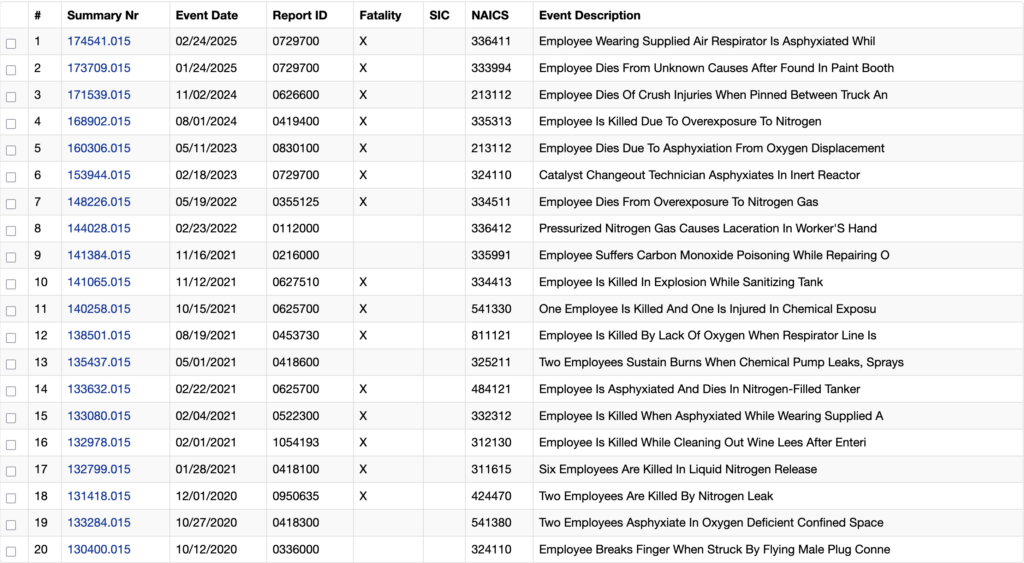
Nitrogen (N2) and carbon dioxide (CO2) are becoming very popular in food plants for a whole host of reasons. A number of years ago, we lost six workers to an N2 event at a food plant in GA. A look at OSHA data from 2020 to the present shows incidents involving N2 (see below). But as many of you know from the many discussions we have had on this site, N2 and CO2 are NOT hazardous gases; they’re inert gases. In fact, 78% of the air we breathe is N2. The hazard associated with N2 or CO2 is that TOO MUCH of these gases means LESS O2, and when we get down to 19.5% O2, we are in an IDLH atmosphere. Remember, normal O2 levels (at sea level) are 20.8%.
So the question is… how much N2 or CO2 is a hazard?
This is not meant to be a “trick question.” But it often is. We should work to ensure we have an INHERENTLY SAFE working environment. This means we maintain the amount of N2/CO/ace BELOW the level at which, if 100% of either gas were released, the working space would NOT drop below 19.5%. I personally do NOT give credit for any mechanical ventilation unless the facility is mature enough that it has the ventilation fully DEFINED and QUANTIFIED in a design basis, and it’s in a FORMAL Preventive Maintenance (PM) program with a defined frequency of testing/validation. But my #1 objective is to ensure the QUANTITY of available N2/CO2 gas is INHERENTLY SAFE.
When the space has enough N2/CO2 to create a Hazardous Atmosphere, the space MUST have O2 detection with alarms (as we discussed in previous articles). These O2 detectors MUST be in a Calibration Program and functionally tested ANNUALLY. It’s the price we pay for having an invisible/odorless gas in the workspace that poses a fatal hazard. Those of you playing in the SIF sandbox should apply your SIF efforts to these working spaces!
We have seen some crazy situations involving both N2/CO2, and the business clearly was in way over their heads! The safety team was NOT fully abreast of the risks associated with the use of these gases, and on a couple of occasions, we were told to “stay in our lane” as we watched the workers walking through a cloud of condensed air because so much of the asphyxiant was leaking from the process.
No detection, no postings telling workers of the hazards they were working in, nothing. We even asked the workers to see if they could explain the white gas cloud they were walking through, and in most observations, the workers had no idea they were working in a room with a known asphyxiant(s). None of the machines were labeled, none of the piping was labeled, none of the doors to enter the room/area were labeled – NOTHING. No HAZCOM training on this new chemical; most had an SDS, but no one actually read it, and the safety teams were not trained on the hazards.
So, when would we need to post danger signs for this hazard?
My position is that when there is enough of either gas to leak into the working space and drop the O2 to 19.6%, we need signs posted, training, and detection with alarms. If the space is larger than the amount of gas present, we can discuss something LESSER, but understand that “inventory control” is an ADMINISTRATIVE control, and in my years, it’s one I see broken routinely. When I was a safety manager, I would limit the number of Cylinder Storage spots to the allowed limit, yet I could walk into that area and find more cylinders than were allowed. This is why I always required mechanical exhaust ventilation as an ENGINEERING control anywhere an asphyxiant gas was present, regardless of the volume of gas(s) that was stated to be available!