
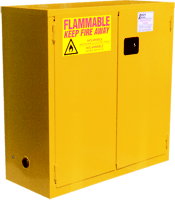
To change things up a bit, let’s take a test to see just how well we understand the inner workings and limitations of flammable storage cabinets.
- TRUE or FALSE- Glass containers should NOT be used to store flammable liquids inside flammable storage cabinets.
- How many latch points must be on each door on a flammable liquid cabinet?
- EXTRA CREDIT – Explain why that number is required
- TRUE or FALSE – A flammable liquid storage cabinet requires a built-in secondary containment.
- EXTRA CREDIT – if required, how deep must it be, and if not required, explain the rationale for not needing one within the cabinet
- TRUE or FALSE – NFPA 30 requires that flammable storage cabinets be vented outside the building.
- TRUE or FALSE – If I vent my flammable storage cabinet with a mechanical fan, using an existing fume hood exhaust system is perfectly acceptable.
How did you do? Think you aced it? Here are the answers:
- TRUE
- Three (3)
- TRUE
- FALSE
- FALSE
Let’s discuss the answers, as well as the EXTRA CREDIT questions.
- Due to thermally induced stress, ordinary glass containers exposed to heat will fail at about 212°F (100°C). Storage cabinets offer protection from radiant heat, but only for a limited period of intense fire exposure. This limitation must be recognized. Specially designed cabinets that provide extra protection for glass containers are available.
- The three-point latch requirement on the metal storage cabinet doors is intended to maintain the integrity of the cabinet during exposure to fires. Without a three-point latch arrangement, the metal would warp when exposed to a fire, resulting in the exposure of the cabinet’s contents to the fire.
- The required two inch (50 mm) raised sill allows minor spills and leaks to be retained. PLEASE NOTE that NFPA 30 does not prohibit using the bottom of the cabinet for storage; however, it is NOT a recommended practice based on the “certifying agency” of the cabinet.
- NFPA 30, 9.5.4 states… Storage cabinets shall not be required by this code to be ventilated for fire protection purposes. Venting of storage cabinets has not been demonstrated to be necessary for fire protection purposes. Additionally, venting a cabinet could compromise the ability of the cabinet to adequately protect its contents from involvement in a fire, because cabinets are not generally tested with any venting. Therefore, venting of storage cabinets is not recommended. However, it is recognized that some jurisdictions might require storage cabinets to be vented and that venting can also be desirable for other reasons, such as health and safety. In such cases, the venting system should be installed so as to not substantially affect the desired performance of the cabinet during a fire. Means of accomplishing this can include thermally actuated dampers on the vent openings or sufficiently insulating the vent piping system to prevent the internal temperature of the cabinet from rising above that specified. Any make-up air to the cabinet should also be arranged in a similar manner. If vented, the cabinet should be vented from the bottom with make-up air supplied to the top. Also, mechanical exhaust ventilation is preferred and should comply with NFPA 91, Standard for Exhaust Systems for Air Conveying of Vapors, Gases, Mists, and Noncombustible Particulate Solids. Manifolding the vents of multiple storage cabinets should be avoided.
9.5.4.1 If a storage cabinet is not ventilated, the vent openings shall be sealed with the bungs supplied with the cabinet or with bungs specified by the cabinet manufacturer.
As clearly stated, the storage cabinet is not required to be vented for fire protection purposes. However, vent openings are often provided by manufacturers because some jurisdictions mandate that the cabinet be vented to prevent possible vapor accumulation in the cabinet and because some users desire this feature if the cabinet will be used for the storage of toxic or noxious materials. It should be understood that venting the cabinet might defeat its fire integrity. If it is not necessary or not required that the cabinet be vented, the vent openings should be kept tightly capped with metal bungs provided for that purpose.
9.5.4.2 If a storage cabinet is ventilated for any reason, the vent openings shall be ducted directly to a safe location outdoors or to a treatment device designed to control volatile organic compounds (VOCs) and ignitible vapors in such a manner that will not compromise the specified performance of the cabinet and in a manner that is acceptable to the authority having jurisdiction.
A.9.5.4.2 A “safe location” should be selected as the location of a vent discharge to minimize the potential for ignitible vapors to travel to a source of ignition after discharge from the vent. Electrical equipment that does not meet the requirements for hazardous locations can serve as an ignition source. The Technical Committee advises that vent discharge locations should consider such factors as the following:
- Characteristics of the exhausted material (vapor density, toxicity, velocity of discharge, etc.)
- Proximity to potential ignition sources
- Building openings such as doors, windows, air intakes, and so forth
- Dispersion characteristics (distance to discharge within the flammable range, direction of discharge, atmospheric conditions, and the influence of building and neighboring buildings on discharged vapors)
- Likelihood of vapor accumulation following discharge, such as accumulation under building eaves
- Likelihood of sufficient discharge volume to allow an ignitible concentration to reach an ignition source
Historically, NFPA 30 has provided prescriptive guidance, often based on area classification requirements, and results have been acceptable. Closer distances should be accepted only if an analysis by a qualified person justifies closer distances. Similarly, the specified distances might not be acceptable for all installations, thus the guidance provided above. If the cabinet must be vented, the following procedures should be followed:
- Remove both metal bungs and replace with flash arrester screens (normally provided with cabinets). The top opening will serve as the fresh air inlet.
- Connect the bottom opening to an exhaust fan using substantial metal tubing having an inside diameter no smaller than the vent. The tubing should be rigid steel.
- The fan should have a non-sparking fan blade and a non-sparking shroud. It should exhaust directly to outside.
- The total run of exhaust duct should not exceed 25 ft (7.6 m).
Note that the technical committee has added considerable guidance on venting the cabinet to a safe location. Venting the interior of a storage cabinet directly to the interior of a standard laboratory hood via flexible plastic duct is improper and dangerous. Not only is the cabinet’s integrity violated, but safety of the hood and anyone using it is seriously compromised.