
An ammonia system at an industrial food processing facility over-pressured, activating one of its overpressure safety relief valves. Ammonia was released into the atmosphere for approximately eight (8) minutes until the refrigeration compressor was manually shut down by disconnecting the supply power, and the pressure in the system was reduced.
INVESTIGATION CONCLUSIONS
The industrial food processing facility utilizes an Individual Quick Freezer (IQF) freezer refrigeration system. The IQF is used to rapidly freeze individual food pieces, preserving quality and preventing clumping. IQF works by moving separated food items through a spiral conveyor with extremely cold, high-velocity air, freezing them in minutes and maintaining optimal product quality. The cold temperatures are achieved using an ammonia refrigeration system. The IQF refrigeration system at the facility is independent of the facility’s other refrigeration systems.
A typical industrial ammonia refrigeration system works by continuously moving heat from a cold space to a warmer one using ammonia as the refrigerant. The cycle begins in the evaporator, where cold, low-pressure liquid ammonia absorbs heat from the space being cooled and evaporates into a gas. This gas then flows to a compressor, which increases its pressure and temperature, turning it into a hot, high-pressure vapor. From there, the ammonia enters a condenser, where air or water removes heat from the vapor, causing it to condense back into a high-pressure liquid.
Finally, the liquid passes through an expansion valve, which drops its pressure and temperature, producing a cold, low-pressure mixture that returns to the evaporator. This repeating cycle of absorbing heat, compressing, rejecting heat, and expanding is what provides continuous industrial-scale cooling.
Liquid ammonia rapidly boils when released to atmospheric pressure and expands to about 850 times its liquid volume, forming a large dense vapor cloud. This happens because its boiling point is –28°F, causing instant vaporization once pressure is removed. Ammonia is hazardous and toxic. Small amounts can irritate the eyes and lungs, while higher concentrations can cause severe breathing difficulty or lung damage. Ammonia is also corrosive, so it can burn the skin and eyes on contact, and liquid ammonia can cause cold burns or frostbite. Exposure can become dangerous very quickly, especially in confined spaces.
The IQF ammonia refrigeration system has several integrated safety features to prevent hazardous exposure and accidental release. These include remote sensors to monitor levels, pressures, and temperatures in the system. A microprocessor control board mounted on the compressor in the machine room monitors input from the sensors and is designed to alert when inputs reach a set alarm level and unload or shut down the compressor if inputs reach set critical levels. If pressures in the system exceed critical levels, safety pressure relief valves are installed throughout the system and are designed to open at a set pressure of 250 psi, releasing ammonia through a common piping system to a safe outdoor location.
Ammonia refrigeration systems in BC must be installed in a Class T refrigeration machine room, as specified by the CSA B52 Mechanical Refrigeration Code. These rooms house the compressors, vessels, piping, and other components required for the refrigeration cycle. Class T rooms are engineered to meet stringent regulatory requirements for ventilation, containment, fire resistance, and operator safety, ensuring that hazardous ammonia refrigerant is properly managed to protect workers and facility occupants.
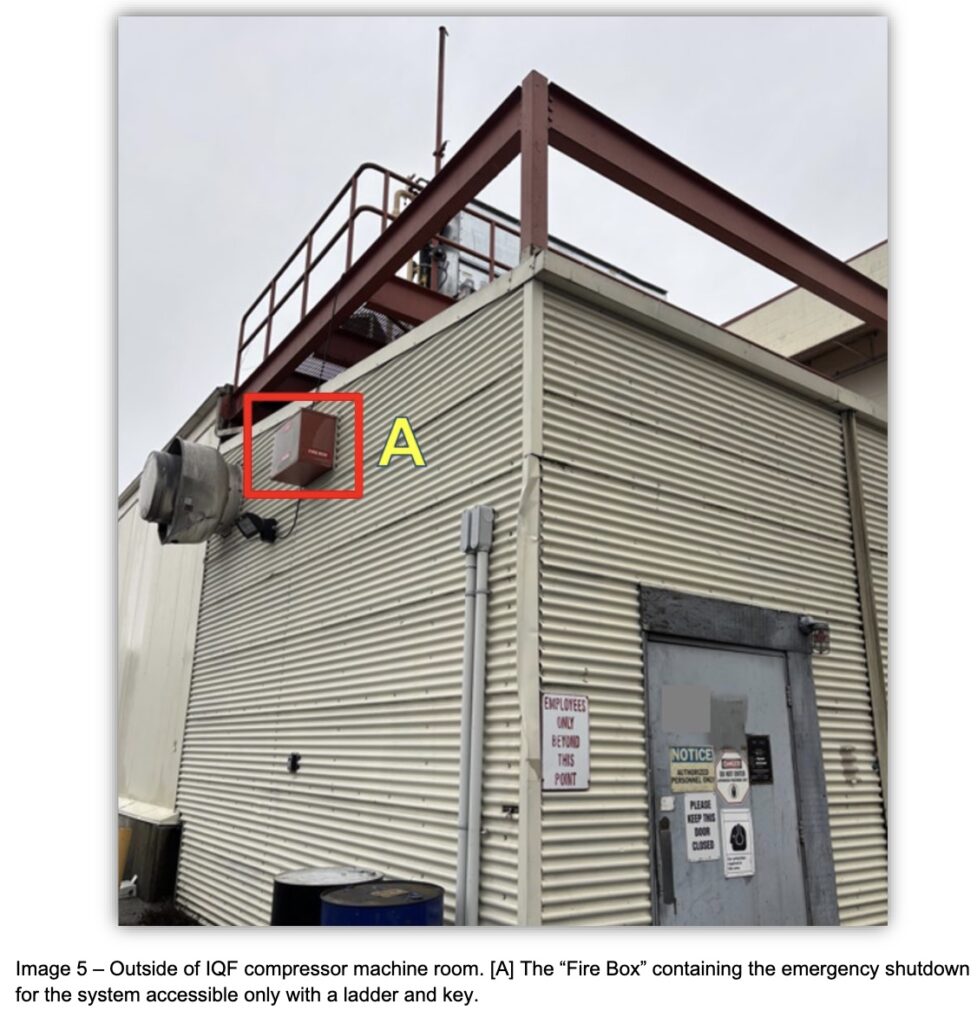
The CSA B52 Mechanical Refrigeration Code requires remote pilot control (Emergency Stop) immediately outside of the machinery room solely for shutting down the equipment in an emergency.
Failure scenario(s)
The IQF spiral freezer at the facility is a stand-alone ammonia refrigeration system separate from the other refrigeration systems at the industrial food processing facility. The ammonia compressor was in a Class T machine room. The room was equipped with ammonia monitors that displayed their readings on a panel outside the entry door to ensure safe access. The room was also fitted with an automatic ventilation system. The compressor was controlled by a microprocessor in a control box mounted on the compressor inside the machine room (Image 8). Typical operation of the compressor was activated and stopped by use of the control buttons on the control panel. The system lacked remote monitoring or control and was not connected to the facility’s Direct Digital Control (DDC) system used for the other refrigeration systems at the plant. The IQF machine room did not have any emergency stop controls installed immediately outside of the access doors to the room.
The control on the compressor had been experiencing faded digits on the control display. The facility hired an industrial service company to repair the display. On September 20th, 2025, the contractor replaced the display board for the compressor control. The display board worked for a period of time, then just before the incident began, it began fading again. The contractor returned on the day of the incident to diagnose the problem. At the time, the refrigeration system was in production, and the compressor was running. The contractor opened the control panel box and visually examined the components inside, but informed the facility that the system and compressor would need to be shut down for further diagnostics and testing. The facility operators opted not to stop production and decided to reschedule the contractor to return a few days later when the system was planned to be shut down.
Shortly after the contractor left, the refrigeration system pressure began to rise above normal operating pressure. When the pressure exceeded the set alarm threshold of 195 psi, the control would have displayed the alarm on the controller display. The control board was not set up to remotely alert or provide and audible alarms at the set alarm level. The control was only able to identify the alarm on the controller display. As the pressure exceeded the critical setpoint of 200 psi, the controller failed to unload and shut down the compressor. The pressure continued to rise until it reached the set pressure of the pressure safety relief valves (250 psi).
When it reached this pressure, one of the relief valves opened, and liquid ammonia began to flow through the relief valve piping exiting the relief valve stack outdoors above the machine room. The compressor and ammonia pump continue to run, maintaining the high pressure and allowing a constant release of liquid ammonia to the atmosphere. When the ammonia was first released, an employee on an elevated outdoor patio at the facility during a work break noticed it.
An ammonia sensor within the relief valve stack detected ammonia and sent an automated email alert to facility staff. Quickly after the release began, employees responded to the machine room. There were no immediately accessible emergency stop buttons outside of the machine room doors, so the employees had to enter the machine room to access the compressor control and attempted to stop the compressor by pressing the stop button on the control. Pressing the stop button failed to stop the compressor (Image 8).
Eventually, another employee entered the machine room and shut off the main electrical disconnect for the compressor while it was operating under load. A third-party refrigeration contractor who was onsite completing other work responded and shut off the main ammonia valves in the machine room.
During the ammonia release, the entire facility was evacuated to a safe muster station on the other side of the building. While the evacuation was underway, two employees sustained minor injuries and were transported to the hospital for treatment.
During the ammonia release, the emergency services were called, and the responding fire department and Police shut down access to the public road in the immediate area of the release and surrounding businesses.
The sensor in the relief valve stack identified that the release stopped and the alarm was cleared approximately eight minutes after it began at 12:41. At approximately 14:00, the ammonia had dissipated, and the fire department gave all clear and allowed employees to return to the building. It’s estimated that up to 600 pounds of liquid ammonia may have been released into the atmosphere and surrounding area.
Facts and evidence
Statements
Facility operators
- The display on the compressor’s control board had recently been replaced, and the new board had begun to fade and was very hard to read.
- At approximately 12:00, a contractor was onsite to look into a non- functioning digital display for the compressor. Due to the fact that the equipment was running, a decision was made to reschedule the diagnostics until the system was not in operation, so a follow-up visit was planned.
- Prior to the incident, there were no unusual sounds, smells, or operating issues reported other than the display being dim.
- At 12:33:28, the IQF stack ammonia sensor went into a critical high alarm and notified the maintenance manager automatically by email.
- An employee in the lunchroom balcony noticed what appeared to be ammonia vapor coming from a vent stack and alerted maintenance.
- Around the same time, a member of the public called 911, reporting what they believed to be a possible structure fire.
- The facility was evacuated. Two people were injured during the evacuation and were taken to hospital.
- An employee attempted to shut down the compressor through the main compressor controller but was unable to do so.
- Another employee then shut off the main electrical disconnect to the compressor, which also shut down the ammonia liquid pump.
- The ammonia stack sensor returned to normal at 12:41:14, eight minutes after it alarmed.
- At approximately 14:00, the fire department gave all clear, and employees were allowed back into the building.
Refrigeration technician
- 600 pounds of ammonia were added to the system after the incident, but they cannot confirm that it was the amount released during the incident.
- There was nothing found during regular monitoring or testing before or after the incident that identified any system failure other that the microprocessor that may have led to the compressor not shutting down.
- The only remote shutdown aside from the button on the main controller was in the firebox outside the machine room.
- The compressor safeties were tested about six weeks prior to the incident.
- The condenser fan and pump may have not been operating as well to allow the head pressure to reach the relief settings.
- The IQF compressor is stand alone and is not remotely monitored or controlled.
- When the IQF compressor safeties reach alarm levels there are no audible or visual alarms or notifications other than line items on the compressor display board.
- Some other plants, like ice rinks, sometimes connect the overpressure monitors to the e-stop circuits.
Controls contractor
- They originally replaced the display board on the control in September and was called back when the new board display began to fade.
- They were there the day of the incident and opened the control box and visually examined the boards and wiring but did not touch or alter anything and closed the box.
- The facility was in production, so a visit was rescheduled for further diagnostics.
Documents
- The annual compressor safety test document shows that the compressor safety was tested on December 31, 2025, by a qualified refrigeration mechanic.
- The safeties tested include setpoints for high discharge pressure alarm (195 psi) and shutdown (200 psi), load limiting setpoints for discharge pressure Stop Load (185 psi) and Force Unload (190 psi). and Relief Valve Set Pressure (250 psi) and Expiry Date (Feb 2029)
Video
This clip from a video recorded by a bystander shows the rate that toxic ammonia was released into the atmosphere from the relief vent stack during the incident.
Causes and contributing factors
The incorrectly functioning compressor control board resulted in abnormal operation and allowed the pressure to rise above typical levels without automatically shutting the compressor down at it’s set pressure levels. The redundant safety pressure relief valves worked as intended and protected the pressurized system by releasing the excess pressure to the outdoors.
Contributing factors to the incident include:
- The required emergency stop buttons were not installed immediately outside of the machine room doors and did not allow for the shutting down of the compressor and required employees to enter the machine room to shut it down.
- The integration of the IQF compressor control not providing and audible, visual alarms or notifications to supervisory staff when set pressure alarm levels were reached, allowed the escalation of the ammonia pressures beyond the setpoint of the safety relief valves without early intervention.
- The decision by the facility to continue compressor operation and postpone the control repair diagnostics when there was a known issue prevented early intervention prior to the system overpressure and ammonia release.