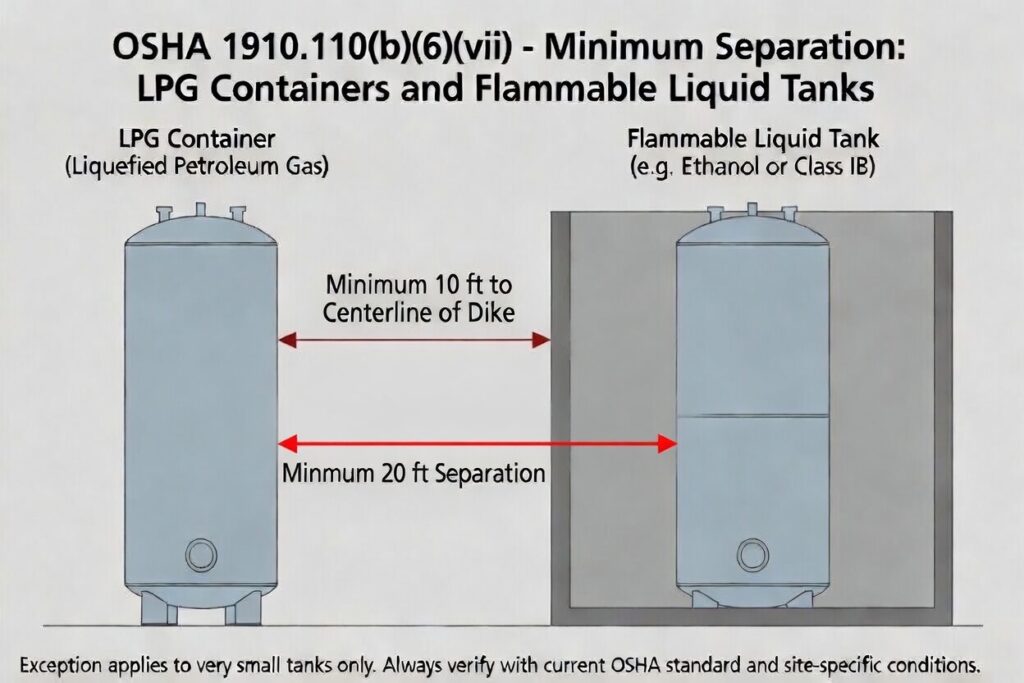
We routinely find facility siting issues when LPG Tank(s) and Flammable Liquid Tank(s) are located in the same area. OSHA, NFPA, IFC, etc., all require a separation distance between the two (2) types of tanks. This is ALL about preventing a setup for a BLEVE, as a pool of flammable liquid finding its way under an LPG tank may be one of the most dangerous situations we can have in a process area. There are TWO (2) distances:
- Distance between the tank walls, and
- Distance from the flammable liquid tank(s) secondary containment wall and the LPG container(s)
Not only do the standards/codes require these separation distances, but they also require an additional layer of protection to prevent the accumulation of flammable liquids beneath adjacent liquefied petroleum gas containers.
Here is my explanation and image I use in my advanced flammable liquids and gases training course(s):
1910.110(b)(6)(vii) The minimum separation between liquefied petroleum gas containers and flammable liquid tanks shall be 20 feet, and the minimum separation between a container and the centerline of the dike shall be 10 feet. The foregoing provision shall not apply when LP-Gas containers of 125 gallons or less capacity are installed adjacent to Class III flammable liquid tanks of 275 gallons or less capacity.

1910.110(b)(6)(viii) Suitable means shall be taken to prevent the accumulation of flammable liquids under adjacent liquified petroleum gas containers, such as by diking, diversion curbs, or grading.