
So I asked Google Gemni + to calculate the pressure wave in a room that is 40′ X 40′ X 20′ tall with the catastrophic failure of a 1-ton chlorine cylinder. In a 32,000 ft3 room, we must determine the volume of gas released during the “instantaneous flash” and the resulting internal static overpressure.
Variables and Assumptions
- Cylinder Contents: 2,000 lbs (1 ton) of Liquid Chlorine
- Internal Pressure: ~115 psig (saturated vapor pressure at 70°F
- Room Volume (Vroom): 40′ X 40′ X 20′ = 32,000 ft3
- Flash Fraction: When liquid chlorine at 70°F is suddenly released to atmospheric pressure (14.7 psia), approximately 17.5% of the mass flashes to vapor, reaching equilibrium at the boiling point (-29°F).
Step-by-Step Calculation
Step A: Determine the mass of the flashed gas
Massflash = 2,000 lbs X 0.175 = 350 lbs of chlorine gas
Step B: Convert mass to volume (SCF)
The specific volume of chlorine gas at standard conditions is approximately $5.4\text{ ft}^3/\text{lb}$.
Volumegas = 350 lbs X 5.4 ft3/ lb = 1,890 standard cubic feet (SCF)
Step C: Calculate the Pressure Increase (Delta P)
In a sealed room, the pressure increase is the ratio of the added gas volume to the room volume, multiplied by atmospheric pressure (14.7 psi).
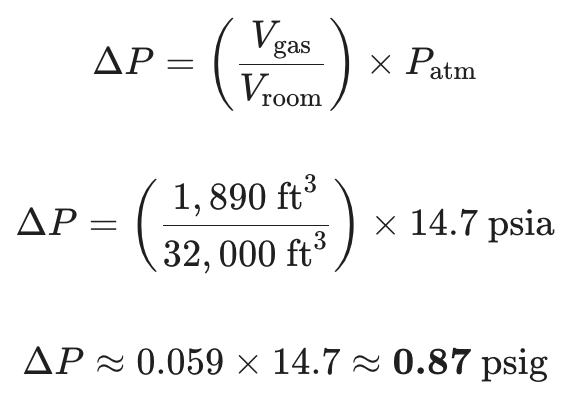
The Result: 0.87 psig
The resulting internal static pressure wave is approximately 0.87 psig.
Safety Evaluation: Structural Impact
While 0.87 psig may seem negligible, it is extremely dangerous in a structural context. Industrial buildings are designed to handle wind loads, but not internal overpressure.
- 0.3 to 0.5 psig: Large glass windows shatter; corrugated metal siding can buckle or pull away from fasteners.
- 0.7 to 1.0 psig: Critical Threshold. Standard unreinforced masonry (cinder block) walls—common in chlorine rooms—will likely suffer structural failure or total collapse.
- 1.0 to 2.0 psig: Near-total destruction of lightweight timber or unreinforced masonry buildings.
Critical Engineering Note: “The Piston Effect”
This calculation represents the static overpressure (the room filling with gas). However, at the exact moment of failure, a dynamic shock wave (blast wave) is generated near the cylinder.
- Within a 5–10 foot radius of the cylinder, the localized pressure wave will be significantly higher than 0.87 psig, capable of throwing heavy equipment and causing immediate fatal injuries through blunt force trauma.
- If the room is not equipped with Explosion Venting (per NFPA 68), the walls will act as a pressure vessel until they reach their breaking point, at which time they will fail catastrophically, potentially turning bricks and debris into secondary projectiles.
Source: Source: me and Gemini+