
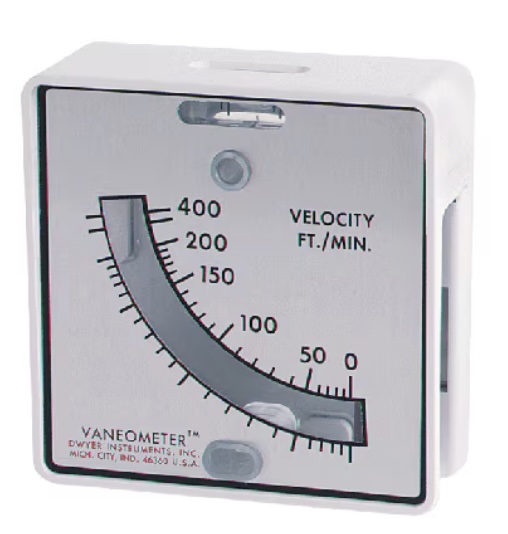
 This $50 device is priceless in validating that the ventilation system is functioning as designed
Verifying that a mechanical exhaust system provides sufficient airflow is critical for preventing the accumulation of flammable vapors. The use of a Vaneometer™ is ideal for monitoring low-velocity air currents (typically 25 to 400 feet per minute) at the face of hoods or exhaust inlets. This $50 device is priceless in validating that the ventilation system is functioning as designed
Before beginning the measurement, ensure the environment is safe for testing.
- Intrinsically Safe Check: The Vaneometer™ is a mechanical device, but ensure any support equipment (like flashlights or tablets) is rated for the specific hazardous location.
- System Status: Ensure the dedicated mechanical exhaust system is running at its normal operating load.
- Baseline Conditions: Close all doors and windows that would normally be closed during processing to ensure the test reflects actual working conditions.
The Vaneometer™ relies on a weighted vane that swings in response to air pressure.
- Leveling: For an accurate reading, the instrument MUST be held perfectly level. Use the built-in level on the device.
- Vane Inspection: Ensure the vane moves freely and is not bent or obstructed by debris.Orientation: The meter must be held perpendicular to the airflow. The air should hit the vane directly on its “face.”
To ensure the ventilation is “adequate,” you must measure the Face Velocity at the exhaust intake.
Step 1: Divide the Opening into a Grid
Do NOT take a single measurement in the center. Airflow is rarely uniform. Mentally divide the exhaust hood or intake opening into equal-sized squares (e.g., a 3×3 grid).
Step 2: Take Point Measurements
- Hold the Vaneometer™ at the CENTER of each grid square
- Wait for the vane to stabilize (usually 3–5 seconds)
- Read the velocity in Feet Per Minute (FPM) from the scale
- Record each reading. If the vane is pulsing, record the average between the high and low swing.
Step 3: Calculate the Average Velocity
Calculate the Average Face Velocity (Vavg) using the following formula:

Evaluation of Adequacy
“Adequacy” is determined by comparing your Vavg against the design specifications for the room or specific regulatory standards (such as NFPA 30 or OSHA 1910.106). Both standards require that the ventilation MUST be at least 1 CFM per square foot of floor area, with a minimum of 150 CFM.
NFPA 497
3.3.1 Adequate Ventilation.
A ventilation rate that affords six air changes per hour, 1 cfm per square foot of floor area (0.3 m3/min/m2), or other similar criterion that prevents the accumulation of significant quantities of vapor-air concentrations from exceeding 25 percent of the lower flammable limit (LFL).
Note: If any single grid point reads significantly lower than the others (e.g., less than 70% of the average), there may be “dead spots” where flammable vapors can accumulate, even if the overall average is acceptable.
Maintain a log of the verification for compliance records:
- Location ID: (e.g., Exhaust Fan #4, Mixing Room A).
- Measured Average: Expressed in FPM.
- Pass/Fail: Based on the facility’s Standard Operating Procedure (SOP).
- Corrective Action: List any adjustments made (e.g., “Cleaned pre-filters to restore flow”).