
Simply stated… We inhale the exact same proportion of oxygen at high altitude as you do at sea level, but because the gas is at a lower pressure, the oxygen molecules are not pushed into our bloodstream with enough force to adequately oxygenate your tissue. Whether you are at sea level or standing on the summit of Mount Everest, the atmosphere remains roughly 20.9% oxygen. It is entirely the lack of overall atmospheric pressure—specifically the resulting drop in the partial pressure of oxygen—that makes it harder to breathe. Here is the mechanical breakdown of why this happens:
The human respiratory system does not operate on percentages; it operates on pressure gradients. For oxygen to physically cross the alveolar membrane in your lungs and bind to the hemoglobin in your blood, there must be a sufficient driving pressure behind it. This is governed by Dalton’s Law of Partial Pressures, which states that the total pressure of a gas mixture is the sum of the partial pressures of its individual gases.
PO2=Patm × 0.209
Because the total atmospheric pressure (Patm) drops non-linearly as altitude increases, the partial pressure of oxygen (PO2) drops right along with it, even though the 20.9% ratio never changes.
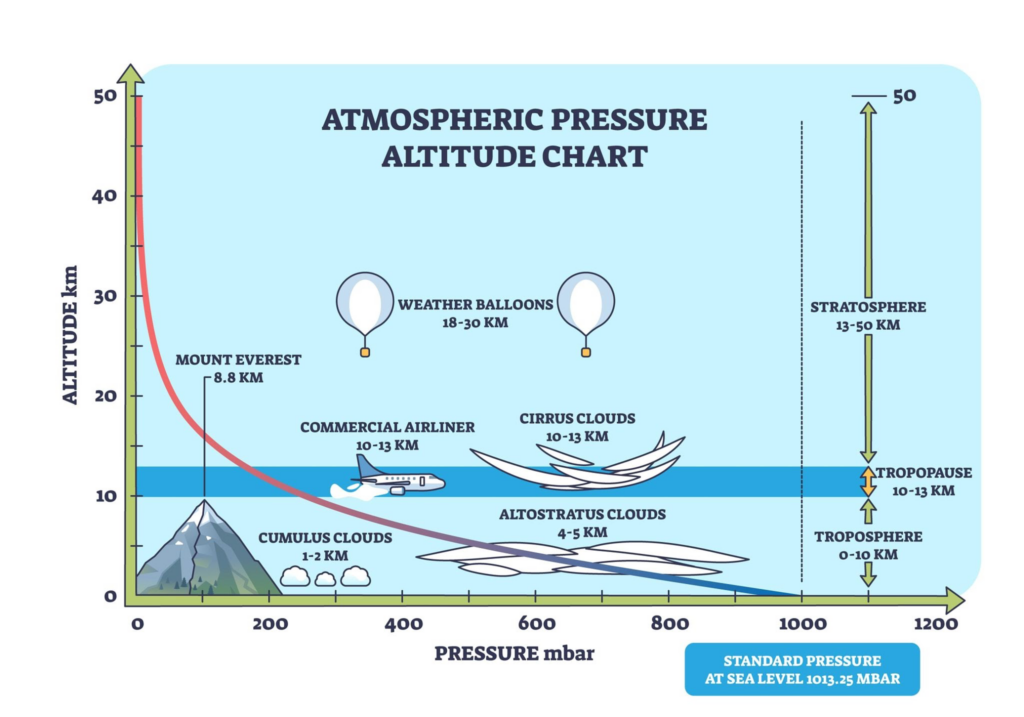
Atmospheric Pressure vs. Altitude. Source: VectorMine / Getty Images
At sea level, the total atmospheric pressure is 14.7 psia. The partial pressure driving oxygen into our blood is roughly 3.07 psia.
As you go higher, the air becomes less dense. There are fewer gas molecules of all types (nitrogen, oxygen, argon, etc.) per cubic foot. By the time you reach 18,000 feet, the total atmospheric pressure is cut in half.
| Altitude (ft) | Oxygen Concentration | Total Pressure (psia) | Oxygen Partial Pressure (psia) |
|---|---|---|---|
| Sea Level | 20.9% | 14.7 | 3.07 |
| 10,000 | 20.9% | 10.1 | 2.11 |
| 18,000 | 20.9% | 7.3 | 1.53 |
| 29,029 (Everest) | 20.9% | 4.9 | 1.02 |