
Do fire extinguishers have to be labeled?
Answer – Yes. So what does OHSA require in 1910.157(c)(1)?
The employer shall provide portable fire extinguishers and shall mount, locate and identify them so that they are readily accessible to employees without subjecting the employees to possible injury.
1910.157 was adopted from NFPA 10 back in 1980 and in that standard there was a requirement to “identify” those fire extinguishers that were “obstructed from view”; NOT blocked, but rather they could not be seen from the area because of “visual obstructions”.
Here is what NFPA 10 currently states:
6.1.3.3 Visual Obstructions.
6.1.3.3.1 Fire extinguishers shall not be obstructed or obscured from view.
6.1.3.3.2* In large rooms and in certain locations where visual obstructions cannot be completely avoided, means shall be provided to indicate the extinguisher location.
6.1.3.3.3 Where signs are used to indicate fire extinguisher location, the signs shall comply with the following:
(1)They shall be located in close proximity to the extinguisher.
(2)They shall be visible from the normal path of travel.
So with all of this said, does it make sense to place a sign only a few inches from a fire extinguisher? If the fire extinguisher is CLEARLY visible from the area it is there to protect then no sign is needed. HOWEVER, if the area has storage or obstructions such that the view to the extinguisher may be “obstructed”, then the sign MUST BE HIGH enough so that it can be seen from within the area. This is the purpose of these signs.
And while on the topic of “visual obstructed”, I need to mention the “visually challenged” fire extinguisher(s). As safety professionals, we tend to walk into a room and begin to scope out the exits and fire extinguishers. How many times have we been in a large building hallway and could not see one fire extinguisher the entire length of the 100′ hallway? But as we continue to walk down the hallway we come across one of the embedded cabinets and sure enough, just inches above it or directly on the cabinet we see the fire extinguisher sign/label. I call these the “visually challenged” rather than “obstructed view” extinguishers because there is nothing obstructing their view from the area they are intended to protect, they are just invisible. In these arrangements, a flat label/sign on the wall or case WILL NOT SUFFICE. It is here where we need to deploy 3D signage that protrudes out from the wall (perpendicular to the wall) so that users in the area can look down the hallway and identify the extinguisher location.
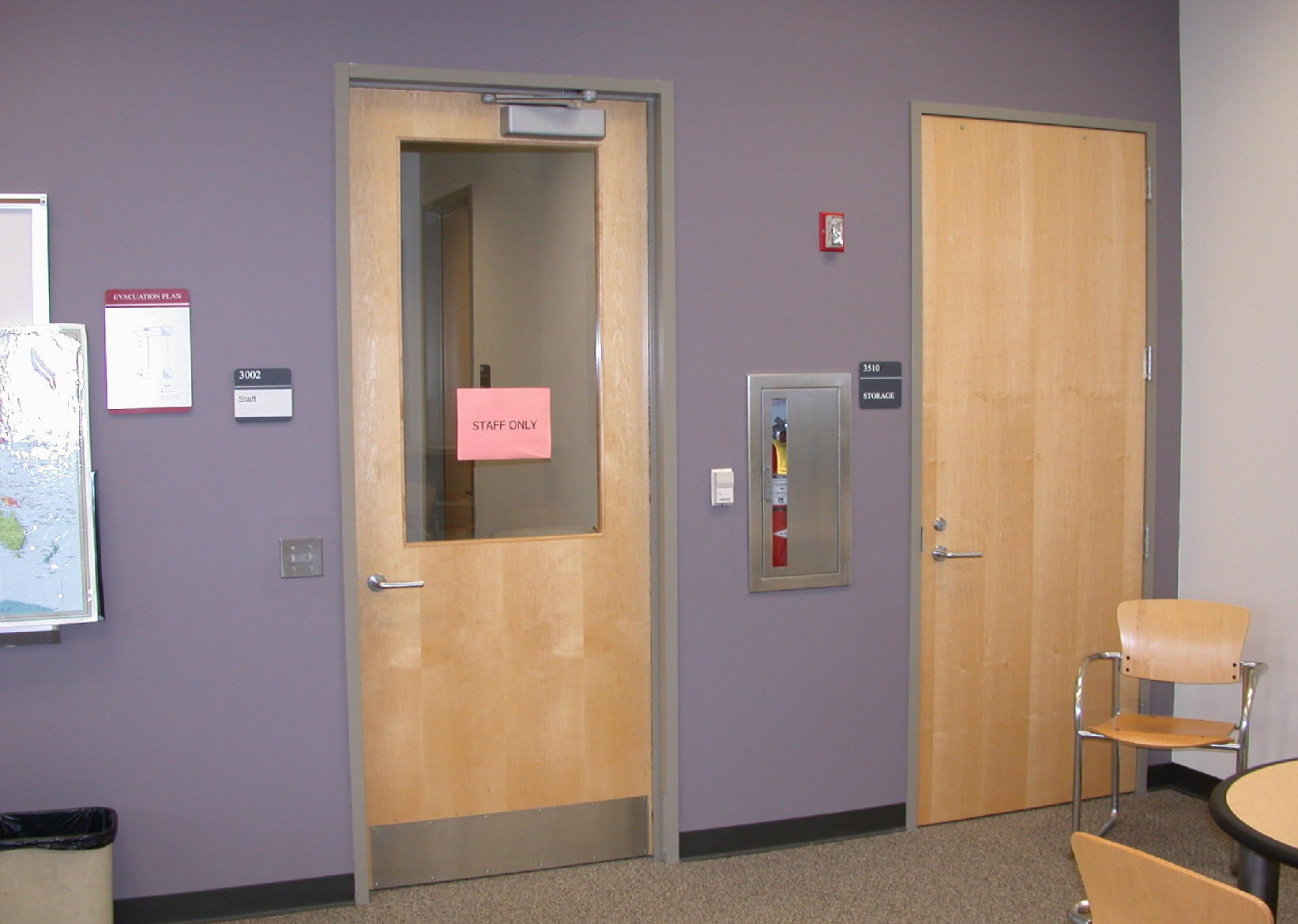
This photo is an example of an embedded cabinet that is flush with the face of the wall. In a room like the one shown, this type of cabinet would not be visually obstructed and the see-through glass allows it to be recognized as a fire extinguisher. However, use this same cabinet in the hallway outside this room and this cabinet will be invisible as it does not protrude out from the wall. It is this hallway use where we need a sign/label that is perpendicular to the wall so that this “visually challenged” extinguisher can be identified.