
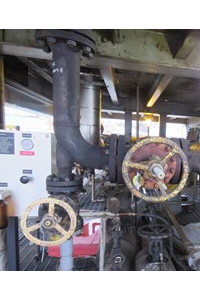
A worker on a contracted maintenance crew at an oil refinery partially unbolted a flange on a live crude oil heat exchanger. An undetermined volume of oil was released. Another worker, a refinery employee who participated in the incident response, was exposed to the resulting crude oil vapors, which are believed to have contained hydrogen sulfide (H2S). The second worker sustained injuries from the exposure. No other injuries were reported.
Investigation conclusions
Cause
The worker misidentified the flange that needed to be unbolted.
At the facility level below the maintenance work zone, the piping system for heat exchanger 1, which had been unbolted, was similar to that of heat exchanger 2 and connected to it via a common manifold. Heat exchanger 1 was active, whereas heat exchanger 2 was not.
Although heat exchanger 2 was locked out and blinded on the manifold, there were no other visual cues to distinguish its piping from the adjacent active piping. Also, the maintenance worker who unbolted the flange could not see through the upper floor grating because sheets of plywood had been placed to guard against dropped tools. As a result, the maintenance worker inadvertently broke the integrity of the active piping at the flange. Heated crude oil began to spray from the flange, and a vapor plume likely containing H2S and other hazardous gases formed in and around the third level of the facility. The maintenance worker and the rest of the oil and gas services firm’s workers immediately left the structure after being radioed by their supervisor to evacuate; no injuries were reported by this crew.
Failure to ensure the worker followed safe work procedures for emergency response.
As one of the initial responders to the vapor plume, the refinery worker entered the facility to determine the source of the product release. Workers are permitted to enter areas with H2S concentrations above 20% of the LEL to respond to an emergency, but the oil refinery owner did not ensure that the necessary safety measures were in place. No supervisors or other refinery workers intervened to ensure that, during this emergency, the refinery worker donned a self-contained breathing apparatus (SCBA) before entering the facility. The worker was exposed to H2S and likely also to BTEX (a group of volatile organic compounds). Not using respiratory protection, such as an SCBA, was contrary to safety procedures taught during H2S training and in emergency drills.
Contributing factors
Inadequate information.
Neither the owner of the oil refinery nor the oil and gas services firm planned the maintenance work so as to provide adequate information to the maintenance worker. The oil and gas services firm had an effective flange management system. However, it was NOT used on the day of the incident. Refinery workers had effectively blinded and locked out the piping at the manifold for heat exchanger 2, which was within the job scope. But this system did not furnish the maintenance worker with adequate information to distinguish similar active piping nearby from the inactive piping. Had effective planning by the maintenance crew’s supervisor and the refinery’s representative occurred, the risks and hazards posed by the active piping would likely have been more effectively controlled. The oil and gas services firm had already developed controls that the workers who were completing the work were familiar with, such as the flange management system. Had it or other such means been used in the vicinity of the work zone, the maintenance worker would have had visual clues regarding which flange to work on and most likely would have unbolted the flange for heat exchanger 2, as he intended.
Inadequate emergency drills.
The owner of the oil refinery failed to provide sufficient emergency drill training to all its workers who could be required to respond to an incident. Drills occurred infrequently, and some refinery workers stated that they had never attended a drill despite the fact that they were expected to respond to emergencies. Refinery workers were able to respond quickly to the unintentional hazardous substance release, shutting down the active heat exchanger and tightening the bolts on the flange in under eight minutes. However, the response exposed the refinery worker to airborne contaminants. Had adequate emergency drills taken place, the worker might have stopped, assessed the situation, and donned respiratory protection before entering the facility.