
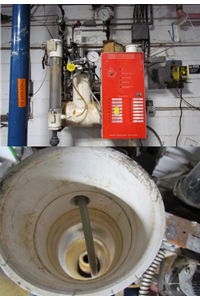
At a poultry-processing plant, a worker (engineer) was responding to an ammonia leak from an air purger (equipment that removes air and other non-condensable gases from the refrigeration system to improve efficiency). He described the signs of the problem to a refrigeration mechanic over the telephone. While waiting for the mechanic to arrive, the worker was splashed with ammonia-saturated water (ammonia mixture) from the water bubbler. When the mechanic arrived later, he opened the water shut-off valve to flush water through the water bubbler, and was also splashed with the ammonia mixture. The two workers sustained chemical burns.
Investigation conclusions
Cause
Ammonia instead of non-condensable gases is discharged from the purger.
The purger discharged ammonia instead of non-condensable gases into the compressor room. Before the engineer closed the foul gas isolation valve and the liquid supply isolation valve, liquid ammonia or ammonia vapor had already entered the purger and continued to mix with the water in the water bubbler, which became saturated with ammonia. As the engineer was troubleshooting the ammonia leak, liquid ammonia or ammonia vapor mixed with the ammonia-saturated water in the bubbler, triggering a reaction strong enough to splash the mixture onto the engineer.
When the refrigeration mechanic attempted to flush the ammonia mixture from the water bubbler, it splashed onto him. It is possible that water flowed into the water bubbler and came into contact with residual liquid ammonia that had entered it, which then caused an energetic reaction. It is also possible that when the refrigeration mechanic opened the water shut-off valve, the initial flow of water combined with the air in the line to cause water to spray into the water bubbler, resulting in the ammonia mixture splashing onto him.
Contributing factors
Purger not maintained according to the manufacturer’s instructions.
The purger’s manufacturer recommended a variety of daily, monthly, quarterly, and annual maintenance and stated that, even with regular maintenance, the purger should be replaced after 15 to 20 years of service. Minimal preventive maintenance work, as recommended by the manufacturer, was done on the purger by the poultry-processing employer and the refrigeration company. Although the refrigeration company had performed repairs when the purger leaked ammonia in February, April, and June 2021, the poultry-processing employer did not ensure that regular maintenance was performed on the purger.
Inadequate implementation of the emergency response procedure.
Although the poultry-processing employer had an ammonia environmental, exposure control, and response program in place at the time of the incident, the program was not effectively implemented. The engineer was both the incident commander and the sole authorized worker who attended to the ammonia leak, contrary to the employer’s emergency response procedures, which specify that two authorized workers are to respond. As such, the engineer did not have another worker to assist with monitoring ammonia levels, ensure that no other workers entered the compressor room while the engineer was addressing the ammonia leak, or provide first aid when the engineer was splashed with ammonia. The refrigeration company did not ensure that two ammonia response technicians were dispatched to the plant, as required by its written emergency procedures.
Engineer not trained in purger troubleshooting.
The engineer did not receive any training on the purger and was not responsible for monitoring, inspecting, or maintaining the purger. The Engineer was neither trained nor competent to work on the purger.
Inadequate supervision.
The poultry-processing employer failed to provide adequate supervision to ensure the health and safety of the engineer. There were no supervisors available to provide instruction and assistance to the engineer and to ensure that the employer’s ammonia environmental and exposure control and response program was followed.