
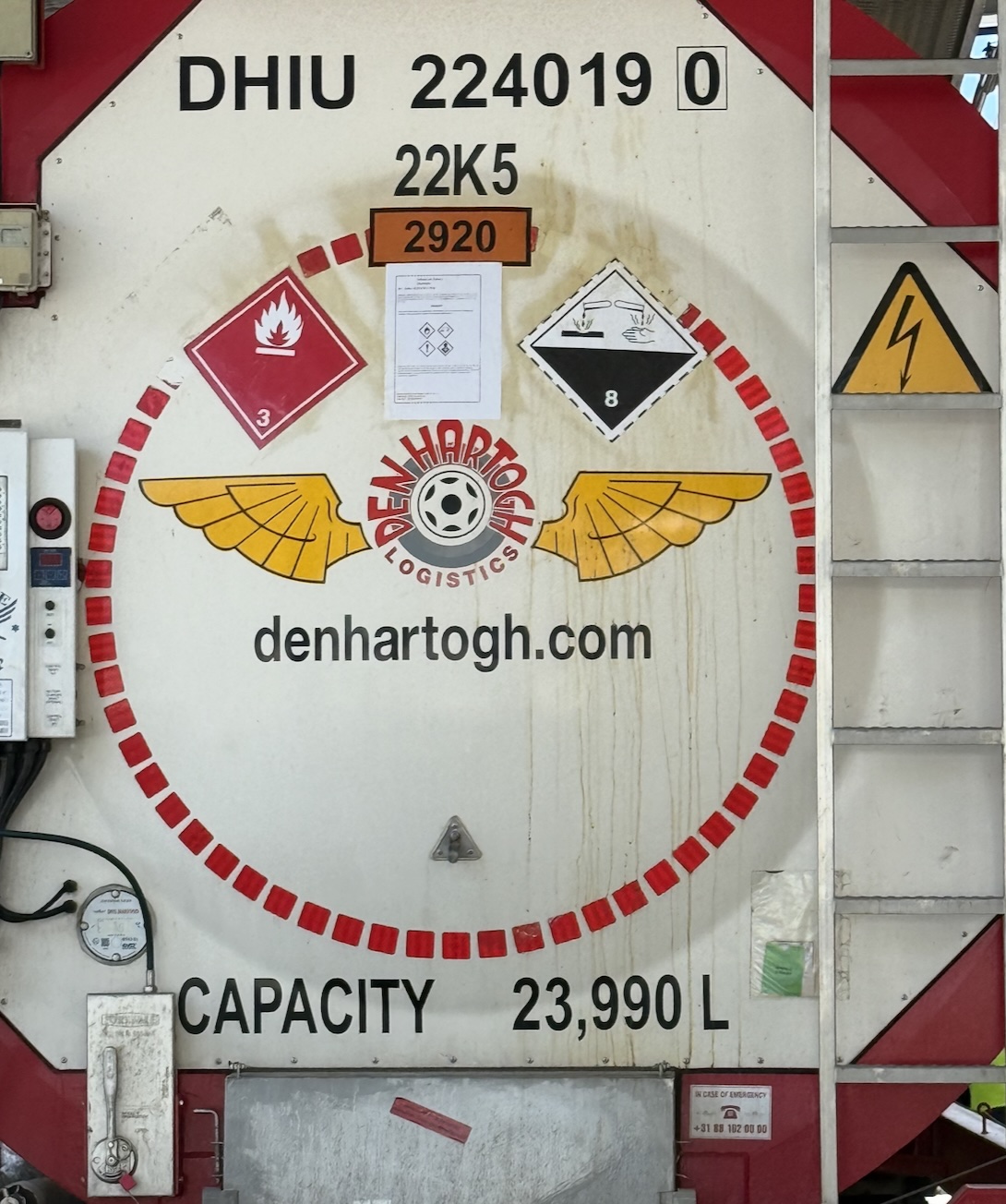
If we look closely at this ISO container, specifically between the two (2) placards, we will see a laminated GHS label with the product identifier, pictogram(s), signal word, manufacturer’s name, and phone number. But is that middle label required on this ISO container?
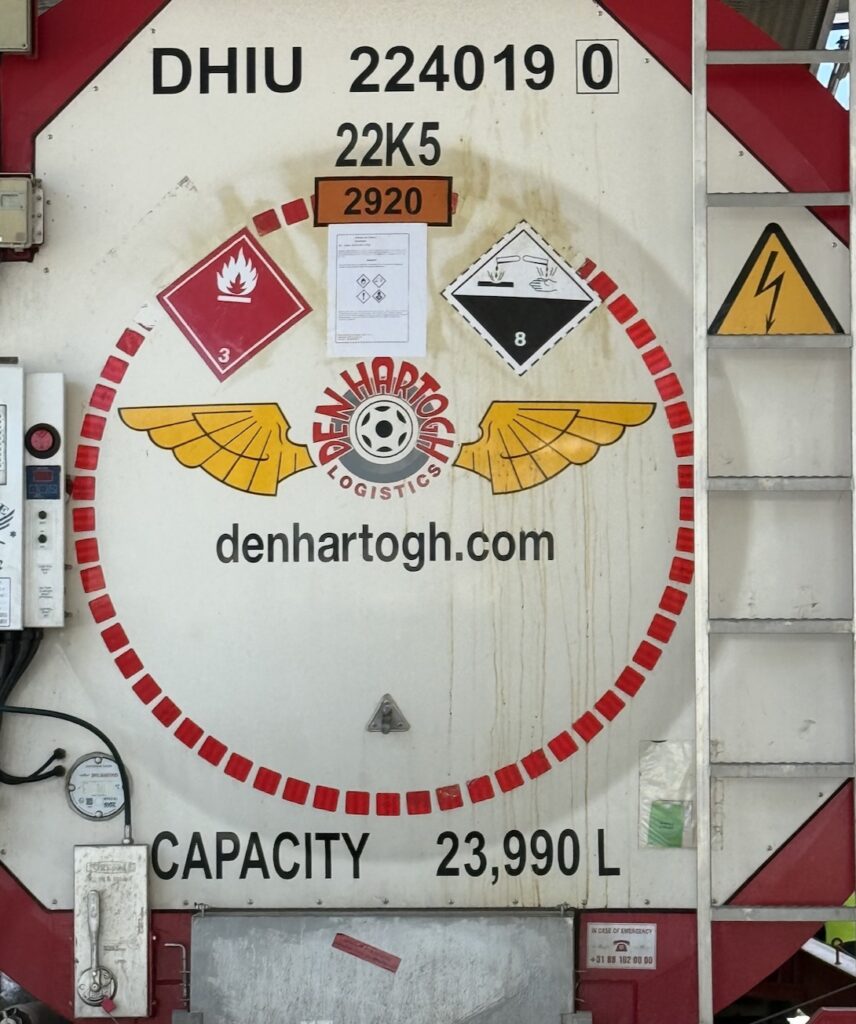
The HCS 2012, paragraph (c), defines pictogram as “a composition that may include a symbol plus other graphic elements, such as a border, background pattern, or color, that is intended to convey specific information about the hazards of a chemical.” The DOT requires diamond-shaped placards (labels) containing hazard symbols for the transport of chemicals. Therefore, because DOT labels contain symbols, they are considered pictograms under HCS 2012.
During transportation, the DOT label requirements take precedence over the requirements of HCS 2012, as indicated in (f)(5). Appendix C, C.2.3.3, of the standard states:
“Where a pictogram required by the Department of Transportation under Title 49 of the Code of Federal Regulations appears on a shipped container, the pictogram specified in C.4 for the same hazard shall not appear.”
However, since OSHA proposed the modification to the HCS, DOT has updated its regulation to state that GHS pictograms would NOT be in conflict with a DOT label. Therefore, OSHA intends to revise Appendix C, C.2.3.3 of the standard, and in the interim, OSHA will allow labels to contain both DOT
pictograms (labels as they are referred to by DOT) and the HCS pictograms for the same hazard.
For example: If a 55-gallon drum container is required to have BOTH DOT and HCS elements, and the chemical’s classification requires the same pictograms under both DOT and OSHA rules, the manufacturer or importer has two (2) options:
1) The manufacturer, importer or distributor may choose to display only the DOT pictogram for the hazard, or;
2) The label may display both pictograms for the hazard.
For hazards where DOT requires no pictograms (e.g., carcinogens), HCS pictograms must appear.
DOT Tanker Truck and Railroad Tank Car Labeling
In situations where a tank truck, rail car, or similar vehicle serves as the container for the hazardous chemical, the labeling information may be posted on the outside of the vehicle or attached to the accompanying shipping papers or bill of lading. A label may not be shipped separately, even before the hazardous chemical is shipped, since doing so would defeat the purpose of providing an immediate hazard warning. Mailing labels directly to purchasers bypasses employees who handle the hazardous chemical during transport. (Note the exemption in (f)(4)(i) for solid metals, plastic items, shipments of whole grain, and solid wood (i.e., untreated lumber)).
If a tanker truck or railroad tank car that is labeled in accordance with the DOT labeling requirements arrives at a facility and is offloaded into a storage tank, without storage of the tanker truck or railroad car, the DOT labeling would be sufficient on the tanker truck or railroad car.
If the tanker truck or railroad tank car is stored (wheels chocked and cab/engine disconnected from the tanker/rail car) prior to offloading, the requirements of HCS apply and the labels must comply with (f)(7). (OSHA is allowing this to be labeled as a stationary process container).
If the tanker truck or railroad tank car becomes part of the process (e.g., hooked up to the piping system, used as a process container), it must be labeled in accordance with paragraph (f)(7). OSHA is allowing this to be labeled as a stationary process container.
If the tanker truck or railroad tank car is used as a transport container in-house (e.g., internal railroad car system), (f)(7) does not apply and the container must be labeled in compliance with the workplace labeling rules in (f)(6)(i) or (ii), as the container is no longer stationary.