
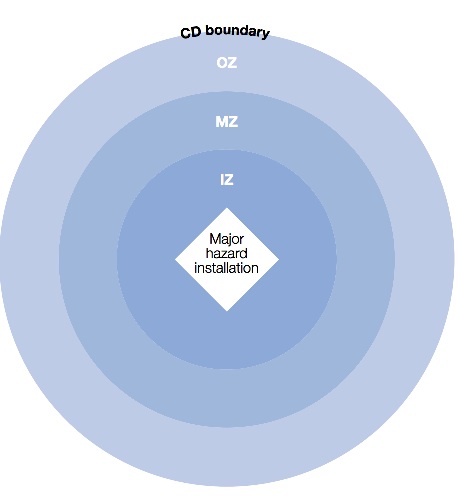
 With the recent catstrophe/tragedy in West, TX the politicians have been none stop in calling for more regulations to stop another such accident. I have become senical in my aging process and have just about come to the conclusion that NO LAW can fully prevent another such tragedy; especially one written by lawyers in Washington, DC! But the one common question that is being asked is “How did so many homes, schools, and care facilities come to be built in such close proximity to such a facility”? It is a great question and the answer to which will play a major contributing factor in this accident. But we are not the first nation to be faced with this question and our friends “across the pond” have already paved a path for us to follow… if we are so bold to as actually take action to protect communities. In the U.K. they call it “Land Use Planning” (LUP) and they even have software that community leaders can use to examine the risk of allowing a “high risk industry” into a community or allowing a community to develop in the shadow of a high risk facilty. They call this PADHI (planning advice for developments near hazardous installations) and it is the name given to the methodology and software decision support tool developed and used in HSE. It is used to give land use planning (LUP) advice on proposed developments near hazardous installations. During 2006/07, the software decision-support tool, known as PADHI+, was provided to planning authorities (PAs) to enable them to consult HSE for advice online.
PADHI uses two inputs to a decision matrix to generate the response:
- the zone in which the development is located of the three zones (that make up the CD) that HSE sets around the major hazard (see paragraphs 26–31);
- the ‘sensitivity level’ of the proposed development which is derived from an HSE categorisation system of ‘development types’ (see ‘Development type tables’).
The matrix will generate either an Advise Against or Don’t Advise Against response. When consulting HSE using PADHI+, the PA should produce a letter which confirms HSE’s advice.
Additionally there is guidance in the form of ‘rules’ on how to deal with the more complex cases where:
- the development is located in more than one zone;
- more than one major hazard is involved;
- the proposal is for more than one development type (using HSE’s categorisation method); or
- the development involves a small extension to an existing facility.
PADHI can be used to obtain HSE’s advice on Pre-Planning Enquiries (PPEs) in a similar way as formal consultations on planning applications, provided sufficient information is available. Any decision on a PPE will be conditional on the assessment of the formal planning application which will be made using the information that is appropriate and relevant when HSE is consulted by the PA, through PADHI+. Using this guide could be regarded as doing your own PPE.
CLICK HERE for more on the UK’s HSE Land Use Planning (LUP).