
A study of equipment failures in the process industries indicates human and organizational errors are the major cause. One in five accidents caused by equipment failures in the chemical process industries is the result of human and organizational errors. Significant factors in equipment failures included:
- Poor contractor control
- Failure to follow procedures
- Lack of planning
- Poor management and supervision; and
- Simple misjudgments
The study also identified the equipment most likely to fail and cause accidents.
- Piping systems (25%),
- Reactors (14%),
- Storage tanks (14%),
- Process vessels (10%) and
- Heat transfer equipment (8%)
accounted for over two-thirds of accidents caused by equipment failures.
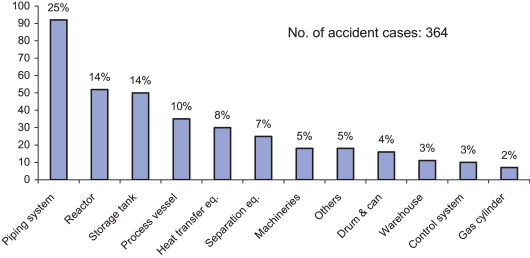
The study, a joint research project by Aalto University in Finland and Universiti Teknologi Malaysia1, looked in detail at 549 accidents reported by the Japanese Failure Knowledge Database in 2011. In total, two-thirds of these involved the chemical process industries, of which 284 cases involved equipment failures.
The study revealed that about 78% of equipment failures in the Chemical Process Industry (CPI) are technically oriented, including design and human/technical interface errors. The most frequent equipment involved in accidents is piping 25%, because of its large number and complexity. The second is reactors, which account for 14% of the total because of their generally risky nature. The results of the proportions of equipment that were in accident-causing are in agreement with the earlier average data. The study showed that single variables are capable of causing reactor accidents in over 50% of cases, while in piping systems there are typically 2.5 accident contributors.
The accident data was further analyzed for accident contributors.
15 common accident contributors were detected, 13 of which are technical categories. The study showed that on average human and organizational accident causes are the largest category (20%), contamination was second (12%), followed by heat transfer (12%), flow (11%), reaction (9%) and layout (7%) oriented contributors.
Further study revealed which accident contributors are most typical for each equipment type: human and organizational reasons are the most common accident contributors for storage tanks, piping, and heat transfer equipment. For reactors, the common contributors are heat transfer and reaction-related problems, and for process vessels, contamination. The contributors were also analyzed in detail for each equipment type.
In main contributor analysis, the main cause of the accident was analyzed. The most frequent main contributors in equipment accidents are human and organizational issues (16%), contamination (14%), flow related aspects (13%), heat transfer (12%) and layout (11%). These six correspond 2/3 of all main contributors. It can be seen that the share of human and organizational main contributors is less than in the sub-contributors list. Also there are few reaction related main contributors.
The accident data was further analyzed to estimate the risk from each accident contributor to cause an equipment accident. For this purpose the “share as main contributor” (SMC) of contributors was studies. The SMC of accident contributor tells how often it acts as a main contributor compared to its overall presence as a contributor. Those accident contributors that act most frequently as main contributors should be focused, especially if they have a high SMC. The largest SMC are poor layout (70%) and fabrication/construction/installation (63%), where the average SMC of all contributors is 46%. It can be noticed that the human and organizational contributors have a low SMC (38%) but the occurrence frequency is the highest.
Also the SMC’s of accident contributors for each equipment type were analyzed and presented vs. contributor frequency in a four-quadrant analysis figure, which aims to point out the risky contributors for each equipment type. The risky contributors are those, which tend to be frequent and in addition have a high SMC. For piping system accidents the most critical accident contributors are the layout, fabrication/construction/installation and construction material. Unwanted reactions are the dominating the reactor failures. For storage tank, the main issue is the flow-related problems and also human and organizational errors, because of very high frequency. For pressure vessel and separator failures contamination is the most risky contributor responsible while corrosion is an important cause of heat transfer equipment failures.
In general reactor can be considered relatively the most risky equipment, it has relatively few accident contributors but they SMC are high. This means that a single contributor is capable of causing an accident alone. As an opposite piping has a low SMC meaning there are typically several contributors to an accident. On the other hand there are a high number of piping failures.
An interconnection study between the accident main and sub-contributors was done to analyze which main and sub-contributors go together. For certain pairs large interdependency was found. For example, in storage tank accidents, the flow-related main contributor goes 83% together with human and organizational sub-contributors.
The interconnection of accident contributors provides an early sign of process accidents, especially for the low SMC of equipment (i.e., the other than reactors, which often have only one accident contributor). The combined effects of contributors at the same time worsen the equipment condition and shorten the equipment life that directly increases the risk of equipment caused accidents.
Results also point out that the contribution of technical aspects to accidents is very significant. Most technical contributors are directly related to design and some to installation. In this study the design errors and faults in operator–technical interface were included in technical categories. Only the operation-related human and organizational causes and external reasons were out of technical categories. The share of non-technical is 22% of all contributors and 17% of main contributors. Hence, accident prevention through design changes is a very effective way to eliminate risks.
CLICK HERE (pdf) for this study.