
The AT&T Standard Section 620-140-501 (often referred to as Bell System Practice, or BSP, 620-140-501), published in June 1976, is a foundational safety document for the telecommunications industry. It outlines the strict procedures for testing, purging, and ventilating manholes and other confined spaces before and during employee entry. Because telecommunications workers frequently operate in underground manholes that could harbor toxic gases, combustible atmospheres, or dangerous dust, AT&T developed this comprehensive standard to prevent injuries and fatalities.
Here is a breakdown of the standard’s primary guidelines and its lasting impact:
1. The “7.5 Air Exchanges” Purge Rule
The most famous component of this standard is its Purge Time Chart, which is still widely used and cited in industrial safety today.
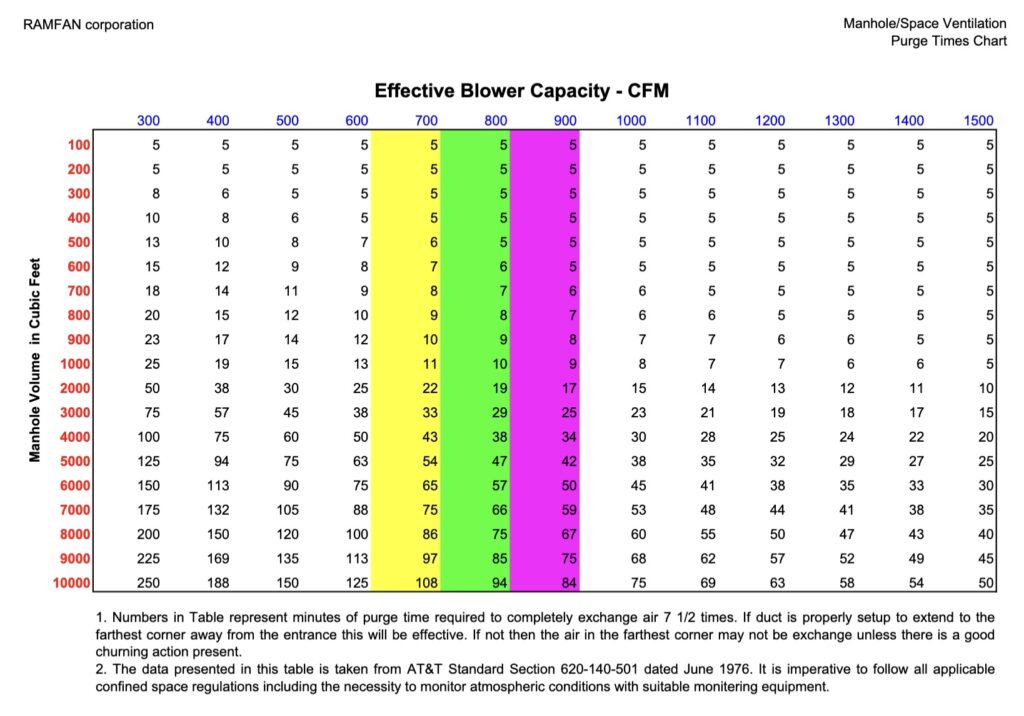
- The Formula: The standard dictates that a manhole’s atmosphere must be completely exchanged 7.5 times before it is safe to enter.
- The Chart: It provides tables cross-referencing the volume of the confined space (in cubic feet) with the effective capacity of the ventilation blower (in Cubic Feet per Minute, or CFM). This gives workers the exact number of minutes they must run the blower before descending into the manhole.
2. Proper Equipment Placement
The practice emphasizes that pumping air into a space is only effective if the equipment is positioned correctly:
- Duct Placement: The ventilation duct must be extended to the farthest corner away from the manhole entrance to ensure a “churning action” that completely exchanges the air. If placed incorrectly, dead zones of toxic air can remain.
- Intake Position: The blower intake above ground must be positioned away from vehicle traffic and generator exhausts to prevent pumping carbon monoxide down to the workers.
3. Lead Dust Mitigation
In 1976, much of the underground telecommunications infrastructure still relied on older lead-sheathed cables. The standard addresses the severe health hazards of airborne lead dust.
- Hovering the Hose: The standard warns against placing the blower hose too close to the manhole floor in dry conditions, as the forced air would stir up accumulated toxic lead dust.
- Repurging After Pulls: Because physically pulling and removing old cables scuffs off lead particles, the standard requires that workers exit the space after a cable pull and repurge the manhole for an additional 10 minutes before re-entering.
Though published in 1976, Section 620-140-501 was so thoroughly researched that it essentially became the blueprint for modern confined-space ventilation code in the telecom industry.
Many contemporary occupational safety regulations still defer to it. For example, specific state-level OSHA standards (such as the Virginia Confined Space Standard for the Telecommunications Industry) explicitly state that if a work crew utilizes continuous mechanical ventilation conforming to the 1976 Bell System Practice 620-140-501, continuous monitoring for oxygen concentrations in that confined space is not legally required.