
NIOSH has released its Fire Fighter Fatality Investigation report regarding the Maine Lumber Mill COM DUST explosion. Lots of learnings in this report.
Fire origin and explosion cause
The State Fire Marshal’s Office and Bureau of Alcohol, Tobacco, Firearms and Explosives (ATF) cause-and-origin preliminary investigation classified the fire as accidental. It indicated that the area of origin was the unloader mechanism at the base of the incident silo. It also determined the facility’s fire suppression system in the top of the silo headspace did not activate because temperatures at that elevation did not reach the activation threshold after the fire originated at the base of the silo. The preliminary investigation identified the subsequent explosion cause as combustible dust.
KEY POINTS
- Two volunteer firefighters died following an explosion of an oxygen- limiting silo that occurred on May 15, 2026.
- The explosion critically injured eleven volunteer firefighters and two EMS providers.
- Facility employees and firefighters were unaware that the silo was oxygen-limiting or that its contents were a combustible dust hazard.
- Over the past 40 years, NIOSH investigated several incidents where firefighters directing water into an oxygen-limiting silo unintentionally caused explosions.
- SUMMARY
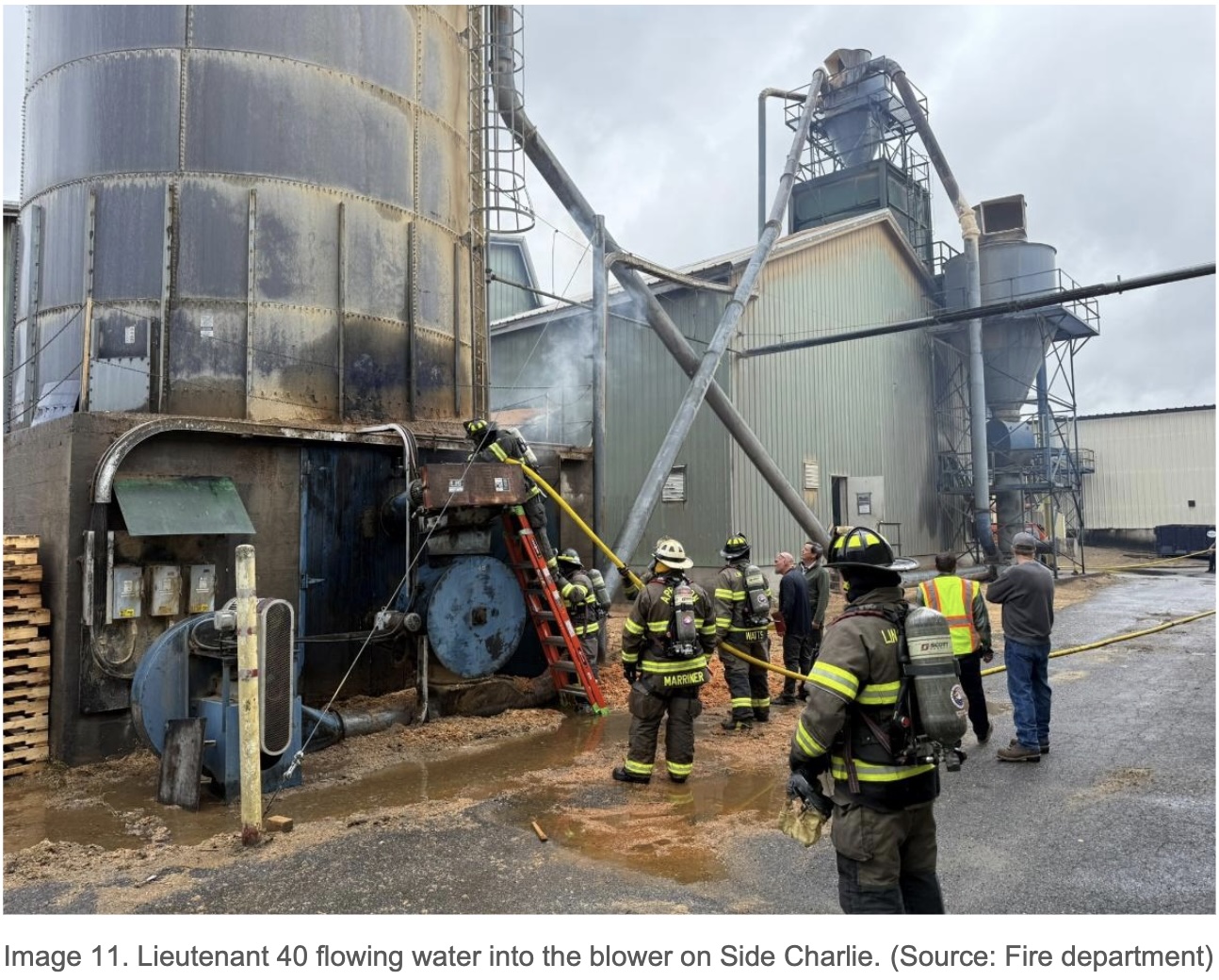
The facility automatic notification system reported a fire in the silo with employees subsequently finding smoke conditions. When the fire department arrived, they deployed a hoseline and directed water into an opening at the silo’s base. Facility owners and employees remained at the silo to answer questions to assist firefighters. After some time, firefighters believed the fire was largely under control. Without any warning, the silo launched into the air followed by a large plume of fire at the bottom as it rose. The explosion threw surrounding facility employees, firefighters, and EMS providers away in a blast of pressure and fire. Approximately two hours after the explosion, a personnel accountability check found that one firefighter was missing and later declared deceased. Another firefighter died four weeks later as a result of injuries sustained at the incident. See Table 1 for contributing factors and prevention actions.
Contributing factors and prevention actions
- Combustible dust explosion – Train fire officers and firefighters on the hazards associated with different types of silos, including any unique hazards posed by silo contents.
- Fire suppression tactics for silo fires – Ensure firefighters choose the appropriate firefighting tactics for silo fires and never direct water or foam into an oxygen-limiting silo.
- Incident command – Establish and maintain unified command with high-hazard occupancy representatives throughout the incident.
- Personnel accountability system – Use a personnel accountability system to identify the location and function of all operating personnel.
- Fire department pre-incident planning – Develop a pre-incident plan for all high-hazard occupancies, such as lumber mills.
- Lumber mill emergency planning – Ensure fire safety and evacuation plans include information on combustible dust explosion hazards and share this information with responding fire departments.
- Combustible dust explosion mitigation and prevention – Properly operate and maintain silos and implement the applicable requirements of NFPA 660, Standard for Combustible Dusts and Particulate Solids.
- Hazard identification – Update relevant codes and standards to require hazard labeling for bulk storage enclosures containing combustible dust.
The fire departments in this incident responded to several silo fires at the lumber mill over the past 20 years. All of these fires occurred in the silo at bagger #1, a conventional silo. At the incident, firefighters employed similar tactics of flowing water into the oxygen-limiting silo as these efforts worked previously at the conventional silo. NIOSH investigators obtained the manufacturer’s published silo emergency procedures. Under fire department instructions, the document states “DANGER: Do not fight fire by adding water or foam to the structure.” The document warns against spraying water or foam into the oxygen-limiting silo as it will force air in and may create a potentially explosive mixture [Harvestore 1993]. The application of water into the silo in this incident likely entrained oxygen into the silo headspace, stirred up dust within the contents, and caused it to become suspended in an explosive concentration.
CLICK HERE for the full report