
As elevation increases, atmospheric pressure decreases, which means flammable liquids can “flash off” at lower temperatures. I always use the “Mile High Stadium” example in my training courses to explain this principle as it relates to Boiling Points and Flash Points. But NFPA explains it like this…
C.4 Effect of Ambient Pressure.
C.4.1 The vapor pressure above a liquid depends only on the temperature at the surface and the time necessary to reach equilibrium. The fraction of the total pressure exerted by a vapor determines the composition of the vapor–air mixture. Thus, where the total pressure is reduced, as could be the case at high altitudes, the vapor concentration in air increases.
C.4.2 Because flash points are reported at a pressure of 1 atm [101.3 kPa (760 mm Hg)], an ambient pressure less than that value lowers the actual effective flash point. The flash point correction given in ASTM E502, Standard Test Method for Selection and Use of ASTM Standards for the Determination of Flash Point of Chemicals by Closed Cup Methods, is expressed as follows:
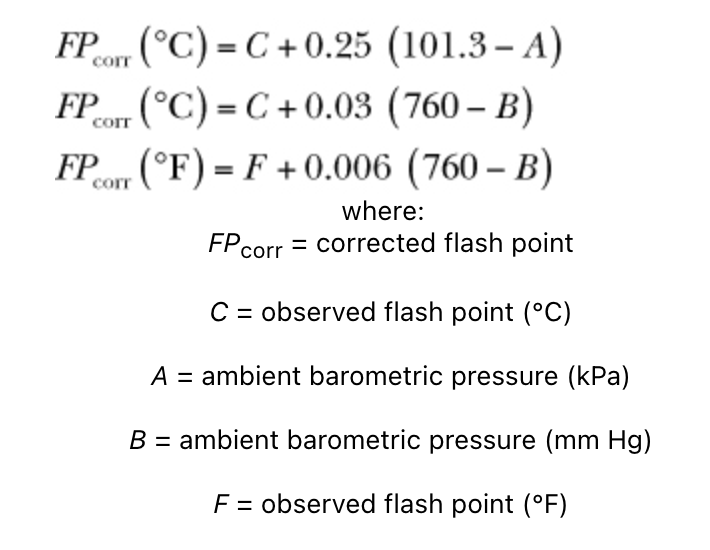
Here is my worked example using Toluene:
At Empower Field at Mile High, the elevation is 5,280 ft, and standard atmospheric pressure is about 12.1 psia, versus 14.7 psia at sea level. Using the FP of 42°F sea-level flash point as the reference:
| Location | Atmospheric pressure | Toluene flash point |
|---|---|---|
| Sea level | 14.7 psia | 42°F |
| Mile High Stadium | ~12.1 psia | ≈36.4°F |
So, about 36°F is the calculated flash point at Mile High Stadium — roughly 5.6°F lower than at sea level.