Last week I wrote a posting about LOTO and got a lot of e-mails regarding the tone of my postings. To make my point, this week’s “photo of the week” is taken from an on-line training program for LOTO. Look very closely at this photo and post the OSHA violations you see. There are TWO (2) that are visible without having to ask anyone any questions.
What is really scary is this website is an “attempt” to train teens who may find themselves working in a “wood shop”. I certainly admire the intent in training our youth in safety practices; however, training them IMPROPERLY will leave a bad and lasting impression in their minds for safety professionals like me will spend months/years correcting. CLICK HERE to review this on-line LOTO Training and see how many deficiencies you can find…
Just another example of BEING CAREFUL with who is hired or how safety training is conducted.
see more examples of incorrect application of LOTO found in on-line training program or programs that have been submitted to SAFTENG and rejected.
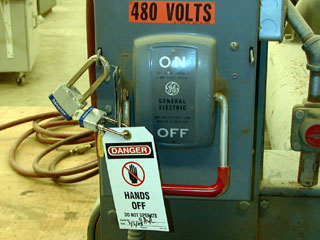
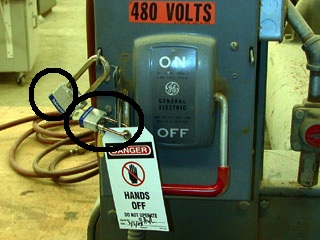
Here are the two OSHA violations that jump out at me: (see photo below)
- Key left in actual LOTO lock.
- The LOTO lock and the lock used to lock the electrical box closed are the color lock. Granted the facility may have decided to use “size” as their means to identify their LOTO locks, but this photo can show you how using “size” as the means to identify LOTO locks can be confusing.
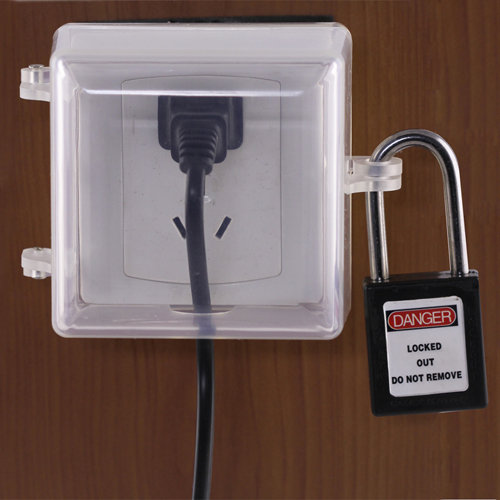
This one I think someone got ahead of themselves and forgot to do the most CRITICAL STEP… unplug the plug from the power source! When I get the argument that the black LOTO lock was used to “lock” the plug in place then this is a clear violation of…
1910.147(c)(5)(ii) Lockout devices and tagout devices shall be singularly identified; shall be the only devices(s) used for controlling energy; shall not be used for other purposes; and shall meet the following requirements:
Not sure what to make of this next photo! From first glance one may think this is “technically correct” from a “tagout” standpoint; however, look very close at this arrangement and you will see why this looks like it does… answer below

Do you see why this tagout is done this way? First, why all the loops of the plastic tie wraps? Answer: the tag is left hanging on the conduit so that one is ALWAYS available for “tagout”. Notice there is NO WRITING on the tag; no name of who applied the tag or why. ALL the plastic wire loops are used so that the user has enough slack to manipulate the tag into position from its normal hanging position. Now the biggest issue that I had with this is, look very closely to how the tag is “fastened” to the disconnect handle. In the photo you see the plastic tie wrap going into the handle; however, do you see it coming out? Nope, thats because the tag is held in place using the “tail” of one of the plastic tie wrap loops. The users of the tag just stuck the tab into the hole when they wanted to “tag out” the disconnect. So to be clear, the attachment of the tag does not meet…
1910.147(c)(5)(ii)(C)(2) Tagout devices. Tagout devices, including their means of attachment, shall be substantial enough to prevent inadvertent or accidental removal. Tagout device attachment means shall be of a non-reusable type, attachable by hand, self-locking, and non-releasable with a minimum unlocking strength of no less than 50 pounds and having the general design and basic characteristics of being at least equivalent to a one-piece, all environment-tolerant nylon cable tie.