
I want to try an clarify a couple of misconceptions that I and others may have implied over the past year. Each time I do a HAZCOM session I get asked the same questions, not from the workers, but from the EHS/Management personnel overseeing the facility’s HAZCOM program. In this post I try and answer these same questions in a very direct, clear and concise manner. If you have further questions or wish to add something to this discussion, PLEASE feel free to post your questions/comments in the comments section below this post and I will do my best to answer/respond in a timely fashion.
1) There has been NO change to either NFPA’s 704 or the HMIS labeling systems. These labeling systems will CONTINUE to be a VIABLE OPTION for an employer’s IN-HOUSE LABELING of secondary containers containing hazardous chemicals. These labeling systems will CONTINUE to use their Numbering System of 4 = MOST HAZARDOUS and 1 = LEAST HAZARDOUS.
2) OSHA’s new GHS Labels, which we all trained on in 2013, are for chemical manufacturers, importers, and/or distributors to use on the containers they are then sending to us. Those of you that are merely managing a HAZCOM program at a facility that is NEITHER a chemical manufacturer, importer, or distributor will have NO IMPACT on your current in-house labeling systems. And for the record, just because you buy chemicals and bring them into your workplace does NOT make you an “importer”. PLEASE see the definition of “importer” in 1910.1200(c). It states:
Importer means the first business with employees within the Customs Territory of the United States which receives hazardous chemicals produced in other countries for the purpose of supplying them to distributors or employers within the United States.
3) As a facility that is NEITHER a chemical manufacturer, importer, and/or distributor you will in most all likelihood NOT be applying the new GHS labels that contain the pictograms, signal words, hazard and precautionary statements, etc. to your secondary containers. This new GHS label is REQUIRED for the chemical manufacturers, importers, and/or distributors to use and is NOT necessarily intended for our SECONDARY container labels used at a facility. We can AND SHOULD (my opinion) continue to use the NFPA 704 and/or HMIS labeling system(s) for our secondary containers. However, if a facility wishes to begin using the new GHS Labels on their secondary containers they may do so – BUT IT IS NOT REQUIRED. This decision would also be MASSIVELY EXPENSIVE and TIME CONSUMING.
4) I have found it EASIER and MUCH LESS CONFUSING to NOT even mention that the numbering schemes in GHS and NFPA/HMIS are flip flopped when training workers; as in reality this means NOTHING to the worker using the in-house labeling systems (e.g. NFPA or HMIS). The GHS Hazard Categories are ENTIRELY DIFFERENT from the NFPA and HMIS warning systems. For example, an employee may see on a new label (or on its SDS) that the material is a “Category 1 Flammable” material. This means something ENTIRELY different than what an NFPA or HMIS label would depict. In this example, the “Category 1 Flammable” material is in fact the HIGHEST DEGREE of hazard for flammable material in the GHS Hazard Cetegories, and as such the NFPA or HMIS Label will CONTINUE to depict this degree of hazard by placing a “4” in the flammable (RED) section of these labels. As safety professionals, this is CRITICAL that we understand this and based on how our HAZCOM program is structured, certain employees MUST understand this as well. We can NOT simply take the GHS “Hazard Category” number and transpose it onto the NFPA/HMIS labels. This seems to be where most of the confusion is at… A “Category 1 Flammable Liquid” will in fact be labeled with a “4” in the red section of a NFPA or HMIS label.
5) Although not a change from the previous labeling requirements, I wish to remind everyone that merely placing a NFPA or HMIS label on a container by itself is NOT compliant (and never has been). We MUST have a “product identifier” as well as “words, pictures, symbols” (i.e. NFPA or HMIS labels) on the container.
6) Our bulk storage tanks would also be considered “in-house labels” and would also be PROPERLY labeled with an NFPA or HMIS label ALONG WITH the chemical name (or some other product identifier). We are NOT required to label our bulk tanks with the new GHS label containing pictograms and such.
So let me close by providing a real-life example of how our HAZCOM program, in regards to in-house labeling under 1910.1200(f)(6), will be impacted under this revised standard:
A truck delivers a pallet of four (4) 55-gallon drums of Ethanol. These four drums arrive with the new GHS label that contains the pictograms, signal word, hazard and precautionary statements, etc. The employee who handles these drums at the loading dock, as well as those who come in contact with these drums as they move throughout their journey to their point of use, MUST understand the NEW GHS labels. This means they need to know the nine (9) pictograms, the difference between signal words DANGER and WARNING, etc. When it comes time for an employee to transfer the ethanol from one of these labeled ethanol drums into a secondary container for use in the workplace, this employee MUST label this secondary container (PLEASE do not get me started on the labeling exception found in 1910.1200(f)(8)!!!!). This employee MAY CONTINUE to use the HMIS or NFPA labeling systems (which have NOT changed). So if you have a secondary container that is PRE-PRINTED with the Ethanol NFPA Label AND the word “Ethanol” is on the secondary container then this container AND its pre-printed label is STILL compliant. Here is an example:
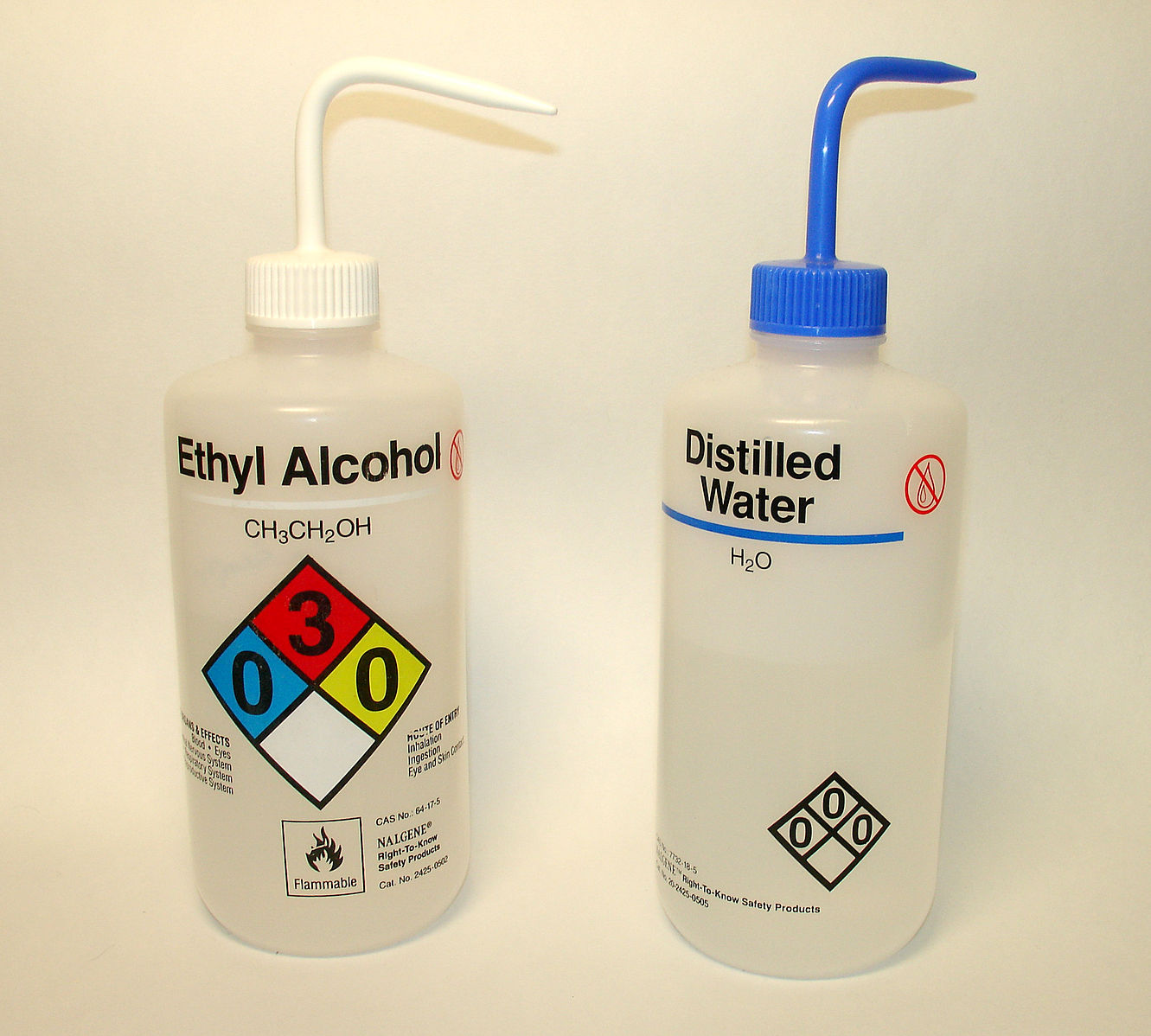
Where we may run into some issues is when the employee has a blank container and when that employee goes to transfer that material into this blank secondary container he/she may have some difficulty in determining the proper “numbers” to place in the NFPA or HMIS label. There is some concern that this employee may CONFUSE the GHS “Hazard Category” numbering scheme, which goes from 1 to 4, with the NFPA/HMIS Hazard Warning numbering scheme and ERRONEOUSLY TRANSPOSE the GHS “Hazard Categories” (found on the M/SDS or 55-gallon drum) over to the NFPA/HMIS label. So in this regard, depending on how your HAZCOM program is structured; those employees who will be RESPONSIBLE for labeling secondary containers (and for many of us this will be nearly every single employee!) they MUST understand the DIFFERENCE between the GHS “Hazard Category” and the NFPA/HMIS warning systems numbering system(s).
So an employer has a choice…
1) continue using the NFPA/HMIS labeling for thier in-house labeing system AND ensure that those employees who will be responsible for labeling these in-house secondary containers FULLY UNDERSTAND that the GHS “Hazard Categories” are NOT the numbers to be used in the NFPA or HMIS labels.
2) begin to use the new GHS Label on ALL containers, including those secondary containers used in the workplace.
Either way, we MUST UPDATE our written HAZCOM program to reflect this in-house labeling system(s). So far I have seen the NFPA/HMIS numbers being provided on the new SDS so in most situations the employee(s) will be able to get the correct numbers for the NFPA/HMIS labels; however, when these numbers are NOT provided on the new GHS Label or the new SDS, use of the NFPA/HMIS labels may become difficult.