
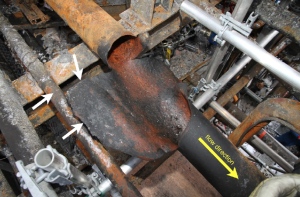
 This is another lesson’s learned regarding piping and its mechanical integrity. On October 6, 2011, an explosion and subsequent fire occurred in the Middle Distillate Unifiner (MDU) area at a Canadian refinery and injured 52 workers. This third party analysis of the piping involved and its failure mode paint an ugly picture of how improper MI management can lead one to misunderstand the true condition of their piping. The incident also points out that changes to processing conditions can have a long-term impact on the MI of piping (and vessels as well). In this case, a change in process conditions created more water vapor in the pipe that failed and this factor lead to increased corrosion rates; however, the refinery did not recognize this and therefore did NOT increase their inspection/testing frequencies on the piping. EVERYONE who participates in process safety should take the time to read this report and ask the question… “Could this happen here?” Here are the report summary and link to the full report…
A preliminary examination of the fire scene identified ruptures in five (5) separate piping segments containing the flammable product. Visual and metallurgical examination of these five (5) ruptures, along with a review of process data, concluded that the initial rupture was the 6″ Reactor Effluent Line 07-P008-FA5M-6. The remaining four (4) ruptures occurred as a result of exposure to fire. The 6″ Reactor Effluent Line contained partially refined diesel fuel, hydrogen gas, and hydrogen sulfide gas. Hydrogen gas, having a particularly low ignition energy, was most likely the first fuel ignited. Ignition was likely due to the release of an electrostatic build up from product flowing out of the ruptured. The 6 inch Reactor Effluent Line ruptured due to uniform wall thinning from corrosion along the upper half of the pipe. The primary corrosion mechanism likely involved ammonium chloride, ammonium bisulfide, and hydrochloric acid. A non-annular product flow also contributed to this failure. Pipe wall thinning was substantial enough in the ruptured pipe joint that the failure occurred under normal operating conditions with no indication in the process data of a pressure or temperature upset. All of the older 6-inch Reactor Effluent Line pipe that was examined by Anderson Associates Consulting Engineers exhibited similar corrosion patterns with wall thicknesses below CCRL’s retirement thickness. The individual pipe joint in the 6 inch Reactor Effluent Line containing the rupture was substantially thinner than all the others. Our examination confirmed that this pipe joint met all mechanical and chemical requirements for ASTM A53 Grade A pipe. In summary, significant metallurgical differences noted between this ruptured joint and adjacent pipe joints; therefore material properties did not cause or contribute to this substantial pipe wall thinning. It is also not likely that this preferential wall thinning was simply due to a substitution of the wrong pipe such as schedule 40 in place of the correct schedule 80. If this has occurred we would not have noted measured wall thickness greater than nominal schedule 40.
In summary, it was clear from our examination that there was no good reason for the preferential wall thinning in the ruptured pipe joint, aside from it being substantially older than the pipe on either side. As CCRL did not begin maintaining complete records until the late 1980s, this could not be confirmed. A refinery wall thickness inspection identified very high corrosion rates at the cooler end of the 6 inch Reactor Effluent Line between 2008 and 2010. Corrosion rates were high enough during this time that a portion of Reactor Effluent piping, downstream of the rupture needed replacement. This increased corrosion rate occurred because of process changes after 2008. These process changes caused conditions to favor water vapor condensation in the pipe on a more frequent basis. The formation of liquid water in the Reactor Effluent Line lead to concentrated corrosive droplets, particularly when the product flow pattern was stratified or stratified wavy.
Upon discovering these high corrosion rates near the cooler end of the 6 inch Reactor Effluent Line, no additional thickness measurements were taken to confirm the extent of corrosion. Additionally, no root cause or corrosion analysis was conducted on any of the piping that was removed and replaced. Our inspection of the replaced pipe sections revealed that very high corrosion rates were still present after 2010, indicating the refinery made no modifications to the process to reduce corrosion rates. The refinery did not have a formalized inspection procedure for the 6-inch Reactor Effluent Line. There are, however, no requirements for a formal pipe inspection procedure under local jurisdiction. Industry practice is general to follow American Petroleum Industry (API) recommendations, which the refinery appeared to be doing informally. However, the current informal inspection procedure did not predict this catastrophic failure, nor the corrosion below retirement thickness in all of the retrieved Reactor Effluent Line pipe. This suggests a review of the current inspection procedure is required.