
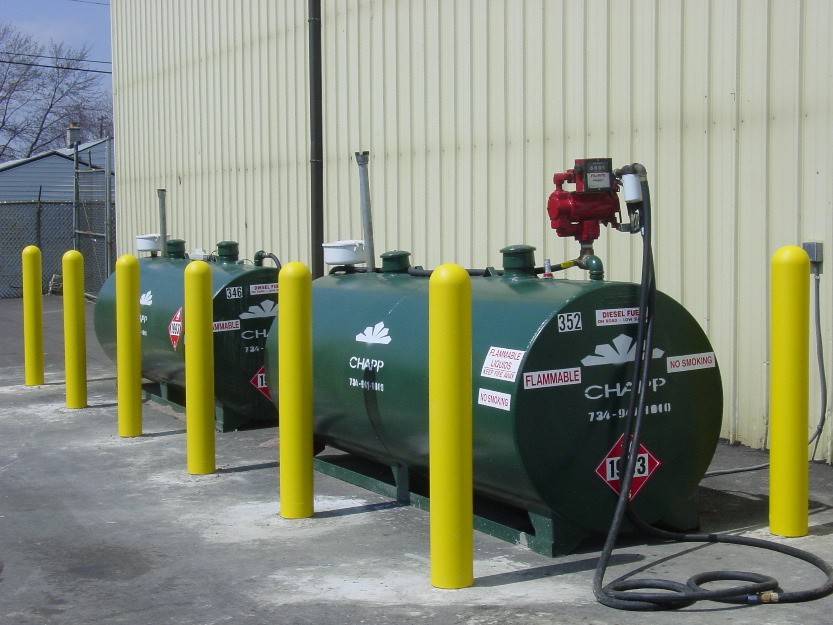
 Most everyone has seen a bollard; they may not have realized what they were seeing at the time, but most have seen one. But this group of people who have seen one grows much smaller when we begin to ask “what makes a bollard a safety device?” A couple of years ago I shared an engineering standard for bollards and vehicle protection. That page has been viewed more than 200,000 times since 2012, so there must be some level of interest in these safety devices. I lost count of the number of e-mails I received asking if the post was a “joke”, as who in their right mind would have an engineering design for a post?!?! Well, a well designed, constructed, chemical process that utilizes mobile equipment within their process battery limits… that’s who! Just last year we issued several audit findings for either the lack of or improper design of bollards protecting bulk tanks and other “critical” process equipment. These were PSM audits… so what RAGAGEP did we reference?
The International Fire Code (IFC) Section 312 – “Vehicle Impact Protection”. Yes, I went to the State Fire Codes proverbial well of excellent codes to drive safety improvements within a PSM/RMP covered process. I know it is a far stretch for OSHA or EPA to use these codes as an RAGAGEP, or at least I have never seen or heard of them doing so, but the facility was in a state that had adopted the IFC so the Code did apply to their process which contained flammable liquids. Here is what the IFC says about vehicle impact protection.
312.1 General.
Vehicle impact protection required by this code shall be provided by posts that comply with Section 312.2 or by other approved physical barriers that comply with Section 312.3.
312.2 Posts.
Guard posts shall comply with all of the following requirements:
-
- Constructed of steel not less than 4 inches (102 mm) in diameter and concrete filled.
- Spaced not more than 4 feet (1219 mm) between posts on center.
- Set not less than 3 feet (914 mm) deep in a concrete footing of not less than a 15-inch (381 mm) diameter.
- Set with the top of the posts not less than 3 feet (914 mm) above ground.
- Located not less than 3 feet (914 mm) from the protected object.
312.3 Other barriers. Physical barriers shall be a minimum of 36 inches (914 mm) in height and shall resist a force of 12,000 pounds (53375 N) applied 36 inches (914 mm) above the adjacent ground surface.
SO as we can see “sticking posts in the ground” and saying a prayer that the vehicle would feel the bump and stop, rather than having the assurances that the post(s) would actually PREVENT contact with the process equipment is quite different. We see a lot of bollards in a horizontal position (e.g. pushed over and ineffective) that did not stand a chance against a golf cart much less a tractor-trailer backing into it!
These requirements are very clear:
- concrete filled 4” pipe or larger. NOT a hollow piece of pipe or 3” pipe!
- each post is to be NO MORE THAN 4’ apart on center. This does not mean 4’ from each post, it means that you measure from the center of the bollard(s) and this distance can not exceed 4’.
- set at least 3’ deep in a 15″ diameter hole and fill with concrete. So if the bollard has to be at least 3’ high (above grade), this means a 6’ long, 4” diameter pipe is the MINIMUM size pipe we can use to construct our bollard and comply with the IFC.
- lastly, but the MOST often found deficiency is the 3’ high post MUST be 3’ OUT FROM the equipment it is protecting. And by the way, if someone decides to make their bollards 4’ tall, then the distance from the equipment MUST ALSO be 4’.
Please do not think these devices are intended to stop some wild and crazy people from driving their vehicles into our equipment. Those are SECURITY BARRIERS and those barriers make these bollards requirements look like spaghetti! These bollards are intended to PREVENT UNINTENDED contact with our equipment.
A common question we get asked is
“what about maintenance access”? We need to get a vehicle inside that area from time to time to perform maintenance”. Can we make some of the bollards so that they can be removed?”
The short answer is YES… that is what Section 312.3 “Other barriers” is intended to permit. They allow us to use a different design, as long as that design can “resist a force of 12,000 pounds applied 36 inches (914 mm) above the adjacent ground surface”. This design would require “engineering paperwork” to establish its strength. I would go one step further and ask for some type of administrative control that is in place to permit the removal of the “vehicle barrier” in order to allow a “vehicle” to circumvent said barrier!!! Do we evacuate the portion of the process that is at risk of contact with the approved vehicle? Do we require spotters to be used each time the vehicle is moved? I mean how would we defend our actions sitting across from OSHA or EPA after having a reportable release of our HHC/EHS that was caused by a vehicle that we allowed to bypass the “vehicle barriers”. Trust me, the outcome is not favorable!!!
So we have at least have a starting point for a design basis for our vehicle impact protection systems. But here are a few questions to consider:
- Would we list these as a “safety system” in our PSI? I am willing to bet that these devices are mentioned in just about every facility siting analysis (or we should maybe take another look at our FS analysis!).
- We see them listed in PHA scenarios as a “safeguard”. So does this make these bollards part of our PSM/RMP program?
I think it does, and now we have an engineering design that we can call our Bollard RAGAGEP.
UPDATE on 5/6/15: Some have asked about NFPA’s Bollard Design Spec’s, here they are:
NFPA 55: Compressed Gasses and Cryogenic Fluids Code, 2013 Edition
4.11.1.2 Where guard posts are installed, the posts shall meet the following criteria:
-
-
- They shall be constructed of steel not less than 4 in. (102 mm) in diameter and concrete-filled.
- They shall be spaced not more than 4 ft (1.2 m) between posts on center.
- They shall be set not less than 3 ft (0.9 m) deep in a concrete footing of not less than a 15 in. (381 mm) diameter.
- They shall be set with the top of the posts not less than 3 ft (0.9 m) above ground.
- They shall be located not less than 5 ft (1.5 m) from the tank.
-