
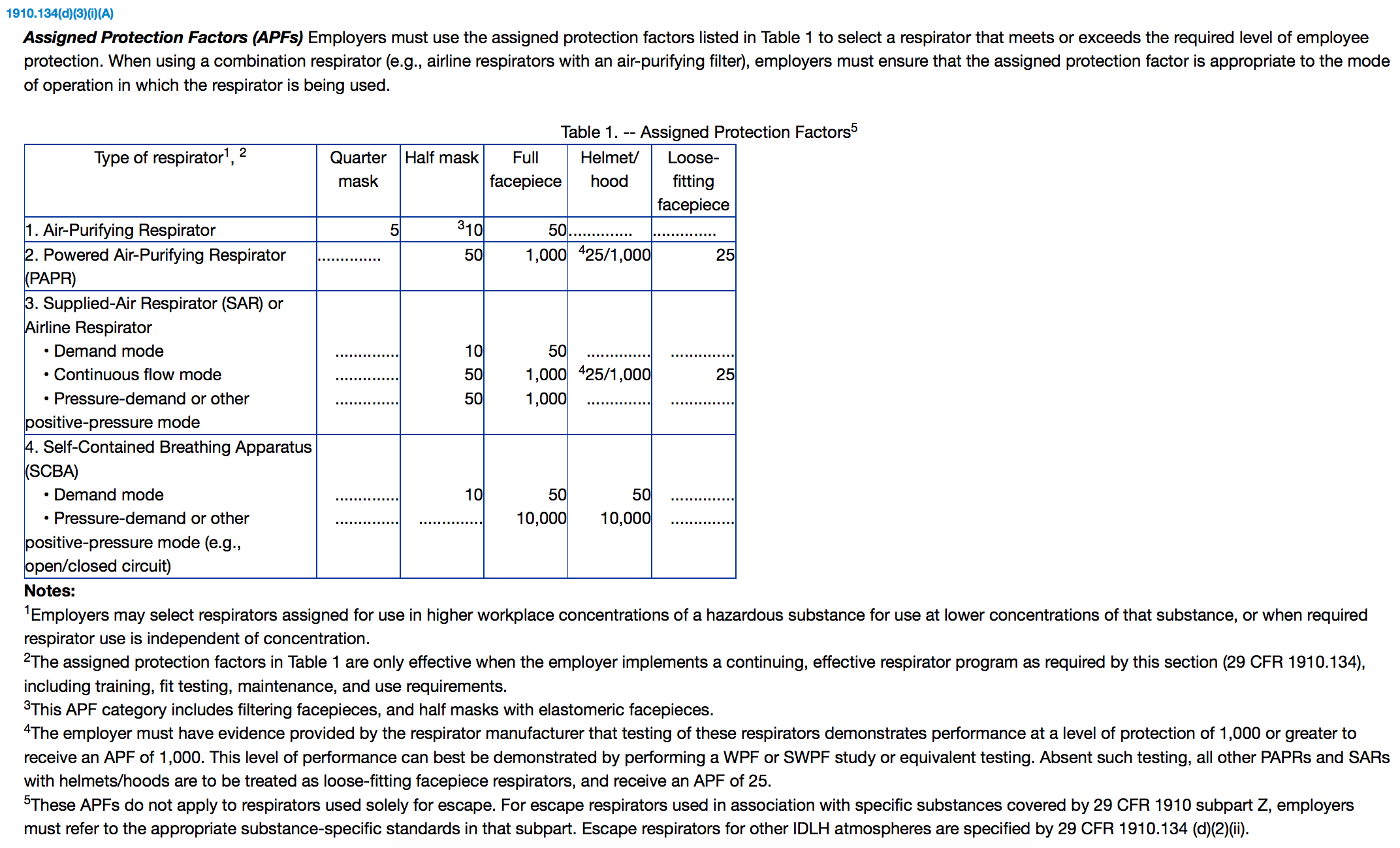
Sounds like a simple question and often the answer is easy when dealing with reputable respirator manufacturers; however, the idea that providing a PAPR to a worker assures a higher protection factor is just wrong. When we look at OSHA’s Assigned Protection Factors (APF) in 1910.134(d)(3)(i)(A) we see Table 1. – Assigned Protection Factors where PAPRs have two (2) APFs “425/1,000” for “Helmet/hood” and a dedicated APF for “loose fitting face piece” of 25. It is footnote #4 in Table 1 that so many look over. Basically OSHA has assigned a protection factor of 25 for PAPR with a “Helmet/hood”, unless…
4The employer must have evidence provided by the respirator manufacturer that testing of these respirators demonstrates performance at a level of protection of 1,000 or greater to receive an APF of 1,000. This level of performance can best be demonstrated by performing a WPF or SWPF study or equivalent testing. Absent such testing, all other PAPRs and SARs with helmets/hoods are to be treated as loose-fitting facepiece respirators, and receive an APF of 25.
How can this impact worker safety?
Most think that a PAPR provides a baseline APF of 1,000 meaning that it is more protective that a Full Face APR. It is a very common practice to provide a PAPR to employees who can not pass a fit test or the employer wants to provide an alternative style respirator so that employees do not have to be clean shaven. Regardless of the reason, when the PAPR has a helmet/hood we MUST assume the PAPR has an assigned protection factor of 25 UNTIL the manufacturer provides us evidence that testing of these PAPR(s) with a helmet/hood demonstrates performance at a level of protection of 1,000 or greater to receive an APF of 1,000.
An assigned protection factor of 25 is HALF that of what a full-face APR provides (e.g. 50). So if we have based our respiratory protection on exposure monitoring data that established the need for a protection factor over 25 and we established a Full Face APR for the task, but we have a couple of employees who choose to use the PAPR helmet/hood instead, we may be establishing a FALSE SENSE of protection against these exposures. In other words, the PAPR with a helmet/hood (or loose-fitting facepiece) MAY NOT be providing the necessary level of protection.
So we can NOT use the APF of 1,000 for a PAPR helmet/hood type respirator UNTIL we have on file the documentation from the manufacturer showing that testing of these PAPR(s) with a helmet/hood demonstrates performance at a level of protection of 1,000 or greater. As for a “loose-fitting facepiece” the APF for the PAPR will ALWAYS be 25, never more.
NOTE: (emphasis by me)
Workplace Protection Factor (WPF) study- a study, conducted under actual conditions of use in the workplace, that measures the protection provided by a properly selected, fit-tested, and functioning respirator, when the respirator is worn correctly and used as part of a comprehensive respiratory program that is in compliance with OSHA’s Respiratory Protection standard at 29CFR 1910.134. Measurements of Co and Ci are obtained only while the respirator is being worn during the performance of normal work tasks (i.e., samples are not collected when the respirator is not being worn). As the degree of protection afforded by the respirator increases, the WPF in-creases.
SimulatedWorkplace Protection Factor (SWPF) study- a study, conducted in a controlled laboratory setting and in which Co and Ci sampling is performed while the respirator user performs a series of set exercises. The laboratory setting is used to control many of the variables found in workplace studies, while the exercises simulate the work activities of respirator users. This type of study is designed to determine the optimum performance of respirators by reducing the impact of sources of variability through the maintenance of tightly controlled study conditions.