
In Part 1 of this series I established how this material is a Category 1 Flammable Gas based on both the manufacturer’s SDS and OSHA’s Hazardous Communications Standard Appendix B. In this article I wish to address how an HFO-1234yf storage tank, which is an ASME pressure vessel, should be labeled, versus how some have been found labeled. This article will apply to BOTH NFPA 704 “Diamonds” and the Hazardous Materials Identification System (HMIS). I have observed incorrectly labeled HFO-1234yf pressure vessels more times than I have seen correctly labeled vessels. I am trying to figure out how this error came about, but my gut tells me we have once again placed too much emphasis on “marketing materials” rather than SDS data and in two cases, the manufacturer actually instructed the business to use the HMIS Flammable “2”. Without question, HFO-1234yf is a Flammable “4” in both the NFPA 704 and the HMIS labels and here’s why…
Let’s first look at NFPA 704, as all the tanks that I have come across, were using the NFPA 704 Diamond (even though the manufacturer cited HMIS labels in their communications).
A couple of quick side notes:
- CLICK HERE for FREE access to NFPA 704.
- Although similar, HMIS and NFPA are NOT compatible labeling systems and EACH carries its own classification system(s).
- I am using NFPA 704, 2012 Edition in my analysis
NFPA 704 states the following…
6.2* Degrees of Hazard. The degrees of flammability hazard shall be ranked according to the susceptibility of materials to burning detailed in Table 6.2.
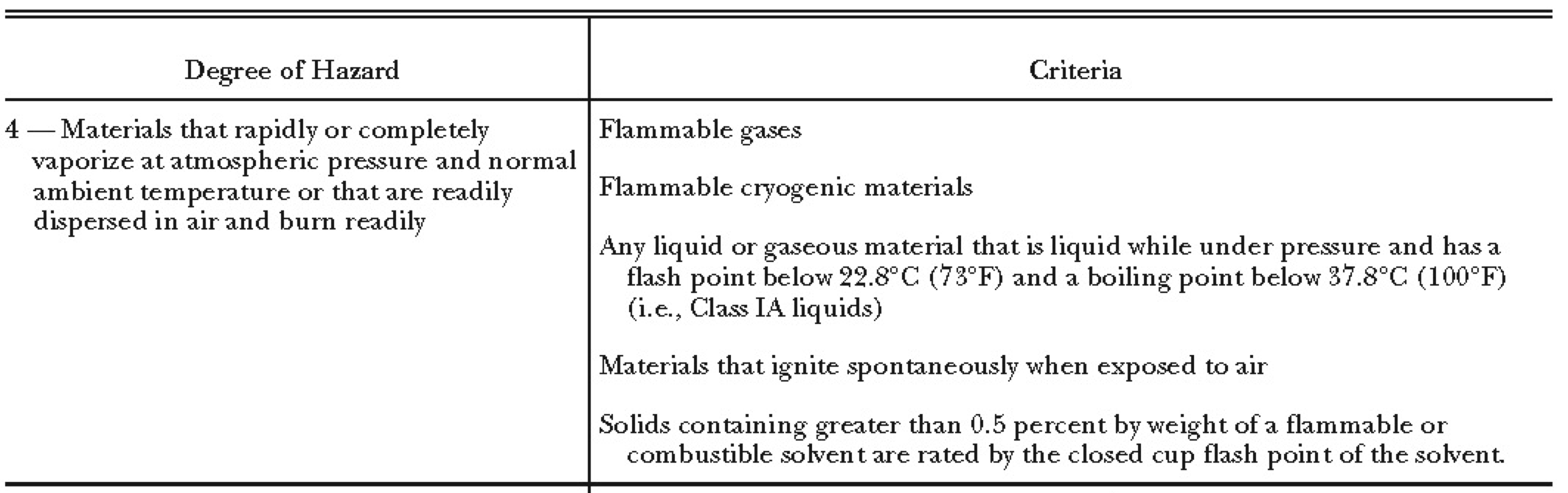
Source: NFPA
So when we look at the SDS from the manufacturer, it is easy to match up the language… “Flammable Gas” (See page 1 of 12).
HFO-1234yf also meets the following:
Any liquid or gaseous material that is liquid while under pressure and has a flash point below 22.8ºC (73ºF) and a boiling point below 37.8ºC (100ºF).
Here is the NFPA rationale for a Flammable “2”. Do any of these characteristics appear on or can we derive any from the manufacturer’s SDS? I say no, but I will let you make your own determination.
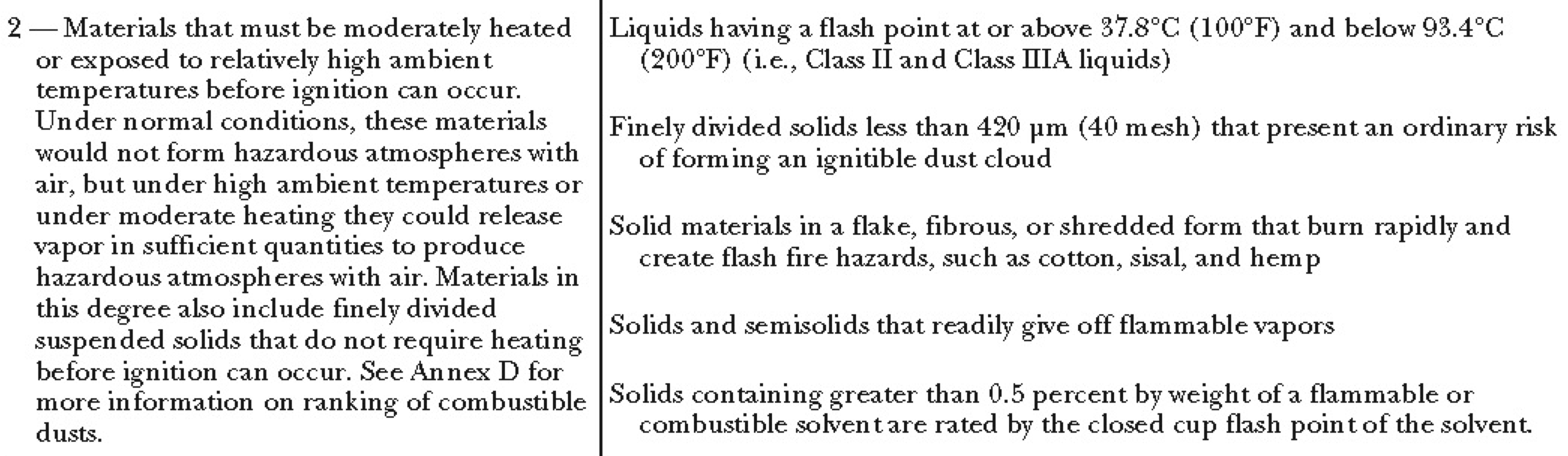
So without QUESTION (in my professional opinion), within the NFPA 704, labeling scheme HFO-1234yf is a Flammable “4” and NOT a “2” as some vessels have been labeled. I am at a loss as to why one manufacturer responded to a facility’s questions about proper labeling and responded the HMIS Flammable is a “2”. This facility luckily kept the communications or I would not have believed it!
Some of you may be asking “could this material be a Flammable “2” in the HMIS labeling scheme” and the answer is NO (in my professional opinion), at least not in the official one from the American Coatings Association. This system, although very similar, is a distinctly different labeling system and the two can NOT be merged and be managed properly.
Here is the HMIS Flammable Labeling scheme:
| 0 | Materials that will not burn |
| 1 | Materials that must be preheated before ignition will occur. Includes liquids, solids and semi-solids having a flash point above 200 F. (Class IIIB) |
| 2 | Materials which must be moderately heated or exposed to high ambient temperatures before ignition will occur. Includes liquids having a flash point at or above 100 F but below 200 F. (Classes II & IIIA) |
| 3 | Materials capable of ignition under almost all normal temperature conditions. Includes flammable liquids with flash points below 73 F and boiling points above 100 F. as well as liquids with flash points between 73 F and 100 F. (Classes IB & IC) |
| 4 | Flammable gasses, or very volatile flammable liquids with flash points below 73 F, and boiling points below 100 F. Materials may ignite spontaneously with air. (Class IA) |
As we can see, a Flammable HMIS “2” is a material that
“must be moderately heated or exposed to high ambient temperatures before ignition will occur. Includes liquids having a flash point at or above 100 F but below 200 F.”
HFO-1234yf has NO such flammable characteristics! The refrigerant is more in line with Flammable HMIS “4” which states:
Flammable gasses, or very volatile flammable liquids with flash points below 73F, and boiling points below 100 F. Materials may ignite spontaneously with air. (Class IA)
Bottom line, it is my professional opinion that HFO-1234yf is an NFPA and HMIS Flammable “4” and not a “2”. Properly labeling the vessels/containers that store the HFO-1234yf will go a long way in helping bring some much-needed respect to this Category 1 Flammable Gas.
Future Tip: Make sure your environmental team is also aware of this material as it will need to be reported on Tier II sheets for those PSM facilities that exceed the 10,000-pound threshold. Improper classification of this material on the annual Tier II sheets could lead to serious issues with EPA in their Emergency Planning and Community Right-To-Know Act (EPCRA) compliance as well as mislead your community emergency responders in their pre-planning. Fire departments need to understand this material is a Category 1 Flammable Gas. I call this out as at most of the manufacturing facilities I have visited and worked with regarding this material, it is their ONLY Category 1 Flammable Gas on site in bulk quantities. Having an “uninformed” Fire Department responding to a fire involving an HFO-1234 storage tank that is labeled a Flammable “2” puts a lot of people at risk!