PLEASE NOTE the LOI in which OSHA adopted EPA’s 1% rule was thrown out by the courts so I am NOT 100% sure OSHA can use the 1% rule from EPA in their evaluations of what is a covered process/HHC.
The smoke is still rising from OSHA’s recent change on Concentrations of greater than 1% for HHC solutions. But already I am getting first-hand accounts from friends that are being impacted in a significant way. Take for example a VERY common corrosion resistance material used in nearly all vehicle/ mobile equipment manufacturing that contains 5% Hydrogen Fluoride.
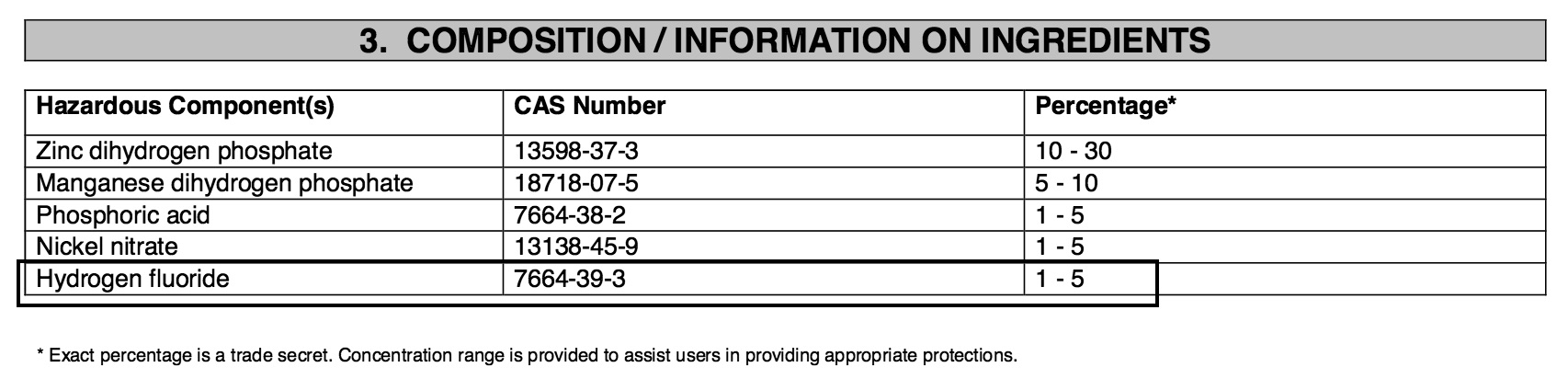
Most large manufacturing facilities making everything from huge bulldozers and cranes to compact cars and motorcycles will use this anti-corrosion material on all metal surfaces to aid in the reduction of rust on their products. As the manufacturer of this corrosion resistance material states…
This coating provides superior corrosion resistance and is preferred as a paint base offering superior adhesion and durability.
The kicker is this material’s exact percentages are a trade secret, so unless you can get the manufacturer to give you the EXACT percentage of HF in their product we have to assume it is the high end of 5%. This product weighs 10.0 pounds per gallon, so yes this is some heavy material. So what does this mean to a business that has never dreamed they would be a PSM covered business…
- The business has a 6,000-gallon storage tank that they use 80% of its capacity (e.g. 4,800 gallons).
- The material weighs 10.0 pounds per gallon for a total weight of 48,000 pounds of this material in their tank/process.
- Using OSHA’s 1% rule formula for HF, the business would do the following:
Weight X % Concentration = amount of HHC
48,000 pounds X 5% = 2,400 pounds of HF
- The business has 2,400 pounds of HF in their “process” using OSHA’s 1% rule formula.
- The PSM Threshold for HF is 1,000 pounds.
- This manufacturer of Bulldozers/Trucks/Cars/Manlifts exceeds the Threshold for HF and therefore the “process” would be covered – Right????
BUT WAIT… what is the “partial pressure” of this HF solution? If it is below 10 mm Hg then we do not have to count this solution.
In determining whether a process involves a chemical (whether pure or in a mixture) at or above the specified threshold quantities listed in Appendix A, the employer shall calculate:
(a) the total weight of any chemical in the process at a concentration that meets or exceeds the concentration listed for that chemical in Appendix A, and
(b) with respect to chemicals for which no concentration is specified in Appendix A, the total weight of the chemical in the process at a concentration of one percent or greater. However, the employer need not include the weight of such chemicals in any portion of the process in which the partial pressure of the chemical in the vapor space under handling or storage conditions is less than 10 millimeters of mercury (mm Hg). The employer shall document this partial pressure determination.
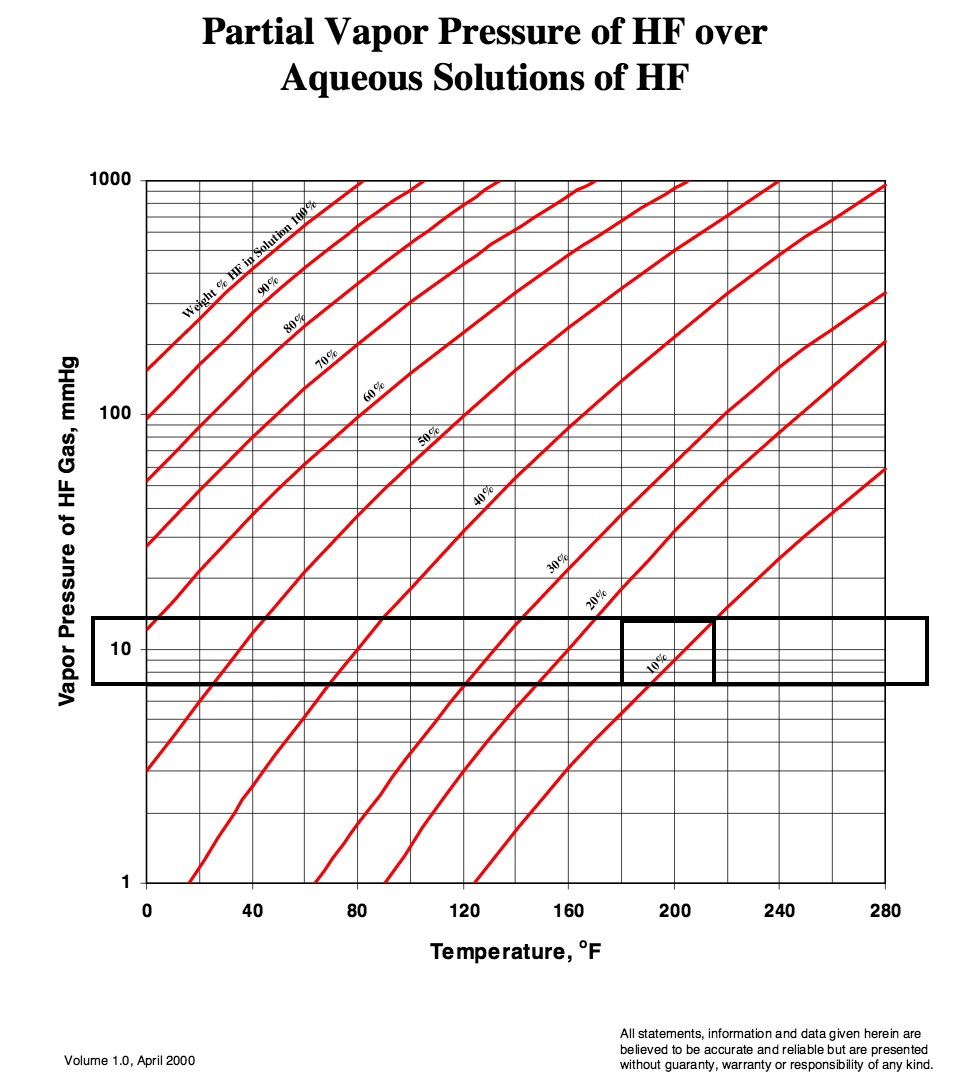
So let’s take a look at the partial vapor pressure of HF over aqueous solutions of HF. (Source: Hydrofluoric Acid Properties, Volume 1.0, April 2000, Honeywell)
As you will see below, the lowest concentration the graph goes down to is 10% HF in the solution. My worked example above is ONLY 5% HF in the solution so we will have to make some assumptions AND document these assumptions to make our case!
On the chart below I have tried to highlight the 10 mm Hg section, as well as where the 10% HF solution pass through it. We can see that for a 10% HF solution to reach 10 mm Hg we would have to heat the solution up to around 200°F. We can safely assume that a 5% HF solution would be higher than 200°F and therefore if we know our solution does not exceed the temperature of 200°F we KNOW that our solutions partial pressure will NOT exceed 10 mm Hg.
Therefore, my working example is NOT a PSM-covered process, even though we exceed the weight of the Threshold when doing the simple (Weight X %) calculation. But when we use the 10 mm Hg exemption we get to exempt the ENTIRE solution since the 5% HF solution’s partial pressure is LESS THAN 10 mm Hg.