
 This explosion is VERY SIMILAR to the fatal hotwork explosion that occurred in 2001 at Motiva Enterprises. The Motiva explosion occurred when a work crew had been repairing a catwalk above a sulfuric acid storage tank farm when a spark from their hot work ignited flammable vapors in one of the tanks. This tank had holes in its roof and shell due to corrosion. The tank collapsed, and one the contract workers was killed; eight others were injured.
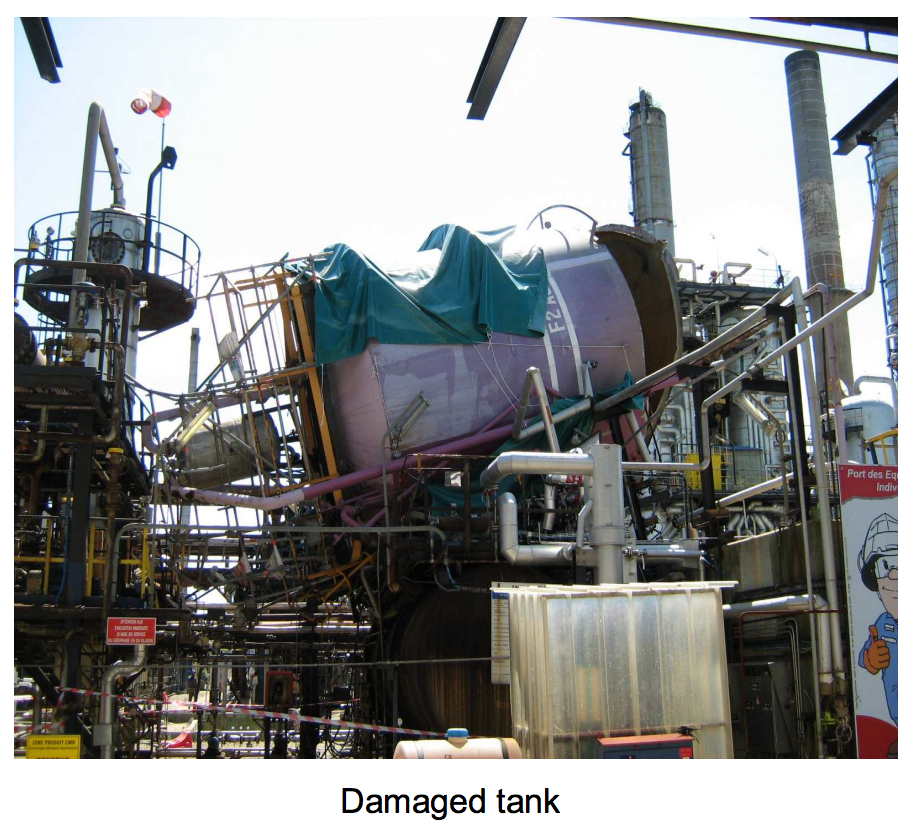
On August 4, 2009, @ 9:15 a.m. an explosion occurred inside a 100-m3 capacity tank (built in 1974) containing 96% sulphuric acid. A member of the plant staff, accompanied by 2 subcontractor employees, climbed onto the tank to open the manhole. An explosion occurred when the plant technician used a grinder to shear the seized bolts. The tank, empty at the time of the accident, was suddenly lifted 2 or 3 m high and then fell back to the ground on top of a nearby drum. As it was falling, the tank brought down the scaffolding that had been installed for upcoming maintenance.
This plant, rated upper-tier SEVESO, was using naphtha and butane as inputs to produce the most widespread intermediate chemical compounds in the petrochemical industry (i.e. ethylene, propylene, butadiene, and benzene), for subsequent input into plastics manufacturing processes.
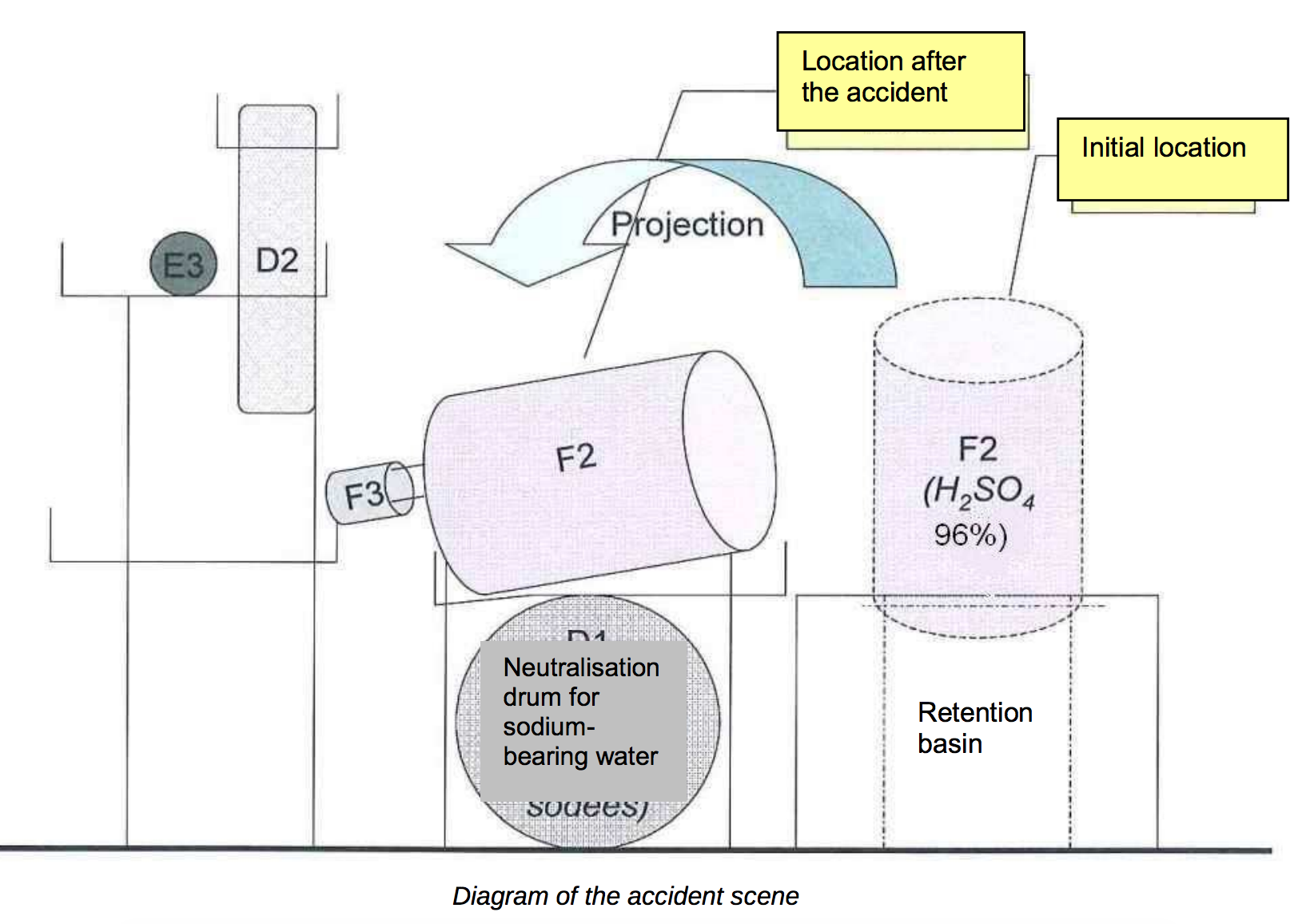
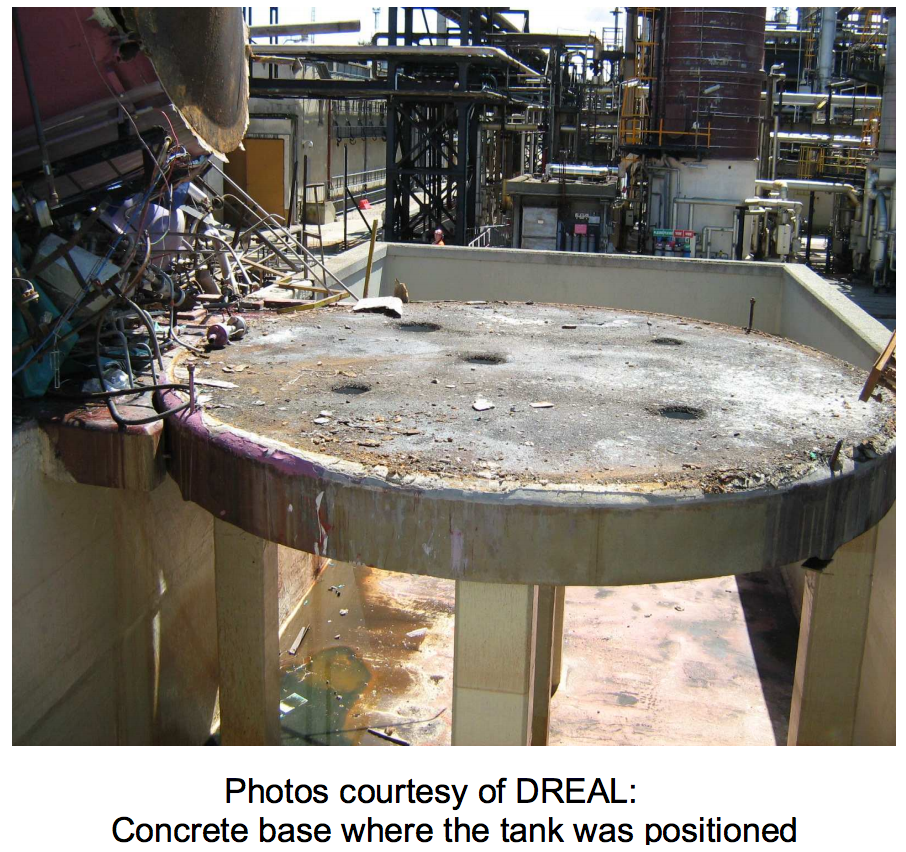
The accident occurred on a 100-m3 capacity tank (built in 1974) containing sulphuric acid concentrated to 96%. Installed outdoors on piles above a retention basin lined with epoxy resin and part of the unit for treating sodium-bearing water, this tank was used to supply :
- the neutralization reactor for sodium water stemming from the absorption of hydrogen sulfide on the vapor cracking unit;
- demineralisation chains of water for boilers and cooling towers with sulphuric acid when the dedicated tank was undergoing maintenance.
This tank had already been repaired in 1989 following an incident that caused its delamination, yet without breaking any fastenings, due to a release of carbonic gas during the sulphuric acid neutralization step (ARIA 23705). A support bracket had been added in response to this initial accident, and the cleaning procedure was also revised.
THE ACCIDENT, ITS CHRONOLOGY, EFFECTS, AND CONSEQUENCES
The accident :
- On 17 July 2009, a leak was detected on the F2 tank containing 70 m³ of concentrated sulphuric acid (caused by a 1-mm hole). This leak was plugged on 18 July using a temporary sealant system following approvals delivered by the onsite inspection department.
- On Friday 31 July, the tank was emptied to a point of inducing pump cavitation. The remaining product was drained into the retention basin and the tank was rinsed with water over the weekend. A scaffolding was set up to accomplish the rest of the works program.
- On Monday 3 August, the rinsing water collected in the retention basin was conveyed to the water treatment plant.
- On Tuesday 4 August, the task of the chemical consignment (platinum plating) of the inventory was undertaken in order to isolate the storage capacity. A member of the plant staff, accompanied by 2 subcontractor employees, climbed onto the tank to open the manhole. An explosion occurred around 9:15 am when the plant technician used a grinder to shear the seized bolts. The F2 tank, empty at the time of the accident, was suddenly lifted 2 or 3 m high and then fell back to the ground on top of a nearby drum. As it was falling, the tank brought down the scaffolding that had been installed for upcoming maintenance.
- The Internal Emergency Plan was activated. The site operator notified the local Prefecture, town halls, and the general public.
Consequences of this accident :
- Three individuals were hurt, with two of the injuries serious.
- Two subcontracted employees and a site technician were on the scaffolding at the top of the tank at the time of the explosion. One subcontractor was ejected towards a neighboring structure 5 meters above ground when the tank suddenly thrust upward. He landed back on the ground away from the scaffolding. The other subcontractor was pinned in the scaffolding. The third victim (plant technician) took a hard fall and was found on the ground unconscious.
- Ten other people were seen by the psychological response team at a treatment office opened onsite.
- No environmental impact was reported and no hazardous substances released.
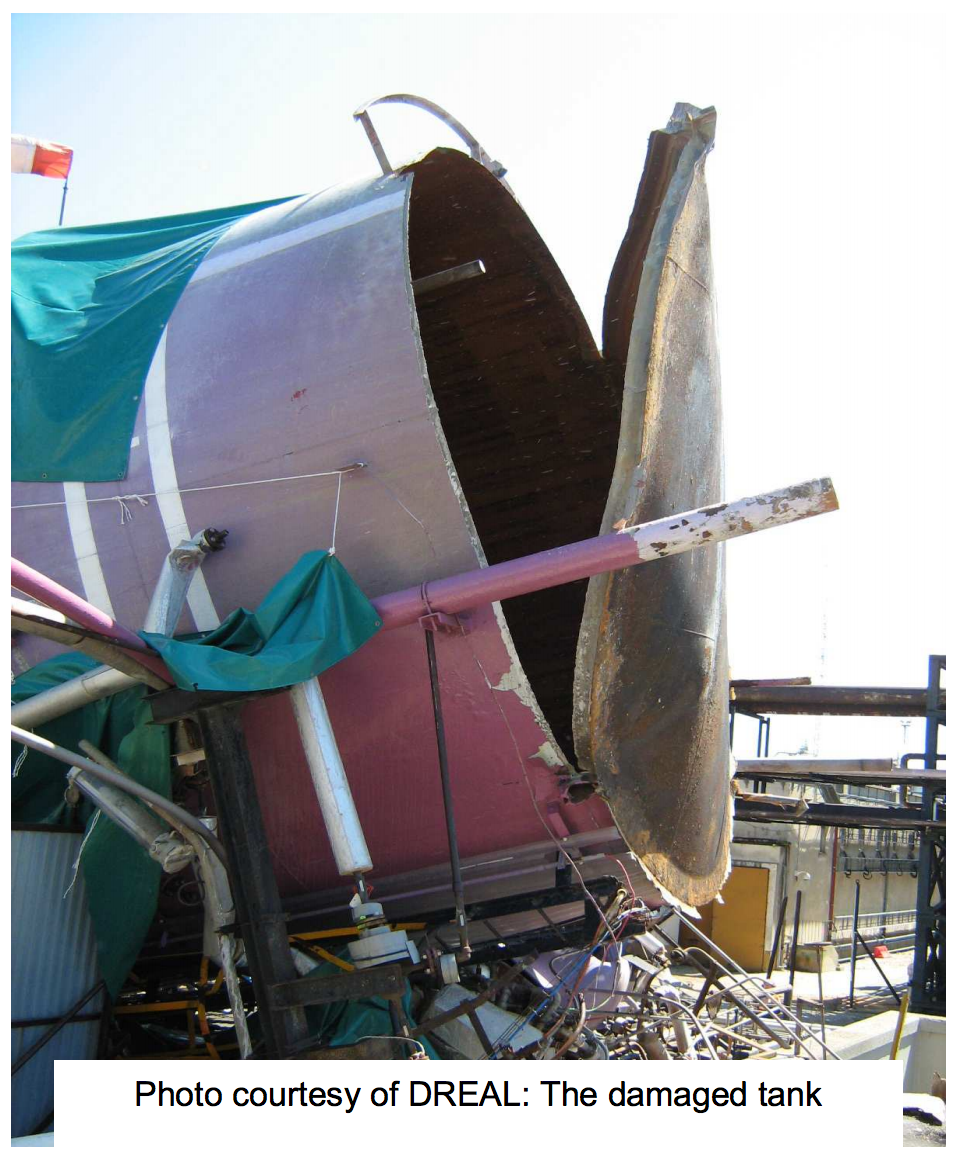
- The damages were limited to destruction of the tank and all connecting piping; the unit was shut down. The tank was torn apart over half the shell/bottom junction circumference. Its anchorages were also ripped out.
THE ORIGIN, CAUSES AND CIRCUMSTANCES SURROUNDING THIS ACCIDENT
- Insufficient rinsing of the tank (just a single rinsing cycle was performed) combined with the presence of a low concentration of sulphuric acid caused an acid attack of the metal, leading to the formation and accumulation of hydrogen at the top of the tank (dome-shaped tank roof).
- The explosion occurred by means of igniting the flammable mix created with air at the time of splitting the corroded bolts on the dome manhole with a grinder.
- The metallurgical assessment performed on this tank indicated the presence of extensive internal corrosion over the lower part of the structure. This observation confirmed the sudden onset of corrosion at the tank sidewall due to diluted acid, thus generating a source of hydrogen production.
LESSONS LEARNT
Regarding risk identification and evaluation
Iron, like the primary common metals (zinc, aluminum), is attacked by diluted acids with hydrogen release, according to the following reaction:
Fe + 2H+ ↔ Fe2+ + H2
Hydrogen is a highly flammable gas (4%-75% in air) at very low levels of ignition energy (0.02 mJ, vs. 0.29 mJ for methane). The risk of a hydrogen explosion is present whenever an acid corrosion of metal has extended to a point of being observable. In certain cases, the flow of fluid against a wall (through friction) or a shock can be of sufficient magnitude to ignite.
A locally high hydrogen concentration (above 4% in air), e.g. in a dead air pocket or at the upper level of an enclosed capacity, can engender an explosion risk when undertaking works on a tank. Such an event occurred in Saint-Fons (69), on 9 August 1989 (ARIA 169), where preliminary flammability measurements conducted prior to the works phase had not enabled detecting the presence of hydrogen at the top of the tank.
The feedback available included reports of several H2 explosions following an attack of diluted acid on steel tanks in a number of facilities: ARIA 169, 22278, 31082 (detailed accident report).
Regarding feedback management, organization, and controls
A series of recommendations were issued before placing the installation back into operation:
- Design : The new tank would be fitted with a bleed valve that was both accessible and maneuverable.
- Tank availability (through steps of drainage and rinsing) was improved. The completed drainage step, facilitated by tank design, was to be visually inspected by opening a manhole at a high point. This improved accessibility will serve to minimize the quantity of residual acid to just drippings at the tank bottom and on its sidewalls, in addition to enhancing not only acid neutralization to return to a neutral pH but also tank rinsing.
Moreover, this operation avoids producing diluted acid and attacking the tank.
- The method for awarding hot-work permits was improved. Feedback mainly focused on building awareness among onsite personnel of both the risks incurred and the atmospheric measurement methods to be implemented (as regards positioning of the explosimeter probe).
- The tank was to be rebuilt using carbon steel; this solution was preferred over a composite so as to streamline inspections.
- During the normal operations phase, a minor hydrogen release into the tank remains a possibility.
Measures were taken to minimize hydrogen production and prevent its accumulation by means of:
- a vent positioned at a high point, with no internal tank structure causing evacuation of the hydrogen eventually produced during operations and preparation;
- continuous flushing with dry air to allow hydrogen to evacuate and the tank to breathe; this feature serves to prevent moist air from entering the tank (one possible cause of corrosion).
- The classified facilities inspectorate requested that the tank is made breakable at the shell roof junction so that in the case of an incident, the tank would remain in place and its contents not ejected.
SOURCE: LESSONS LEARNT from industrial accidents, IMPEL Seminar Aix-en-Provence, 16 and 17 November 2011
NOTE: This EXCELLENT presentation includes the following incidents, A MUST READ for process safety professionals.
- Fire outbreak at a wood recycling plant, Saint-Cyprien (Loire) – France, 22 August 2008
- Break in a liquid hydrocarbon pipeline, Plaine de la Crau (Bouches-du-Rhône) – France, 7 August 2009
- Massive alumina red sludge release after the failure of a containment dam, Kolontár – Hongrie,4 October 2010
- Explosion of a superheater within a steam-cracking unit, Saint-Avold (Moselle) – France, 15 July 2009
- Derailment of LPG tank-wagons followed by a UVCE explosion and an intense fire, Viareggio – Italy, 30 June 2009
- Explosion of a sulphuric acid Tank, Gonfreville l’Orcher (Seine-Maritime) – France, 4 August 2009
- Explosion in a chloralkali plant due to a voltage dip, Ibbenbüren – Germany 23 July 2009
- Rupture of a pipeline within an underground hydrocarbon storage facility in saline cavities, Manosque (Alpes-de-Haute-Provence) – France, 1st may 2010
- Hazardous substance release following inadequate HAZOP studies, Heilbronn – Germany, 21 September 2010
- Fertilizer decomposition in a dryer, Ribécourt-Dreslincourt (Oise) – France, 8 February 2010
- Explosion in a carboxyméthylcellulose production plant (cellulose gum), Nijmegen (Gelderland) – The Netherlands, 11 July 2009
- Bursting of a high-pressure steam pipe, Grand Quevilly (Seine-Maritime) – France, 28 June 2010
- Rupture of an oxygen pipeline, Richemont (Moselle) – France, 13 June 2010