
2015 UPDATE: Some of my refrigeration PSM buddies reminded me that the industry now has its own RAGAGEP for piping installation, ANSI/IIAR 4-2015, Installation of Closed-Circuit Ammonia Refrigeration Systems. I do applaud the IIAR for their work in establishing this ANSI standard for the industry, but for those so happy to “correct me” I like to point out the following from this IIAR RAGAGEP…
13.1.3 Pressure Testing
Pressure test shall be in accordance with Section 538 of ASME B31.5, 2013, Refrigeration Piping and Heat Transfer Components (ref.4.1.1.2).
So yes, the IIAR now has its own RAGAGEP for “Installation of Closed-Circuit Ammonia Refrigeration Systems”; however, it merely references B31.5 and requires what I have explained in this post.
I am confident after the flood of e-mails from Part 1 that most, if not nearly all, professionals responsible for process safety at their facility(s) are aware of “pressure testing” and “leak testing” requirements for their newly installed piping which contains their Highly Hazardous Chemicals (HHC) or as EPA calls them Extremely Hazardous Substances (EHS). But when we begin to peel this onion we almost always find confusion regarding these fundamental process safety requirements. In this article, I hope to explain the difference between a “pressure test” and a “leak test” as well as how these tests MUST be done to comply with the most widely used piping RAGAGEP(s)… ASME B31 series.
As I said, my chosen RAGAGEP for pipe installations is the ASME B31 series, more exact is B31.3 for basic process piping and B31.5 for my refrigeration clients. In fact, refrigeration processes really need to list both RAGAGEPs in their PSI as B31.5 relies on several key aspects found only in B31.3. I will be using the example of installing ammonia refrigeration piping in this article as it seems this industry has some “myths” or as some like to call them “industry practices” that have been incorrectly applied for far too long.
Although AMSE B31 series does not officially define “pressure test” and a “leak test”, I will do my best to explain what they are and how they differ. Both are a REQUIREMENT from both B31.3 and B31.5, but they are different. AMSE B31.5, Section 538 TESTING states:
PLEASE see my earlier article specific to B31.5 requirements for NH3 refrigeration processes and a more detailed breakdown and explanation of these requirements.
(emphasis added by me)
538.4 Field Testing of Refrigerant Piping
538.4.1 General Requirements. Refrigerant piping erected on the premises, except piping components that are factory tested, shall be pressure tested and leak tested after installation and BEFORE operation.
538.4.2 Pressure Test
(a) Piping shall be examined BEFORE pressure is applied to ensure that it is tightly connected. All items NOT subject to the pressure test shall be disconnected or isolated by valves, blanks, plugs, or other suitable means.
(b) A preliminary test at a gauge pressure of up to 25 psig (170 kPa) may be applied, prior to other testing, as a means of locating major leaks.
(c) The temperature of the piping system during testing shall be ABOVE the ductile–brittle transition temperature. (Link added by me)
CAUTION: Take measures to protect personnel from the potential of rupture of piping components during pneumatic testing of systems.
(d) The means used to furnish the test pressure shall have either a pressure limiting device OR a pressure reducing device AND a pressure relief device AND gage on the outlet side. The pressure relief device shall be set ABOVE the test pressure, but low enough to prevent permanent deformation of any of the system components.
(e) The pneumatic test pressure used shall be at least 110% of the design pressure. The test pressure shall NOT exceed 130% of the design pressure of any component in the system.
(f) For large systems that are NOT COMPLETELY VISIBLE to the testing operator, the pressure in the system shall be gradually increased to ONE-HALF of the test pressure, after which the pressure shall be increased in steps of approximately one-tenth of the test pressure until the required test pressure has been reached. The test pressure shall be continuously maintained for at least 10 min. It may then be reduced to the leak test pressure per para. 538.4.3(c).
(g) Mechanical joints at which blanks or plugs are inserted to blank off or facilitate removal of equipment during the pressure test need NOT be pressure tested after removal of the blank or plug provided the joint passes a subsequent leak test.
So there we have ALL the “pressure test” requirements found in ASME B31.5. Here are the KEY aspects of the “pressure test” requirements:
- refrigerant piping erected on the premises MUST be pressure tested BEFORE the introduction of the HHC (ammonia in my example)
- piping TEMPERATURE MATTERS during the pressure test so doing these tests outside in extremely cold weather can pose a challenge!
- the pressure test arrangement MUST have either a pressure limiting device OR a pressure reducing device AND a pressure relief device AND gage on the outlet side.
- the pressure testing arrangement’s relief device MUST be set above the test pressure, BUT low enough to prevent permanent deformation of any of the system components.
- pneumatic test pressure MUST be at least 110% of the piping’s design pressure and shall not exceed 130% of the design pressure of any component in the system.
- when we pressure test large section of the process that is not completely visible to the testing operator, the pressure in the system MUST be gradually increased to one-half (1/2) of the test pressure, after which the pressure shall be increased in steps of approximately ONE-TENTH (1/10) of the test pressure until the required test pressure has been reached.
- test pressure shall be continuously maintained for at least 10 minutes.
It is these seven (7) simple requirements that seem to cause such a roar in many facilities and also the reason why I have always said that “pressure testing” should be conducted under a well-written Maintenance Procedure. The need for a procedure will also come clearer when we get into more details about the testing media and the QC requirements of the gauges used.
Next, we come to the “Leak Test” requirements
Here is what ASME B31.5 states…
(emphasis added by me)
538.4.3 Leak Test. AFTER the pressure test in para. 538.4.2 is COMPLETED, a leak test shall be performed.
(a) Examination for leaks shall be by the gas and bubble formation testing as detailed in Article 10, Section V of the ASME Boiler and Pressure Vessel Code, or by other methods of equal sensitivity.
EXCEPTION: Refrigerant vapor detection methods shall be used when the refrigerant is used in the test medium.
Comply with environmental regulations when venting refrigerants.
(b) The examination shall be made of ALL joints and connections. The piping system shall show NO evidence of leaking.
(c) The pressure used for leak tests shall be either the design pressure or a pressure specified in the engineering design.
As we can see, the “Leak Test” is done AFTER the “Pressure Test”. This test is actually done AFTER the pressure test so as to provide some level of assurance that after the pressure testing equipment/apparatus was removed from the piping AND BEFORE we place the piping into service with full flows of the HHC, we know the process piping is ready to receive the HHC. Ammonia is allowed to be used as the “leak test” media (NOT for the “pressure test”), but please keep in mind that we would use the absolute SMALLEST volume of gas necessary to leak test the piping. Because ammonia has such a low odor threshold, it will not take much to perform this “leak test”!
Here is what ASME B31.5 says about using Ammonia in the “leak test”…
538.5 Testing Medium for Refrigerant Piping
(a) A suitable dry gas such as nitrogen or air shall be used for pressure testing per para. 538.4.2. Toxic gases shall not be used unless personnel are adequately protected from harmful exposure should leaks occur during testing.
(b) Oxygen or any medium with a lower flammable limit below 13% shall not be used for pressure testing.
(c) The system refrigerant may be used for leak testing per para. 538.4.3.
CAUTION: Comply with environmental regulations when testing with refrigerants.
(d) Water or water solutions should NOT be used in testing refrigerant piping.
Lastly, the RAGAGEP requires the following regarding the gauges used in these test(s):
538.7 Pressure Gages
Pressure gages shall be checked for accuracy prior to use in testing, either by comparison with master gages or by setting the pointer as determined by a dead-weight pressure gage tester.
Why have I not mentioned IIAR Code(s) or Bulletins in regards to the installation and testing of ammonia refrigeration piping?
Simply put, our installation code is ASME B31.5 (with some aspects from B31.3). IIAR does NOT have a pipe installation code or a piping pressure test code; in fact, it refers the reader to…. yep – ASME B31.5 (see IIAR 2-2008, section 10.1). Where IIAR plays a role is that we find our “design pressures” in IIAR 2, Equipment, Design, and Installation of Closed-Circuit Ammonia Mechanical Refrigerating Systems.
5.2 Minimum Design Pressure
Minimum design pressures are listed in this Standard where pertinent. However, design pressure shall not be less than the pressure arising under all operating, shipping, and standby conditions. When selecting the design pressure, the suitable allowance shall be provided for setting pressure-limiting devices to avoid nuisance shutdowns and loss of refrigerant at maximum operating conditions.
The code goes on to list the minimum design pressures for all components found in an ammonia refrigeration process.
As IIAR mentions piping, it states in Section 10…
10.1 The design, materials, fabrication, examination, and testing of the piping, whether fabricated in a shop or as a field erection, shall comply with ASME B31.5-2006, Refrigeration Piping [ref.4.1.2], except where noted.
I would like to point out that IIAR 2, Section 15 does, in fact, contain “Leak Testing” protocols for ammonia refrigeration piping; however, it does NOT contain protocols for “pressure testing”. The IIAR RAGAGEP states the following… (emphasis added by me)
15.1.6 Leak Test
15.1.6.1 The high side and low side of the system shall be tested at the greater of:
a. The relevant leak test pressure is shown in Appendix B AND
b. The design pressure for that part of the system.
Here is Appendix B with its LEAK TEST pressures for the HIGH-PRESSURE side and LOW-PRESSURE SIDE of the refrigeration process…
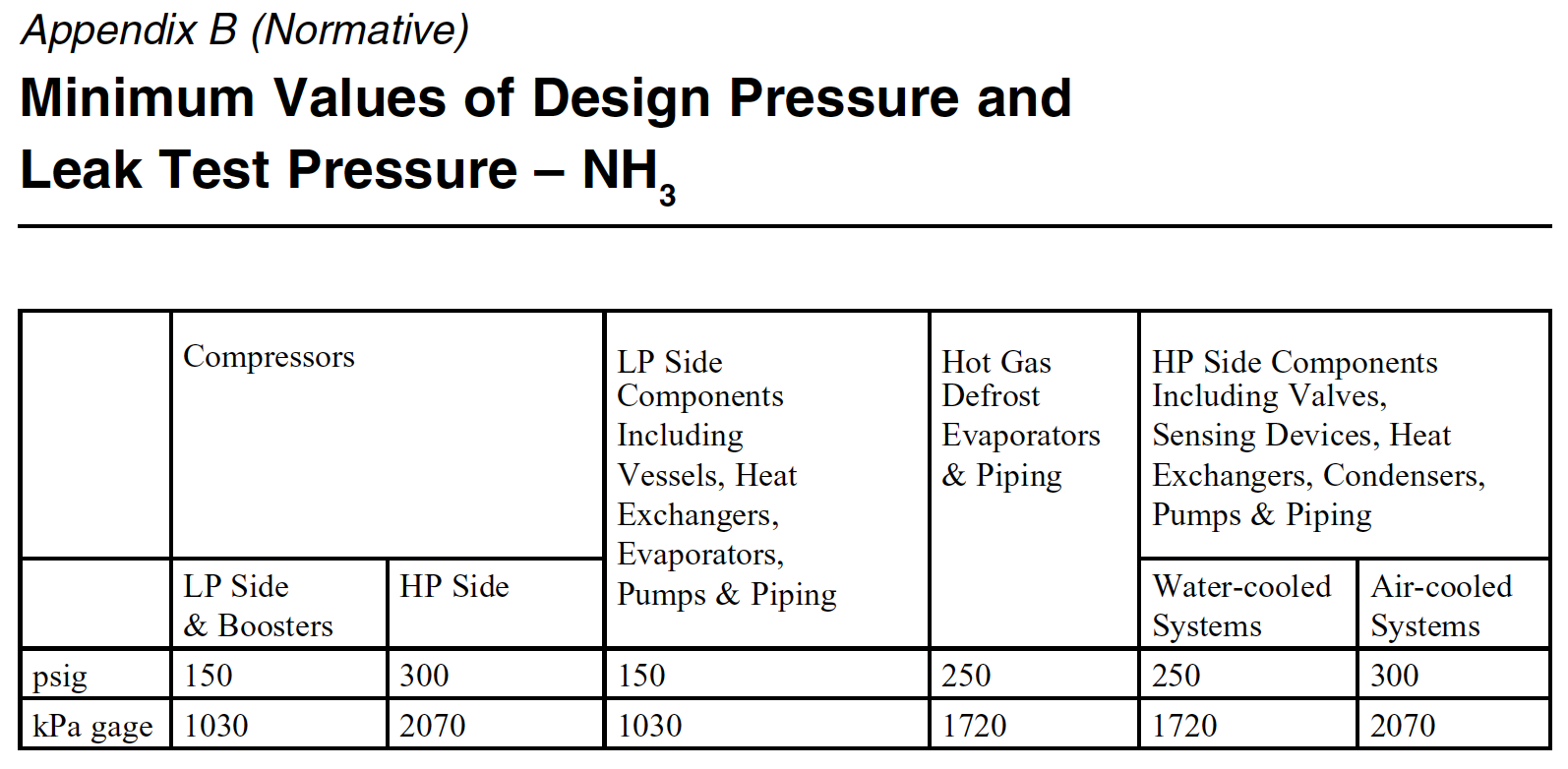
So here is the bottom line, ASME B31.5 is the most widely utilized RAGAGEP for installation and testing of refrigeration piping. IIAR-2 provides us with our minimum design pressures and our “leak testing” pressures. But it is ASME B31.5 that directs us to “PRESSURE TEST” our piping to 110% of the “design pressure”. So if we have designed our ammonia piping to a pressure of 250 psi, then we are REQUIRED to PRESSURE TEST this piping to 275 psi. If our piping is designed at 300 psi, then our TEST PRESSURE must be 330 psi. Once we complete our PRESSURE TESTING we can then use IIAR 2 or ASME B31.5 for our LEAK TESTING. It is a long-standing MYTH that ammonia piping is PRESSURE TESTED to some set pressure such as 250 psi, but somehow and somewhere this found its way into the industry. Just by using IIAR 2, Appendix B we can see that our MINIMUM DESIGN PRESSURES for piping are 150 and 250, which equates to a PRESSURE TEST minimum of at least 165 psi and 275 psi – not 250 psi or even worse 150 psi.
So what has your piping been PRESSURE TESTED to?
NOTES:
CLICK HERE for an excellent technical paper explaining how “Design Pressure” for piping equates to how “MAWP” plays a role in pressure vessel management.
Determining Code Compliance and Pipe System Leak Testing, by William M. Huitt
UPDATE 1/16/2016
A longtime member and supporter thought it would not be right if this posting did not include the pipe testing requirements from International Mechanical Code for Refrigeration. Thanks, J! I would like to say that this code is an ABSOLUTE MUST MINIMUM for those jurisdictions that have adopted it (NOTE: this is from the 2012 code). It is also REQUIRED for all refrigeration processes that have at least 55 pounds of refrigerant. This code is NOT associated with PSM; those processes that will have 10,000 pounds of NH3 or more MUST GO FURTHER in their design and testing. So although this code permits the pressure testing to be done at “design pressures” (vs. 110% of design as found in ASME B31.5) this is NOT permitted for those PSM/RMP covered processes. We should view these codes as an EXCELLENT starting point for PSM/RMP, but certainly NOT the endpoint.
SECTION 1108 FIELD TEST
1108.1 General.
Every refrigerant-containing part of every system that is erected on the premises, except compressors, condensers, vessels, evaporators, safety devices, pressure gauges and control mechanisms that are listed and factory tested, shall be tested and proved tight after complete installation, and before the operation. Tests shall include both the high- and low-pressure sides of each system at not less than the lower of the design pressures or the setting of the pressure relief device(s). The design pressures for testing shall be those listed on the condensing unit, compressor or compressor unit nameplate as required by ASHRAE 15.
Exceptions:
-
- Gas bulk storage tanks that are not permanently connected to a refrigeration system.
- Systems erected on the premises with copper tubing not exceeding 5/8-inch (15.8 mm) OD, with wall thickness as required by ASHRAE 15, shall be tested in accordance with Section 1108.1, or by means of refrigerant charged into the system at the saturated vapor pressure of the refrigerant at 70°F (21°C) or higher.
- Limited-charge systems equipped with a pressure relief device, erected on the premises, shall be tested at a pressure not less than one and one-half times the pressure setting of the relief device. If the equipment or appliance has been tested by the manufacturer at one and one-half times the design pressure, the test after erection on the premises shall be conducted at the design pressure.
1108.1.1 Booster compressor.
Where a compressor is used as a booster to obtain an intermediate pressure and discharges into the suction side of another compressor, the booster compressor shall be considered a part of the low side, provided that it is protected by a pressure relief device.
1108.1.2 Centrifugal/nonpositive displacement compressors.
In field-testing systems using centrifugal or other nonpositive displacement compressors, the entire system shall be considered as the low-side pressure for field test purposes.
1108.2 Test gasses.
Tests shall be performed with an inert dried gas including, but not limited to, nitrogen and carbon dioxide. Oxygen, air, combustible gasses and mixtures containing such gasses shall not be used.
Exception: The use of air is allowed to test R-717, ammonia, systems provided that they are subsequently evacuated before charging with refrigerant.
1108.3 Test apparatus.
The means used to build up the test pressure shall have either a pressure-limiting device or a pressure-reducing device and a gauge on the outlet side.
1108.4 Declaration.
A certificate of the test shall be provided for all systems containing 55 pounds (25 kg) or more of refrigerant. The certificate shall give the name of the refrigerant and the field test pressure applied to the high side and the low side of the system. The certification of the test shall be signed by the installer and shall be made part of the public record.