
This case is significant in a number of ways: 1) manufacturer of the equipment put warning signs on their machines pointing out the hazard(s), 2) manufacturer considered the “doors” on their CNC mills and lathes to be “guards”, 3) manufacturer installed interlocks on the “doors” (i.e. guards), 4) company bought the machines “used” and many of the interlocks were not operational at the time of purchase, 5) one machine did have a functioning interlock, which was bypassed by tying back it’s arm, 6) The VP of the company and the most senior operator felt the machines were safe, 7) neither of these two employees had any training in machine guarding or safety, 8) the company had been cited for machine guarding years earlier and had a serious injury on these machines. OSHA began their inspection based on an employee complaint and issued a willful citation for unguarded CNC lathes and mills. OSHA said the “doors” were guards, based on the manufacturer’s operation manual, manufacturer’s labels on the machines making reference to them as “guards” and the presence of the interlocks on the doors. The OSHRC agreed and upheld the citation as willful and the full amount. Here is the arguments the company made against OSHA’s citations…
This case is not a final order of the Review Commission as it is pending Commission Review
On April 4, 2014, an OSHA Compliance Officer (CO) began an inspection of a plastic products manufacturer in response to a complaint of several safety issues, including Computer Numerical Control (CNC) lathes and mills being operated without necessary guards. On July 23, 2014, OSHA issued a citation and notification of penalty (citation) to Respondent. The citation alleged one willful violation of the machine guarding standard with a proposed penalty of $49,000. The company timely contested the citation. A two-day hearing was held in Cleveland, Ohio on May 5-6, 2015. The primary issue in dispute is whether the company’s employees were exposed to the unguarded moving parts of the cited CNC lathes and mills. For the reasons that follow, the Court affirms the citation and assesses a total penalty of $49,000.
Admitted Facts
The parties submitted the following admitted facts in their Joint Pre-Hearing Statement. (See Joint Pre-Hearing Statement, pp. 4-5 Admitted Facts #1 through #10 (JPHS Fact #)).
- The moving parts of the cited machines are approximately two feet within the confines of the machine.
- OSHA took no measurements of the distance between any part of the operator’s body and the moving parts of the machines.
- OSHA took no photos of any part of an operator’s body entering the zone of danger on the cited machines.
- None of OSHA’s interview statements of the machine operators state the distance of any part of their bodies from the moving parts of the machines while they are operating.
- The same condition was previously cited by OSHA, however the alleged hazard was designated to have “Low probability” at that time.
- Interlocks are not required under the cited standard.
- The alleged hazard of parts being manufactured and/or tooling from the machines being ejected from the machine are not mentioned anywhere in the OSHA investigation file.
- There is no operational need for the operator to have any part of his body within the zone of danger or the confines of the cited machines.
- There was no oil or other substance on the floor in the area of the cited machines which cause an operator to lose his footing.
- The Compliance Officer, in recommending the subject citation used as a standard that 1910.212 was violated if it was “possible” that an employee could have any part of his body enter the zone of danger on the cited machines.
Background & Relevant Testimony
The company fabricates high-performance plastic parts for companies throughout the world and has approximately 40 employees. It produces parts made out of polytetrafluoroethylene, also known as Teflon, and other materials including nylons. The Company’s machines compress and mold polytetrafluoroethylene. The company uses 25 to 30 machines to manufacture more than 7,000 different parts. These parts include gaskets, washers, insulators and seals.
Machines at The Company
The Company uses different machines to manufacturer its parts, including automatic molding pressers, Brown & Sharpe screw machines, drill presses, CNC mills, CNC lathes and engine lathes. The citation alleges five CNC lathe and two CNC mill machines were operated without proper guarding of the machine’s moving parts. The five CNC lathes are referred to individually as lathe #7, lathe #15, lathe #19, lathe #37, and lathe #38. The two CNC mills are referred to individually as mill #510 and mill #810. The Company purchased the machines in used condition in the late 1990s, with the exception of mill #810, which was purchased in about 2007.
The CNC lathes and CNC mills are used to tool (or machine) blank plastic workpieces into finished parts by means of a spindle that rotates at speeds from 250-1,200 revolutions per minute (rpm). The primary difference between a CNC lathe and CNC mill is the position of the workpiece during production. In a CNC lathe, the blank workpiece is attached to a spindle, which rotates, as a tool is applied to produce the finished part. In a CNC mill, the tool is attached to a rotating spindle and the blank workpiece remains stationary on the table during the machining process.
The CNC Lathes
The five lathes produced finished parts through either a hand-loading or a rod-loading process. For a rod-loaded job, multiple finished parts are produced from a 6-foot section of blank workpieces loaded into the CNC lathe. The CNC lathe automatically feeds each individual workpiece through the tooling process until all the workpieces have been machined, at which point the machine “shuts off.” A rod-loaded job can take three to four hours to complete, allowing an operator to run more than one machine at a time. For a hand-loaded job, operators place their hands inside the machines and load each blank workpiece to be manufactured onto the spindle of the lathe. After the cycle is complete, operators again place their hands inside the machines to remove each finished part.
Along the front of each CNC lathe, a “splash guard” door moved on a track from left to right to either enclose the machine’s moving parts or be open to provide access to the point of operation where the workpiece was loaded. The splash guards could be closed and when closed serve as a barrier between the operators and the point of operation. Lathe ##7, 19, 37 and 38 each have a window through which an operator can observe the progress of the machining operation, without being exposed to the lathes’ moving parts when the splash guard door is closed.
Each CNC lathe’s control panel was above the splash guard door. When the splash guard door was open, the opening into the CNC lathe was about 17 inches wide and the height was roughly the distance from an employee’s hip to shoulder. The splash guard door had a window area to allow a view into the machine with the door closed.
Each CNC lathe was manufactured with an interlock device; however, none of the interlocks were functional when the company purchased the machines. An interlock is an “electronic safety device” within the meaning of the cited standard. A functional interlock would not allow the machine to run the production cycle with an open splash guard door. A label on lathe #7 indicated it had a LS-26 splash guard interlock system, but the mechanism was broken and nonfunctional. The splash guard door on lathe #7 did not easily move on its track. The CO observed an employee attempting to open the door on lathe #7 by using two hands and then jerking the door up and down to get it to move along its track.
Instead of plastic or glass, lathe #15’s splash guard door had a fabricated guard over the missing window area that consisted of approximately six vertical bars with several inches of space between each bar. The “window” opening was 12 inches from top to bottom. Lathe #15’s fabricated guard would not prevent an employee from reaching into the point of operation through the gaps between the metal bars while the machine was running. The bars would also not prevent items from coming out of the machine. The interlock mechanism on lathe #15 was held back by a wire making the interlock not functional. Lathe #15 could not be operated by rod feeding.
Lathe #19 had signs indicating there were two interlock devices, LS-26 and LS-27;11 the interlocks were not functional. The CO observed lathe #19 in operation with its door open.
Lathe #37 did not have a splash guard door. It was missing when the company purchased the machine. Instead, a large piece of cardboard was used to cover the open area of the CNC lathe to keep debris chips or oil used for production from coming out of the machine onto the floor. The CO photographed a warning sign on lathe #37 and testified that similar signs appeared on most of the other machines. The sign had the word DANGER across the top and included the warning, “Do Not Open Oil Guard Safety Door While Machine is in Operation.” The warning sign also listed eight specific items to do “BEFORE STARTING MACHINE CYCLE,” including “Splashguard must be in closed position and engaged in interlock system” and “Do not attempt to put your hand in beyond oil guard, while machine is in operation.”
The CO observed lathe #38 in operation and saw that when the door was opened during operation it did not stop, so the interlock was not functional. The plastic in the window of lathe #38’s door was so aged, dirty, and distorted an operator could not see through it to check the progress of the production cycle. The CO observed its operator open the door a few inches so he could see the production cycle.
The CNC Mills
CNC mills at the company are used to profile (reshape or tool) or drill holes into a blank plastic workpiece. Both CNC mill machines had a sliding splash guard door that could be shut and latched. Neither mill #510 nor mill #810 were manufactured with an interlock system. Both CNC mills had a warning sign above the spindle area that read:
WARNING
The CNC unit may suddenly run Table, Spindle head, or Spindle rotation.
DO NOT open door unless machine control is in manual mode and Spindle stop is depressed.
The warning sign also had a depiction of fingers being amputated when too close to a spinning tool and a warning symbol, consisting of an exclamation point inside a triangle, that preceded the word “WARNING.”
Relevant Testimony
The vice-president of manufacturing at the company had been in his role since the company’s formation in 1990. His duties include purchasing, receiving, sales, operations, and safety. He received no training on occupational safety or machine guarding at the company. He stated that the company no longer had a safety officer and that safety was everyone’s responsibility. He had 20 years of experience operating lathes. In the 1980s, he attended lathe training provided by the manufacturer, Miyano. He had operated the company’s CNC lathes and mills. He had operated both a lathe and a mill as recently as a year and one-half ago. He testified the company’s screw machines were guarded with sliding doors. Its presses were also guarded with electric eyes, also referred to as light curtains. These machine guards did not impede the production of the screw machines or presses.
After watching a video in the courtroom of a company employee operating a CNC lathe demonstrating a hand-loaded job, he testified that there was nothing between the operator and the CNC lathe’s point of operation shown in the video. He said the employee was shown standing before an open door about two feet away from the point of operation. He testified that he measured the distance himself. He testified that the CNC lathe automatically stops after the piece is done. After reaching into the point of operation work area and removing the finished piece, the operator replaces it with a new piece by again reaching into the point of operation work area. He testified the operator then turns the CNC lathe back on manually. He also said that the operator can press a red button on the CNC lathe to stop it for any reason. He stated that the door on the CNC lathe served as a splash guard. The door was open in the video and remained open during the production cycle. He testified that the company did not require operators to keep the splash guards closed during operation. He said that it was an option.
He was also shown a video of the front and rear view operation of a CNC mill. This too was a hand-loaded job. He testified that the video showed an operator first putting a part on an arbor and then capping the part so that the part stays on. He said the table then moves away from the operator and a drill comes down and drills a little hole in the part. The table then moves back toward the operator, who then manually indexes (turns) the part, and hits a button that moves the table back under the drill where the process is repeated and another hole is drilled. He testified there were also splash guard doors for the CNC mills. These splash guard doors were not always closed during operation. It was the operator’s choice to close the splash guard doors. He testified that mill operator measured a distance of about 32 to 36 inches separating the front of the door of a mill and the point of operation. He also testified that “[i]t could be about a foot” from where the table moves and the mill’s door.
He testified that the CNC lathes had interlocks that were not being used at The Company. He explained that an interlock device would stop the machine’s operation when the access door was opened. He knew the interlocks on the lathes were not “active” and did not work. He said “I never felt it was necessary to have them [interlocks] work.” He explained that the company had not disabled the interlocks on the CNC lathes; the lathes were purchased in used condition and the interlocks were not functional when bought. He also testified that he was unaware of machines that continued to operate after interlock alarms sounded. The two CNC mill machines also arrived at the company without any interlock devices.
He testified that he had not read the CNC lathe operating manual in its entirety, which was 500 or so pages in length. He acknowledged that the CNC lathe operating manual contained the following material:
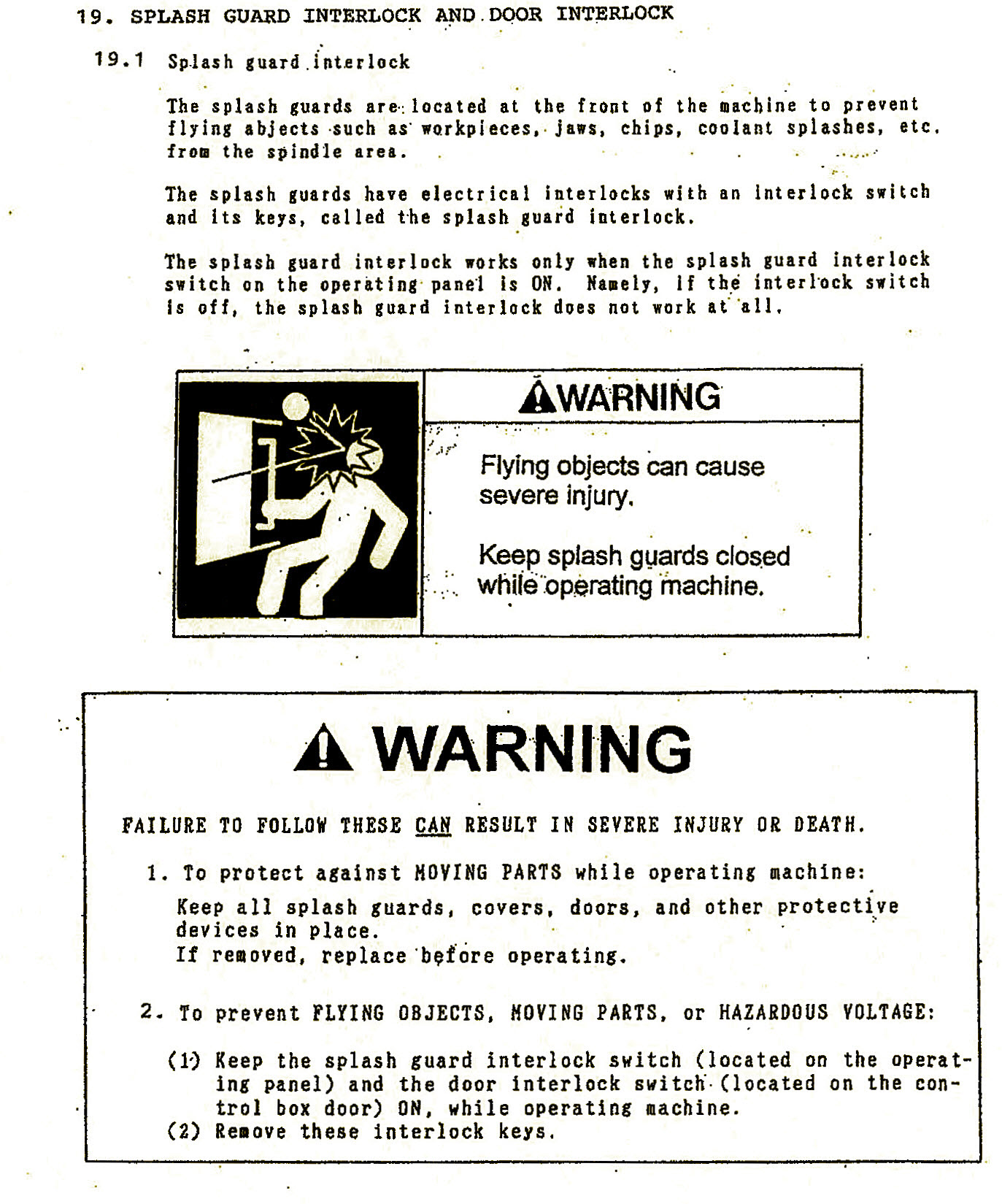
The manual’s upper warning also had a depiction of a person pulling open the splash guard/door being struck in the head by a round object. The manual’s lower warning had a warning symbol consisting of a triangle sign with an exclamation point inside that preceded the word “WARNING.” He testified that he read these warnings as requiring the splash guards/doors be shut only when there was “stuff that’s going to be flying around in there [inside the area that would be enclosed if the doors were shut] or splashing material.” He did not believe the warnings required the doors to be shut to protect against moving parts. He confirmed that it was the company’s practice to operate the CNC mills and CNC lathes with the splash guard doors open. He knew CNC lathes and CNC mills were regularly being operated without the splash guard doors being closed. He believed that, because the company manufactured plastic parts instead of metal parts, the warnings to keep the splash guard doors closed did not apply. He also felt the warning to close the splash guard doors did not apply because in his 40 years in the business he had never seen anything come out and hurt anyone. He admitted that he made the “ultimate decision” that it was acceptable to run the machines with the splash/guard doors open. The company had never required its operators to keep the splash guard doors closed during a production cycle. He said operators sometimes watched the point of operation during the production cycle while the splash guard door was partially open to insure that “the chips are lapping up.” He stated operators needed to occasionally look inside of the machines to observe progress being made on the part.
He stated the company had a general rule that no one was to reach past the door opening of CNC lathes while a workpiece was being tooled. He said it was a hazard for employees to do so for both CNC lathes and CNC mills. He testified an employee trained other employees on CNC lathe operations and instructed them to keep their hands out of the machine. They were told to use the stop button before putting their hands in the machine to make an adjustment. He stated the company had a disciplinary policy for employees that did not follow the rule; however, no one had ever been disciplined.
He admitted he had seen someone put their hands beyond the open door, within two feet of the point of operation, during the operation of a CNC lathe. He testified an op[erator cut and injured his finger on a CNC lathe on October 3, 2012 during its production cycle. His injury was treated with one stitch. He was the injured employee’s supervisor. At that time, the CNC lathes were programmed to tool the workpiece and then pause for a programmed period of time. During the pause, the operator unloaded the finished part and loaded the next blank workpiece to be tooled. The machine began tooling the next workpiece based on its programmed timing. The operator was injured when he attempted to straighten a workpiece on the spindle, at the point of operation beyond the splash door, and the machine started the tooling process while his hand was still at the point of operation. He said the operator violated the company work rule by reaching his hand into the machine while it was still cycling. He did not know why the work rule had been insufficient to protect operators from the hazard. He testified he verbally warned the operator not to reach back into the point of operation once a part was inserted in the spindle even though he “really wasn’t doing anything at that point wrong.” He stated that on October 3, 2012 it was acceptable for an operator to put their hand in the point of operation. He admitted that had the splash guard been closed the operator would not have been exposed to injury. He further agreed there was no potential for operators to put their hand into the point of operation when the splash guard/door was closed. He also agreed the machine would stop if the interlocks were active and an operator opened the door.
He stated that he was familiar with three other reported CNC lathe-related injuries at the company. In April 2012, the same operator cut himself on lathe #15 with an X-ACTO knife used to deburr a chip on a workpiece. His injury did not occur during the production cycle. In March 2013, another operator cut his hand on a part within a machine that was on, but not cycling, when he was cleaning out chips. He also testified that another operator sustained a minor injury when he reached into a machine that was “off” to clean off some chips. When removing his hand from inside the machine, the operator cut it on a sharp tool inside the machine.
He testified that one of the CNC lathes [lathe #37] displayed a splash guard label that stated:
DANGER
Do Not attempt to change, alter or modify the software or mechanism of the machine.
Any unauthorized change or modification of the software or mechanism will be cause for voiding the manufacturer’s warranties and liability, for any injury or damage claim resulting from such activities.
Do Not Open Oil Guard Safety Door While Machine is in Operation.
BEFORE STARTING MACHINE CYCLE
…
4) Splash guard must be in closed position and engaged in interlock system.
…
8) Do not attempt to put your hand in beyond oil guard, while machine is in operation.
He admitted he had read the warning sign. He testified that he discounted its reference to an “Oil Guard.” He further testified the CNC warning sign had been on the lathe since the company bought the used CNC lathe more than ten years before.
He also admitted that he had seen the warning sign on a CNC mill at the company that stated the following:
WARNING
The CNC Unit may suddenly run Table, Spindle head, or Spindle rotation.
DO NOT open door unless machine control is in manual mode and Spindle stop button is depressed.
The warning sign also had a depiction of fingers being amputated when too close to a spinning tool and a triangle sign with an exclamation point inside that preceded the word “WARNING.”
He admitted he understood the warning sign to mean “don’t open up the door if it’s [the CNC mill] running.” He testified that operators did not heed the warning and kept the doors open when the CNC mills were running; just as seen on the video at Exhibit D.
After the 2012 accident, the company changed the lathe’s programming so that the tooling process begins only after the operator manually hits the start button; it no longer had a pre-timed automatic start. He testified that the company did not consider requiring the use of active interlocks on the machines after Mr. Mullet’s accident because he “never felt there was a safety reason for it.” He testified that since the programming change he had not seen anybody reach into the area of the point of operation while a CNC lathe was running. He stated this change in procedure resulted in a faster overall production rate. He also testified that the company had talked about requiring splash guards/doors to be closed at all times during production; but that practice was never “put into place.”
He admitted opening and closing the splash guard door for each cycle could increase the production time of hand-loaded jobs. For a workpiece with a 5 minute production cycle there would be little effect; however, if the production cycle for a workpiece was only 10 seconds long, the additional 5-10 seconds spent to open and close the door for each cycle would have a noticeable effect on overall production time.
On May 29, 2014, he gave the COs a signed witness statement consisting of two pages. In summary, his written statement stated “The guards should always be put on.” He testified that he was referring to “everything in that plant,” including “the CNC lathes.” At the trial, he clarified this broad-sweeping statement by saying he did not require splash guards on CNC lathes. He also clarified his written statement by testifying the company did not require “front door” guards on the CNC mills. His written statement further stated: “I tell employees to close the doors.” At trial, he testified that he was referring to only those rare instances, that occur maybe once or twice a year, where a job is run with coolant. He said:
I tell those guys on the CNCs, when they’re running coolant, I always tell them to close the doors, although I don’t have to because that’s like running through the carwash with your window down. There’s nobody going to have those doors open with that coolant flying out. I don’t want it on the floor. They don’t want it on their clothes. And we don’t want to have a mess to clean up, or a possible safety problem.
In both his written statement and courtroom testimony, he admitted at the time of the OSHA inspection lathe #37 had “a piece of cardboard where the splash guard would be.” His written statement further explained that “Machine #37 has not had a guard for 10 years because it did not come with one.” He acknowledged that a splash guard has since been installed.
In both his written statement and courtroom testimony, he admitted, at the time of the OSHA inspection, lathe #7 had a damaged roller door since it was purchased in the 1980’s. He testified that “the bearings are all wobbly.” He said that the door was “hard to open and close.” In his written statement he admitted that the machine’s operator “may not use this door every single time, ….” In both his written statement and courtroom testimony, he admitted “sometimes interlocks are broken” and one interlock was tied back with wire.
He stated that operators were paid a straight hourly rate and not paid based on production numbers, so there was no financial incentive to keep the splash guard doors open to speed up the process. He also said he never saw employees bumping into each other in the machine shop. He also testified he never heard of a tool or part breaking within a machine and either staying within, or flying out of, the machine. He also testified he did not know it was an OSHA violation to run CNC lathes with the splash guard doors open. He did not believe it was a hazard to do so.
He was the company’s vice president of manufacturing in 2008. He agreed the company told OSHA in its January, 2008 Certificate of Abatement that operators were told to use all supplied machine guards. He did not recall employees being informed that guards must remain on the machine while in operation.
He acknowledged there was a time when machine operators reached into machines, while the machines were running, to grab parts off the machine. He stated “[b]ut the first part off the machine sometimes it just wouldn’t face off right, they would reach in and they would grab it [the part].” He further testified that this practice was eventually changed and the parts “now fall onto the wire” and the operator can “pull the parts out” from inside the machine after the cycle is complete.
CITATION
Secretary’s Burden of Proof
To establish a violation of an OSHA standard, the Secretary must show by a preponderance of the evidence that:
- the cited standard applies;
- the terms of the standard were violated;
- the employer knew, or with the exercise of reasonable diligence could have known, of the violative condition; and
- one or more employees had access to the cited condition.
Citation 1, Item 1
The Secretary cited the company for a willful violation of 29 C.F.R. § 1910.212(a)(1) which requires:
(a) Machine guarding – (1) Types of guarding. One or more methods of machine guarding shall be provided to protect the operator and other employees in the machine area from hazards such as those created by point of operation, ingoing nip points, rotating parts, flying chips and sparks. Examples of guarding methods are – barrier guards, two-hand tripping devices, electronic safety devices, etc.
Specifically, the Secretary alleged that the company did not provide adequate machine guarding to protect employees from the hazard of moving parts for seven pieces of equipment – five XXXXXX CNC automatic lathes and two XXXXXX CNC mills. For each machine, the citation alleged there was a lack of “adequate guarding to protect the employees from the moving parts of the lathe, thereby exposing the employees to an amputation hazard.”
The seven cited machines are:
- Number 7 XXXXX CNC automatic lathe, model number BNC-34, serial number BN30982L.
- Number 15 XXXXX CNC automatic lathe, model number BNC-34, serial number BN30989C.
- Number 19 XXXXX CNC automatic lathe, model number BNC-34, serial number BN32101C.
- Number 37 XXXXX CNC automatic lathe, model number BNC-20S, serial number BN202765.
- Number 38 XXXXX CNC automatic lathe, model number BNC-34S, serial number BD10356.
- XXXXX 510 CNC mill, model number XL-510, serial number ES78829.
- XXXXX 810 CNC mill, model number XL-810, serial number ES81726.
Respondent admitted the interlocks on the lathes were not functioning and that it did not require its operators to close the doors on the CNC mills and CNC lathes during the production cycle. Respondent asserts the Secretary cannot prove the prima facie element of exposure to a hazard because its operators had no reason to be near the point of operation during a production cycle and the Secretary did not show inadvertent contact was reasonably predictable based on how operators used the machines.
Applicability and Violation of the Standard
29 C.F.R. § 1910.212(a)(1) requires employers to use one or more methods of machine guarding to provide protection to operators and other employees in the machine area from hazards created by, for example, point of operation, rotating parts, and flying chips. Examples of guarding methods include barrier guards and electronic safety devices, including interlocks. The standard does not specify which guarding method shall be used; it just mandates that a guarding method shall be used.
Respondent does not dispute that the standard is applicable to the seven cited CNC machines and that its employees routinely operated the CNC mills and CNC lathes without guarding. The Court further finds Respondent’s employees routinely operated the CNC mills and CNC lathes without guarding in violation of the standard’s requirements. The Court finds that the cited standard applies.
The Company asserts the only hazard at issue in the instant case is related to employee exposure to a machine’s moving parts and no other hazards. The company cited Carlyle Compressor v. OSHRC, 683 F.2d 673, 675 (2nd Cir. 1982) and Sec’y of Labor v. Loren Cook Co., 803 F.3d 935, 941 (8th Cir. 2015) to support its assertion that a tool or workpiece ejected from the machine is not covered under the cited standard. Loren Cook is not apposite to the instant case. Loren Cook narrowly held that 29 C.F.R. § 1910.212 (a)(1) did not apply to the hazard of the anomalous ejection of a large 12-pound rotating metal workpiece from a lathe that was the basis of the alleged violation by the Secretary. 803 F.3d at 937. Carlyle held the standard did not cover the hazard of a thrown machine shaft. Neither case is relevant to the hazard of exposure to moving parts in the instant case.
Further, neither case is from the likely circuit of appeal for the instant case. The Court finds these cases are inapposite to the instant case.
Knowledge
The Secretary must prove the employer either knew, or with the exercise of reasonable diligence could have known, of the violative condition. The employer’s knowledge is directed to the physical condition that constitutes a violation. It is not necessary to show that the employer knew or understood the condition was hazardous.
Knowledge is imputed to the employer “through its supervisory employee.” The vice president of manufacturing admitted it was his decision to allow the employees to routinely operate the lathes and mills without use of machine guarding.
Here, the company’s management knew that 29 C.F.R. § 1910.212(a)(1) required CNC lathe and CNC mill machines be adequately guarded from hazards created by moving parts. The Court finds that the company also knew its employees routinely operated the CNC lathes and CNC mills without guarding. It further finds the company’s management was well aware its employees routinely operated the CNC lathes and CNC mills with the splash guard doors open, leaving no barrier between the operators and the point of operation, or other moving parts. The company had ample warning that the splash guard doors on both the CNC lathes and CNC mills needed to be closed while the machines were operating. Lathe #37 and other machines had warning signs that said “DANGER,” “Do Not Open Oil Guard Safety Door While Machine is in Operation.” The warning signs also stated “Splashguard must be in closed position and engaged in interlock system” before starting the machine cycle. Both CNC mills also had warning signs above the spindle area that read “DO NOT open door unless machine control is in manual mode and Spindle stop is depressed.” The warning signs also had a depiction of fingers being amputated when too close to a spinning tool and a warning symbol consisting of a triangle sign with an exclamation point inside that preceded the word “WARNING.” The Company did not heed these warnings and chose to ignore them. The company also ignored additional clear warnings in the CNC lathe operating manual that said: “Keep splash guards closed while operating machine[.]” and “[t]o protect against MOVING PARTS while operating machine: Keep all splash guards, covers, doors, and other protective devices in place. If removed, replace before operating.” Another warning had a depiction of a person pulling open the splash guard/door being struck in the head by a round object. The manual also included a warning that said “FAILURE TO FOLLOW THESE CAN RESULT IN SEVERE INJURY OR DEATH.”
Exposure
The parties agreed there was no operational necessity for an operator to have his hands in a machine during the production cycle. The citation is based on exposure through careless, inadvertent, or intentional contact with a machine’s moving parts. An employee would be exposed to a moving parts hazard by placing his or her hand within a CNC lathe or CNC mill while the machine is cycling. Lathe operators are repeatedly required to put and use their hands at the point of operation inside the machines to insert and retrieve parts and remove debris. This is expected to occur at a time when power is flowing to the lathes, but the lathes are not engaged in an active cycling manufacturing operation. There is a zone of danger for employees within the confines of the CNC lathes and CNC mills at the company.
The Court finds the Secretary has proven it is reasonably predictable for an operator to carelessly, inadvertently, or intentionally contact the point of operation during a machine’s production cycle.
The Commission has long held the definition of the hazard depends on how the machine functions and how it is operated. To establish exposure under the cited standard, “the Secretary… must show that it is reasonably predictable either by operational necessity or otherwise (including inadvertence), that employees have been, are, or will be in the zone of danger.” The zone of danger is “that area surrounding the violative condition that presents the danger to employees [that] the standard is intended to prevent.” Here, the cited standard protects employees from the moving parts of a CNC mill or CNC lathe.
The Secretary asserts the zone of danger is the entire area with the walls of the machine and while in the zone of danger an employee can inadvertently contact moving parts. The Secretary’s expert stated that the zone of danger was “within the confines of the equipment.” For both CNC mills and CNC lathes, the Secretary asserts the point of operation exposes an operator to injury from moving parts. The Secretary also asserts the CNC mill’s moving table presents a hazard to the operator.
The point of operation “is the area on a machine where work is actually performed upon the material being processed.” 29 C.F.R. § 1910.212(a)(3)(i). For the lathes, the point of operation is the location where the blank plastic workpiece is loaded onto the spindle about 2 feet away from the doorway’s threshold. During production, the tool moves to the rotating workpiece to produce the part. (JPHS Fact #1).
For the mills, the blank workpiece is loaded onto a table near the doorway opening. When the production cycle begins, the table moves the blank workpiece toward the point of operation near the back of the machine, approximately two feet from the door’s threshold. The rotating tool then moves vertically down to produce the part.
The Respondent asserts the Secretary’s definition of the zone of danger is too broad and the Secretary has not shown that being next to the open doorway presents a danger to an operator. Respondent asserts the Secretary’s expert was considering hazards that are not at issue in the instant case. Nonetheless, while the Secretary’s allegations in the instant case do not include every hazard that could occur from a lack of guarding, the Court finds the Secretary has shown that the machine’s moving parts can be accessed from any place within the machine when the splash guard door is open. The zone of danger includes the confines of the machine.
The Secretary argues that the company’s operators are exposed to the zone of danger in two ways. The first is when the operator misjudges the timing of the CNC lathe’s cycle and makes contact with the point of operation before the spindle stops rotating or a CNC mill operator enters the zone of danger; e.g., to remove debris. The second is when an operator stands by the open doorway of the CNC lathes and CNC mills during the production cycle. With respect to the Secretary’s first argument, that an operator could make contact because he misjudges the timing of the production cycle, the Court finds it is reasonably predictable a CNC lathe operator could carelessly, inadvertently or intentionally contact the point of operation. The Commission has long recognized the machine guarding standard is designed to protect employees from human mistakes such as distraction, carelessness, and fatigue.
The Court finds the combined factors of the absence of the use of any guarding method, including splash guard doors left open and nonfunctioning interlocks, the repetitive steps in the workpiece hand-loading process, the production cycle’s automatic stop, the fast pace of production with operators standing alongside the open doors, the recurring need to clear out debris from inside the machines by hand and air wands, and the significant experience needed to master the lathe’s operation, make it reasonably predictable a CNC lathe operator would misjudge the lathe’s timing and make contact with the point of operation during a production cycle.
The company knew the interlocks on the five CNC lathes were not functional. Lathe #15’s interlock was “tied back” for more than a decade showing a continuing, conscious decision to render its interlock useless. The company also knew the two CNC mills had no interlocks. An interlock is an “electronic safety device” within the meaning of the cited standard. A functional interlock would not allow part production to occur with an open splash guard door. Because the interlocks on the company’s CNC lathes did not function and were missing on its CNC mills, doors could remain open during production and thus not provide a physical barrier between the operator and the point of operation. JPHS Fact #6 that states “[i]nterlocks are not required under the cited standard” does not absolve the company from being found to have violated the cited standard. Interlocks were an electronic safety device that the company could have used as a guarding method. It chose to not use interlocks, or any other suitable guarding method, as machine guarding to protect its employees from the hazard of moving parts.
The steps of the workpiece hand-loading process for CNC lathes contribute to the likelihood of contact with the point of operation. The operator manually controls the start of the cycle, but not its end. The operator watches the production process and unloads the finished part when he believes the production cycle is finished. The spindle operates at 250 to 1,200 rpm during a production cycle. The spindle stops rotating after the tool backs away from the point of operation. When unloading the finished part, the operator can misjudge whether the spindle has stopped and make contact with the still rotating spindle.
Finally, the fast pace of successive production cycles contributes to the likelihood an employee will misjudge the timing and reach into a CNC lathe too soon. The CNC lathe operator unloads the finished part and loads the next blank workpiece in rapid succession. The record shows the full production cycle for a finished part can be 30 to 120 seconds. In the demonstration video, the production time for the finished part was less than 20 seconds. The video also shows that approximately three seconds elapse from the unloading of a finished part to the loading of the blank workpiece. This very rapid pace of production, with just seconds between cycles, done many times per day, makes it reasonably predictable an operator could misjudge the timing by a second or two and make contact with the rotating spindle. This would be especially true for less experienced employees because it can take 6-7 years for an employee to master the CNC lathe’s operation.
An employee’s 2012 accident demonstrates that misjudging the timing of a production cycle leads to injury. He was injured when the production cycle started while he was adjusting the workpiece inside a CNC lathe. Just as he misjudged the timing of the automatic start, an employee could misjudge when the production cycle had finished and make contact with the point of operation while the spindle was still rotating. Had a guard been in place and used, it would have prevented the employee’s injury. If interlocks were functioning on his CNC lathe, the interlock would have prevented him from even being able to open the splash guard door while the machine was engaged in a cycling operation.
Finally, a quick production pace was important to the company. An operator testified that the ability to quickly hand-load workpieces gave the company a competitive advantage. The VP and the employee acknowledged that closing the door for each production cycle could significantly effect production time, especially for short-cycle jobs. This focus on the pace of production supports the assertion that the fast pace contributes to the likelihood of a mistake.
Here, the evidence shows the specific nature of how the CNC lathes and CNC mills are operated by the company’s employees. By their own testimony, and by additional evidence including videos of the actual operation of both types of machines, it has been shown that Respondent’s employees who operate CNC lathes and CNC mills must necessarily do many of their required tasks either within the confines of the machines or immediately adjacent thereto. While they are performing these tasks, the machines are repeatedly placed into and taken out of the cycled operation. The production cycle occurs over and over, hands in and hands out of the CNC lathes, the machine’s operating cycle turned on and turned off, up to 600 times each day. It is reasonably predictable that The Company’s employees will not be able to maintain the constant vigilance and perfect timing needed to avoid another incident involving contact with moving parts. A repeat of Mr. Mullet’s accident is very possible through contact with moving parts an operator thought had stopped, but had in fact not stopped.
Secondly, the Secretary asserts that being next to the open door of these CNC machines during production also exposes an employee to the zone of danger. Leaving the splash guard doors open while the CNC machines are operating is a ready invitation for operators to enter into the zone of danger for whatever reason, including accident, carelessness and inadvertence; thereby being exposed to the hazard of moving parts. The record shows operators stood by the opening during the production cycle. The width of the lathe’s opening was 17 inches and the height was roughly the distance from an employee’s hip to shoulder. Operators routinely watched the process to determine if debris was accumulating on the workpiece. Further, to use the CNC lathe’s control panel, for example to hit the cycle start button, the operator had to reach across the open doorway. OSHA’s CO observed an employee using an air wand in the CNC lathe’s doorway during a production cycle and an employee with his face next to an open door observing the workpiece’s progress. The door opening for the two CNC mill machines was substantial in size; large enough for the upper body of an operator to stumble or fall into the zone of danger.
Respondent refutes this argument by stating no operator had ever contacted the machine’s moving parts while using an air wand or using the control panel. Further, Respondent asserts this is analogous to the alleged exposure in Fabricated Metal Prod., 18 BNA OSHC at 1073-75. In Fabricated, an employee was observed using a hand wand to clean the equipment with compressed air 12-14 inches away from the point of operation. The Commission found it “remote at best” an employee would make contact with the point of operation as the result of a slip and fall.
The instant case differs from Fabricated in several ways. In Fabricated, the Commission found there was no reasonably predictable exposure to the point of operation from a slip and fall because boxes limited direct access to the area, the machine was equipped with a sensor to shut it down if it detected an adjustment to the machine, and the opening to the points of operation were small – between 1/4 inch to 3 inches.
The Court finds Fabricated is not analogous to the instant case. In this case, there was no obstruction between the operator and the machine’s moving parts. The machines had no sensor or other device to automatically stop the machine. The door openings for both the CNC lathes at CNC mills were substantially larger. Finally, the point of operation could be reached from anywhere within the confines of the machine and not the limited openings of 1/4 inch to 3 inches in Fabricated.
Further, the company cannot rely on its belief that employees are safe because there had been no prior accident other than the one accident. The OSH Act is designed to prevent injury rather than waiting for “an employee to die or become injured.” The Commission has held that a hazard is presumed to exist where a standard sets forth a particular method for employee safety. Here, the cited standard requires guarding of a machine’s moving parts to prevent an injury. Relying on an employee’s “common sense” or judgment rather than provide a guard is not a reasonable means of protection from a machine’s moving parts. (Machine guarding standard requires physical methods of guarding rather than methods of guarding that depend on human behavior; unguarded point of operation posed a hazard that could result in injury in the event of employee carelessness or inadvertence); (Standards require guarding be provided by a device that itself prevents the operator from endangering himself; dependence upon employee behavior misplaced).
The Secretary also asserted that an operator could make inadvertent contact with moving parts if he stumbled or slipped his or her arm or hand into the opening of a CNC lathe or CNC mill machine. The close proximity of the machines with the operators facing away from each other make it predictable operators could bump into each other causing an arm or hand to enter into the zone of danger. The door openings of both the CNC lathes and CNC mills are large. An operator could lose his balance and fall into the zone of danger of an operating CNC mill machine.
Respondent refutes this point by stating this had never occurred and asserts the instant case is analogous to Buffets, Inc., 21 BNA OSHC 1065, 1067 (No. 03-2097, 2005). In Buffets the Commission found there was no evidence of conditions that a slip and fall was a likelihood. Unlike Buffets, the issue here is not whether there is any substance or obstacle that would cause an operator to slip or fall. The hazard in the instant case results from the close proximity of the machines to one another, the operators’ difficulty in seeing each other while operating their machines, and the openness of the zone of danger when the splash guard doors are not closed. The door opening of a CNC lathe is large enough for an employee to insert his arm or hand into the machine after being bumped by another employee. The opening was 17 inches wide and the height was roughly the distance from an employee’s hip to shoulder. The CNC mill machine’s opening is even larger. When the CO observed the operation, he saw that operators stood close to each other and faced away from each other. As a result, he believed it was predictable an operator could accidentally back into another while operating a machine. The CO’s testimony was straightforward and convincing. The Court agrees that a long sleeve shirt or hooded sweatshirt could get entangled on a moving part.
Respondent also relies on other Commission cases to support its position its operators were not exposed to moving parts; e.g.,
- Delek Refining, Ltd., 25 BNA OSHC 1365, 1374 (No. 08-1386, 2015), appeal docketed, No. 15-60443 (5th Cir. June 22, 2015);
- S. D. Beverly Enters., Inc., 21 BNA OSHC 1037, 1038-39, (Docket No. 01-202, 2005) (consolidated);
- Miniature Nut & Screw Corp., 17 BNA OSHC 1557, 1561-63 (No. 93-2535, 1996);
- Jefferson Smurfit Corp., 15 BNA OSHC 1419, 1421 (No. 89-0553, 1990);
- Syntron, Inc., 11 BNA OSHC 1868, 1869 (No. 81-1491, 1984).
In Delek, the Commission found that no one worked near or had duties on the machines, there was no evidence employees were near the zone of danger, and that being 5-10 feet away was too far for inadvertent contact. By contrast, the company’s employees had duties at the machines, they were in and out of the zone of danger many times a day, and were routinely at the CNC lathe’s point of operation. The Court finds Delek does not support Respondent’s position.
In Beverly, the Secretary alleged employees were exposed to moving parts as an operational necessity. The Commission found there was no operational reason for an employee to have his hands at the point of operation and thus there was no exposure. Beverly, 21 BNA OSHC at 1038-39. The Commission noted that, unlike here, the Secretary “makes no claim that inadvertent contact with the rotating agitator could be made by Beverly’s employees during normal use of the unguarded A-200 mixer.” Here, the violation is based on accidental, careless, inadvertent or intentional contact with the point of operation; as such Beverly does not support Respondent’s position.
Neither does Miniature. In Miniature, the Commission found there was no violation of 29 C.F.R. § 1910.212(a)(1) because there was no employee exposure to an unguarded nip point in a flat die thread roller used about once a week where a barrier, the bulk of the machine itself, was between the operator and a small brush an operator might reach for while the machine was not running. The instant case is distinguishable from Miniature. Here, the operator stands next to the zone of danger throughout the production cycle in order to quickly load a workpiece for the next cycle. Further, the operator is placing his hands in and out of CNC lathes at a rapid pace due to short cycle times, and there is no barrier between the operator and moving parts.
In Jefferson, the Commission rejected testimony presented on behalf of the Secretary that straight-line gluer106 operators routinely came within 2 to 5 inches of the unguarded nip points. Instead, the Commission found there was no evidence of an occasion where an operator would be closer than 16 inches to the machine’s nip points. In contrast, here, it is undisputed operators are routinely at the point of operation to load and unload parts within CNC lathes and clear debris in both CNC lathes and CNC mill machines. Jefferson does not support Respondent’s position.
In Syntron, the Commission found there was no violation because the evidence did not show the operator would have a reason to come close enough to unguarded portion of a saw blade. Syntron, 11 BNA OSHC at 1869 (Commissioner Cleary dissenting – Majority taking no account that operator could be injured through inadvertence). Here, the operators were routinely at the point of operation of CNC lathes. Syntron does not support the Respondent’s position.
The Secretary also proved exposure to the hazard of moving parts for CNC mill operators. While a CNC mill operator does not load at the point of operation, the risks are the same for an operator standing near the CNC mill’s open doorway. Because there is no barrier between the operator and the point of operation, an operator is able to reach into the machine to make adjustments or clear debris at any time. The Company cannot rely on an employee’s judgement instead of providing a barrier or other guarding for protection from moving parts. Further, the CNC mill’s opening is large enough for an operator’s arm, hand or upper body part to enter into the zone of danger and make contact with moving parts.
The Court finds the Secretary has proved that it is reasonably predictable the CNC lathe and CNC mill machine operators are exposed to moving parts due to the specific nature of how the machines are operated.
The Court further finds the Secretary demonstrated the operators’ practice of standing next to the open splash guard doorway during the production cycle makes it reasonably predictable careless, accidental, inadvertent, or intentional contact with the moving parts of a CNC lathe and CNC mill would occur.
Finally, the Court finds the Secretary proved it was reasonably predictable operators were exposed to moving parts on the CNC lathes and CNC mills and did not provide the required guarding. The Secretary proved his prima facie case for Citation 1, Item 1.
Willful Characterization
The Secretary classified this violation as willful. A willful violation is done “with intentional, knowing or voluntary disregard for the requirements of the Act or with plain indifference to employee safety.”
“The Secretary must show that the employer was actually aware, at the time of the violative act, that the act was unlawful, or that it possessed a state of mind such that if it were informed of the standard, it would not care.”
A willful violation differs from a serious violation by a heightened awareness and either conscious disregard or plain indifference.
The Commission has repeatedly held that an employer who deliberately disregards known safety requirements acts willfully. In Calang Corp., the Commission held that the “conscious disregard” of the requirements of the cited standards by an employer who had the standards explained to him was willful. In Donovan v. Williams Enters., the court affirmed a Commission decision that an employer who had failed to heed warnings that it was not in compliance with OSHA standards and abate the violations acted willfully. The court stated, “These facts alone are sufficient to establish ‘intentional disregard of’ and ‘plain indifference’ to OSHA’s regulations.”
The Secretary asserts the company had a heightened awareness of the need to guard the moving parts of CNC lathes and CNC mill machines through an OSHA citation issued December 20, 2007, the abatement the company implemented in response to that citation, the company’s warnings to its employees to keep their hands out of the machine, the warning in the CNC lathe’s operating manual, the warning labels on the CNC lathe and CNC mill machines, and the 2012 injury. Respondent asserts none of these are a basis to support a willful characterization. Respondent is wrong. In the aggregate here, they provide an ample basis to justify a willful characterization.
The Secretary asserts the 2007 machine guarding citation, and the subsequent abatement, provided the company with a heightened awareness of the unguarded condition of its machines and the standard’s requirement to guard against moving parts. The Court agrees. The 2007 citation included violations of two machine guarding standards: 29 C.F.R. § 1910.212(a)(1) and 29 C.F.R. § 1910.213(a)(3)(ii). The company’s abatement certification to OSHA stated the machine guards had been installed on the machines and employees were instructed to use them during operations.
Respondent asserts two reasons why the 2007 citation and abatement did not provide heightened awareness: the machines were distinctly different than the instant case and current management team was not involved in the 2007 citation and abatement. Both arguments fail.
The 2007 citation alleged a machine guarding violation for the company’s CNC milling machines. The difference between the company’s CNC mills and CNC lathes is not such that it is reasonable for the company’s management to believe machine guarding was required on a CNC mill, but not a CNC lathe. Both machines are used to modify blank workpieces and individually loaded by the operator. The primary difference is the location of the workpiece. This difference does not support a reasonable belief the machine guarding requirement did not also apply to its lathes.
Respondent also states that, because the company’s current management team was not significantly involved in the abatement of the 2007 citation, there is no heightened awareness. Current management’s asserted lack of significant involvement in the prior citation does not deprive the company of heightened awareness. The company cannot claim ignorance of the 2007 citation and abatement; a corporate entity’s knowledge is through its key employees. See Caterpillar, Inc., 17 BNA OSHC 1731, 1732 (No. 93-373, 1996), aff’d, 122 F.3d 437, 440-41 (7th Cir. 1997). An employer does not lose its “knowledge” when a supervisory employee no longer works for the organization; the employer retains the knowledge. The knowledge the company’s safety officer gained during the 2007 citation and abatement was imputed to the company and remained with the company after his employment ended. Further, the VP has worked for the company since the company was formed in 1990 and as vice president of manufacturing likely would have known if guards were removed from storage and installed on machines. He also agreed the company told OSHA in its January, 2008 Certificate of Abatement that operators were told to use all supplied machine guards.
The Court finds that the 2007 citation and subsequent abatement provided the company with a heightened awareness of the requirements of the cited standard and need to guard the moving parts on its machines. The company allowed its operators to not use guarding in disregard of the standard’s requirements.
The Secretary asserts that The Company’s warnings to its employees show a heightened awareness of the hazards.
Further, The Company ignored the warnings on its machines and operating manual that stated the splash guard doors should be closed. The Company also ignored its own history and dismissed the hazard of making contact with moving parts by consciously deciding not to use guards for the CNC lathe and CNC mill machines.
The VP admitted the company’s machine operators did not comply with the warning signs on the machines. He testified that even though the warnings stated the “splash guard must be in closed position and engaged in interlock system,” he believed, based on his 41 years of industry experience, it did not apply to the the company’s manufacturing process.
The VP admitted he made the decision that operators could operate with the guard doors open and he knew operators generally ran the lathes with the doors open. He also knew employees were warned to keep their hands out of the machine during their training.
The Court finds the company’s warnings to its employees show the company was aware of the risk of injury to an operator. The Court finds the company’s choice to ignore the machine manufacturer’s warning labels based on The VP’s experience in the industry was not reasonable. All the employees each admitted that they had no training on machine guarding or safety generally. The company management replaced the manufacturer’s warnings with its own judgement, despite their lack of expertise in safety or machine guarding. This demonstrates a heightened awareness of the hazard as well as indifference to employee safety.
Finally, after the 2012 accident, the company continued to allow operators to keep the splash guard doors open during production. Instead of following the warnings to close the splash guard doors, the company changed the program for the production cycle and still relied on a general instruction to its employees. Despite its heightened awareness from the accident, the company continued to operate with the doors open in disregard of the standard’s requirements and with indifference to the safety of its employees.
The company asserts that a willful characterization is negated by its good faith belief that it was in compliance. “It is well established that a willful charge is not justified if an employer has made an objectively reasonable, good faith effort to comply with the standard or to eliminate a hazard even though the employer’s efforts are not entirely effective or complete.” Spirit Homes, Inc., 20 BNA OSHC 1629, 1630 (No. 00-1807, 2004)
The company’s good faith belief is based on the lengthy experience of the VP and a long-time employee, its operators feeling safe with the doors open, its programming fix after the 2012 accident, a 2010 OSHA inspection, and its lack of significant injuries. The Company also points out that it did not require the operators to keep the doors open and it did not pay its operators based on production.
Respondent bears the burden of proof to show good faith. An employer’s subjective belief that it is in compliance with an OSHA standard is not sufficient to overcome a finding of willfulness. The test is “an objective one – whether the employer’s belief concerning a factual matter or concerning the interpretation of a standard was reasonable under the circumstances.” “[A]n employer is not necessarily spared from a finding of willfulness by taking any measure, regardless of how minimal, to enhance employee safety.” J.A. Jones Constr. Co., 15 BNA OSHC 2201, 2209 (No. 87-2059, 1993).
For the reasons that follow, the Court finds that the company’s beliefs and actions were not objectively reasonable and do not support a good faith belief it was in compliance or had abated the hazard. Neither management nor operators had safety training. The company presented no evidence to show that management or operators had an understanding of safe operating practices or machine guarding requirements. Thus, the company’s reliance on their experience in the industry for machine safety issues is not objectively reasonable.
The Company cannot rely on an operator’s belief he is safe or give employees the option to work safely. An employer “cannot shift to its employees the responsibility for assuring safe working procedures.” Pride Oil Well Servs., 15 BNA OSHC 1809, 1851. This is especially true here because the company provided no safety training to its employees. The Court finds the company’s reliance on its employees’ perceptions they were safe does not support an objective good faith belief that guarding was not required or needed.
The company also asserts its response to the 2012 accident demonstrates good faith. After the accident, the company modified the CNC lathe’s program to require a manual start of the production cycle in lieu of the automated start. This argument fails. The accident demonstrated that access to the point of operation during a production cycle could result in an injury. The Commission has consistently held the cited standard “requires physical methods of guarding rather than methods of guarding that depend on human behavior.” H. B. Zachry Co. Int’l, 8 BNA OSHC at 1674 (citations omitted). Instead of using the splash guard door with a working interlock or other guarding system, the company simply changed the machine’s program and continued to rely on an operator to avoid placing his hands in the machine. The company’s response did not solve the problem of accidental contact with the machine’s moving parts, as required by the cited standard and by the machine’s own warnings. Thus, its response does not support a good faith belief the hazard was abated.
Further, The Company cannot rely on a lack of significant injury history to establish good faith. The company provided no safety training to its employees and simply relied on an employee to keep his hand out of the machine. An employer cannot rely on luck to prevent an injury. See generally, Whirlpool Corp. v. Marshall, 445 U.S. at 12 (“The Act does not wait for an employee to die or become injured. It authorizes the […] issuance of citations in the hope that these will act to prevent deaths or injuries from ever occurring”). The Court finds the company’s lack of a significant injury history does not provide a basis for a good faith belief that it was in compliance with safety standards or had abated the hazard.
The company asserts that the VP had a good faith belief it was safe for the operators to keep the doors open during the production cycle because the company was not machining metal or using coolant. A supervisor’s belief that a condition is safe does not constitute reasonable, objective good faith. See Sec’y of Labor v. Capital City Excavating Co., Inc., 712 F.2d 1008, 1010 (6th Cir. 1983) (foreman’s good faith belief that trench was safe does not mitigate willfulness); Gen. Motors Corp., CPCG Oklahoma City Plant, 22 BNA OSHC 1019, 1044 (No. 91-2834, 2007) (consolidated) (affirming a willful violation where the employer’s belief was neither “plausible nor reasonable”).
The record does not provide support for the VP’s belief that guarding was needed only when working with metal or when using coolant. The warning in the operator’s manual specifically states that the splash guard door should be closed while the machine is in operation.
Respondent also asserts that the company had a good faith belief it was in compliance because it was not cited for a machine guarding violation after a 2010 OSHA inspection. This argument fails. “[I]t is well established that an employer cannot rely on the Secretary’s failure to issue a citation” as proof of compliance. Peterson Bros. Steel Erection Co., 16 BNA OSHC 1196, 1201 (No. 90-2304, 1993) (citations omitted), aff’d 26 F.3d 573 (5th Cir. 1994).
Finally, not having production quotas or compensation based on production speed does not provide an objective good faith belief that the company was in compliance or operating safely.
The Court finds the company’s assertion it had a reasonable, good faith belief that it was operating its machines in compliance with OSHA standard or it had eliminated the hazard was not objectively reasonable and fails. The Court finds the record supports the characterization of a willful violation.
Penalty Amount
The Secretary properly classified this citation item as willful. The maximum penalty for a willful violation is $70,000. Section 17(j) of the Act requires the Commission to give due consideration to four criteria in assessing penalties:
- the size of the employer’s business,
- the gravity of the violation,
- the employer’s good faith, and
- its prior history of violations.
The Secretary proposed a penalty of $49,000 which is a 30% reduction from the maximum penalty of $70,000. OSHA’s CO testified there was no penalty adjustment for good faith. The record is silent on the level of gravity that was assessed or the penalty reduction provided due to the company’s size by the Secretary.
The Court finds that the Secretary’s proposed penalty of $49,000 is reasonable and appropriate. In assessing its penalty, the Court has considered the size of the company’s business, the gravity of the violation, the company’s good faith or lack thereof, and its prior history of violations. The Court assesses a penalty of $49,000.
Findings of Fact and Conclusions of Law
All findings of fact and conclusions of law relevant and necessary to a determination of the contested issues have been made above. See Fed. R. Civ. P. 52(a). All proposed findings of fact and conclusions of law inconsistent with this decision are denied.
ORDER
Based upon the foregoing findings of fact and conclusions of law, it is ORDERED that:
1. Citation 1, Item 1, alleging a willful violation of 29 C.F.R. § 1910.212 (a)(1) is AFFIRMED, and a penalty of $49,000 is assessed.
CLICK HERE for the full decision