
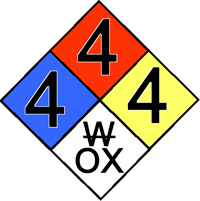
I have to admit that this transition from the old HAZCOM to this Globally Harmonized Hazcom Standard has been a bumpy ride over the past 4-5 years. I have had to correct postings a couple of times with some help from my friends at OSHA and NFPA. But there is one thing that I am 100% certain of, and this has been validated by several OSHA CSHOs and NFPA professionals, is that the NFPA 704 – Diamond is still a viable label and is 100% compliant with OSHA’s GHS HAZCOM. Yes, we have to be sure we do not confuse the NFPA ratings with the OSHA GHS Categories; but the label is still perfectly acceptable. Here’s why…
In OSHA’s new HAZCOM standard, section (f) Labels and other forms of warning, the wording is clear that section (f)(1) applies to “Labels on shipped containers”. And it is true that these labels on shipped containers must contain:
- Product identifier;
- Signal word;
- Hazard statement(s);
- Pictogram(s);
- Precautionary statement(s); and,
- Name, address, and telephone number of the chemical manufacturer, importer, or other responsible party
So if we are receiving “shipped containers” or we are “shipping containers” that contain a hazardous material then the above label content requirements will apply.
But what about our “fixed” and “portable” tanks/containers that will NOT be shipped (nor received as a “shipped container”); how can they be labeled? For that answer, we look to section (f)(6) “Workplace Labeling” which states: (emphasis added by me)
1910.1200(f)(6) Workplace labeling. Except as provided in paragraphs (f)(7) and (f)(8) of this section, the employer shall ensure that each container of hazardous chemicals in the workplace is labeled, tagged or marked with either:
1910.1200(f)(6)(i) The information specified under paragraphs (f)(1)(i) through (v) of this section for labels on shipped containers; OR
1910.1200(f)(6)(ii) Product identifier AND words, pictures, symbols, OR combination thereof, which provide at least general information regarding the hazards of the chemicals, and which, in conjunction with the other information immediately available to employees under the hazard communication program, will provide employees with the specific information regarding the physical and health hazards of the hazardous chemical.
1910.1200(f)(7) The employer may use signs, placards, process sheets, batch tickets, operating procedures, or other such written materials in lieu of affixing labels to individual stationary process containers, as long as the alternative method identifies the containers to which it is applicable and conveys the information required by paragraph (f)(6) of this section to be on a label. The employer shall ensure the written materials are readily accessible to the employees in their work area throughout each work shift.
1910.1200(f)(8) The employer is not required to label portable containers into which hazardous chemicals are transferred from labeled containers, and which are intended only for the immediate use of the employee who performs the transfer. For purposes of this section, drugs which are dispensed by a pharmacy to a health care provider for direct administration to a patient are exempted from labeling.
1910.1200(f)(9) The employer shall not remove or deface existing labels on incoming containers of hazardous chemicals, unless the container is immediately marked with the required information.
1910.1200(f)(10) The employer shall ensure that workplace labels or other forms of warning are legible, in English, and prominently displayed on the container, OR readily available in the work area throughout each work shift. Employers having employees who speak other languages may add the information in their language to the material presented, as long as the information is presented in English as well.
So as we can see, the NFPA 704 Diamond, complies with 1910.1200(f)(6)(ii) as long as it is used PROPERLY, meaning we need the chemical name (or some other identifier) WITH the diamond and all its data.
So before we spend the $ and time re-labeling hundreds of tanks/vessels, consider this information; of course relabeling with Pictogram style labels will be just fine. I just wanted to put this out there for those who may be struggling with how their fixed tanks/vessels must be labeled.
Final comments…
- PLEASE make sure if we use the NFPA Diamond as a label on our containers/tanks/vessels that it is formally included in our written HAZCOM program, training program, including contractor training for those who have a PSM/RMP covered processes.
- We can not “throw out” the NFPA Diamond, as many of you work in states where the state fire code still requires buildings/rooms, as well as tanks/vessels be labeled using the NFPA 704 Diamond.
Good luck and I hope this helps clear up some questions you may have had.