
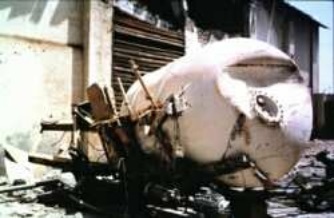
 In my travels around the world, I find that many still view Anhydrous Ammonia as a “chemical that changed the world.” From the fertilizer industry I hear how Anhydrous Ammonia has saved billions from starvation as it works its magic as a fertilizer; from the refrigeration industry, I head how it is the lowest global warming refrigerant available and is good for the environment. All points I wholeheartedly agree with; however, having a lack of respect for this hazardous material can have catastrophic consequences. Case in point, the 1992 Anhydrous Ammonia industrial catastrophe that claimed 129 lives and injured another 1,150 workers and citizens. Here is what we know, and to be fair, as with most significant accidents in developing countries we often do not get the full FACTUAL picture…
On March 23, 1992, an unconnected tanker truck carrying liquid ammonia (NH3) burst open at an oilseed processing facility.
- The front part of the tanker clipped some of the installations then smashed into the wall of an electrical service building
- The back part angled up at 45° and violently smashed against the reinforced concrete lintel of a neighboring building, then ricocheted in the direction of the processing unit, severely damaging the upper level of the process building
- An axle was found over 650′ away on a nearby site
A portion of the 22 tons of NH3 contained in the tank spread through the process building, while another portion was projected with the back of the tank beyond the plant’s property line.
According to eyewitness accounts, the whitish toxic cloud moved over 850′ and dissipated within 10 to 15 min.
Liquid NH3 projection lengths reached some 100′.
The noxious atmosphere hindered the emergency intervention team, which was not equipped with adequate protection, including self-contained breathing apparatus.
Deaths and Injuries
Both the time (1:30 pm shift change) and the location (near the port’s industrial rehabilitation zone) would explain in part the number of casualties:
- 129 dead
- 1,150 injured
Some victims were burned directly by NH3 or positioned by NH3 vapors. Other victims with outbreaks of lesions were diagnosed as not severe at first but went on to develop fatal pulmonary edema just a few days later.
According to the press, onlookers heard the sound of the explosion and flocked towards the contaminated zone, only to fall victim to the accident as well.
According to the doctors, numerous bodies found in this sector had received burns through direct contact with the liquefied ammonia.
The majority of the people killed in the moments following the explosion were in the semi-confined areas of the establishment (plant areas, streets, and rooms where the windows had been blown out), or in the port’s restaurant sector located nearby. A plant manager who was blocked in his office for 25 minutes (as the door was jammed due to the blast from the explosion) was not injured.
The Tank
The tank was built in 1983 by a French company; the tank was just nine years old at the time of the accident. Its construction was monitored by the French administration and was certified in compliance with French regulations relative to the transport of dangerous materials. However, it had been repaired in 1991 after a leak was discovered during hydraulic testing. According to the findings, it appears that the tank ruptured in the location where the repair had been made.
The force of the first impact caused the running gear to separate from the tanker chassis. The axle was found in a neighbouring street roughly 50′ away and the second axle was thrown 650′ into a neighbouring establishment.
The inquiry conducted by the Senegalese authorities established that the tank that ruptured had been overfilled several times. On March 22nd, it was loaded with 22 tons of ammonia instead of the 17 tons authorised by the tank’s original specifications and the maximum filling level established by land transport regulations (TDG – 0.95).
Furthermore, this load corresponds to an ammonia volume of 34.37 m3, more than 1 m3 of the tank’s original capacity. This confirms the previous deformations of the tank associated with the overfilling.
It appears from all evidence I could find that this vessel was NOT protected by any pressure relieving device (PRD).
CLICK HERE to see the French Ministry of the Environment report for more