
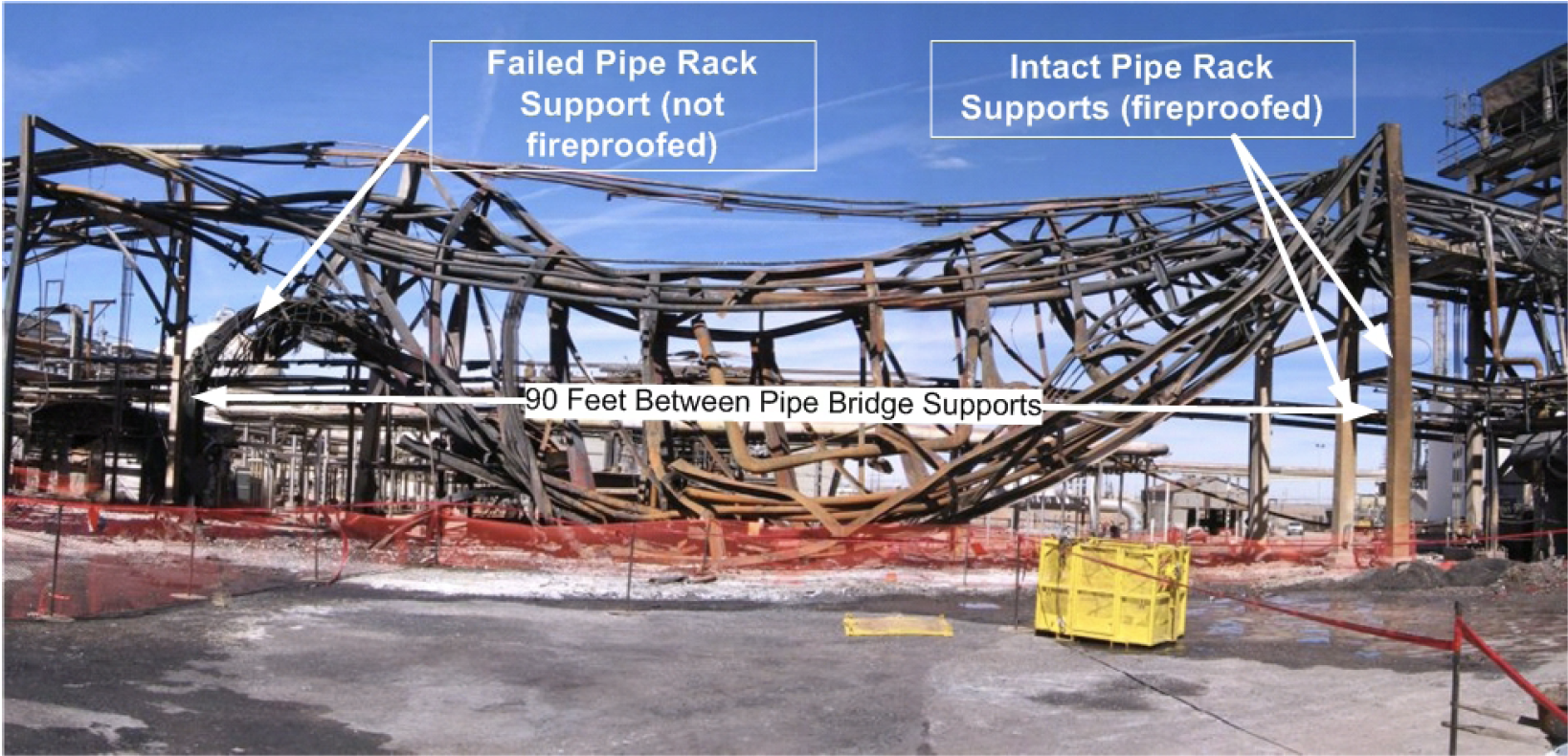
If you follow the CSB investigations, you may remember an incident from years ago where a fire impacted a pipe rack and the supports that were treated for fire resistance withstood the fire and the ones not treated/protected failed, causing the collapse of the structure leading to a much larger fire which then impaled three (3) 1-ton Chlorine cylinders, one of which ultimately failed due to the jet fire. So are pipe supports associated with flammable liquid piping required to be fireproof? The short answer is YES and don’t let someone tell you otherwise! Here is what we have as our safety baseline for flammable liquid piping…
PLEASE NOTE: Although I am explicitly calling out flammable liquid piping, Good Engineering Practices will use this same rationale to protect pipe supports that are in toxic service. Fire and powered vehicles are a pipe support worst nightmares, and we should have learned our lessons by now that it is ONLY A MATTER of time until one of the two makes contact with our piping and/or its supports!
SECTION 5703 – GENERAL REQUIREMENTS
…
5703.6 Piping systems. Piping systems, and their component parts, for flammable and combustible liquids, shall be in accordance with Sections 5703.6.1 through 5703.6.11.
5703.6.1 Nonapplicability. The provisions of Section 5703.6 shall not apply to gas or oil well installations; piping that is integral to stationary or portable engines, including aircraft, watercraft and motor vehicles; and piping in connection with boilers and pressure vessels regulated by the International Mechanical Code.
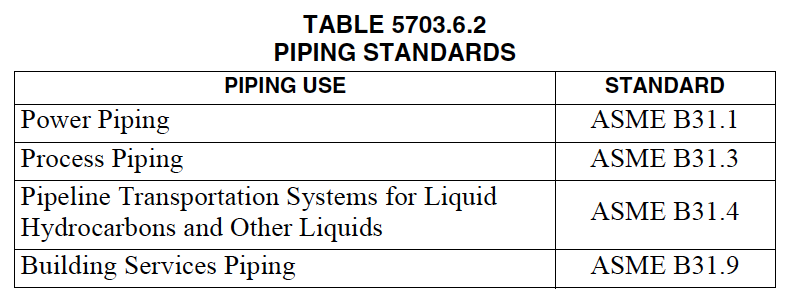
5703.6.2 Design and fabrication of piping systems and components. Piping system components shall be designed and fabricated in accordance with the applicable standard listed in Table 5703.6.2 and Chapter 27 of NFPA 30, except as modified by Section 5703.6.2.1
I want to repeat this requirement as it too will apply to the discussion of protecting pipe supports, albeit not from fire, but even a more imminent hazard – HUMANS DRIVING POWERED EQUIPMENT!
5703.6.4 Protection from vehicles. Guard posts or other approved means shall be provided to protect piping, valves or fittings subject to vehicular damage in accordance with Section 312.
NOTE: Section 312 is the “bollard” design requirements that I have written about many times. Just search for the term “bollard” in my postings.
Here is the purpose of this article:
5703.6.8 Piping supports. Piping systems shall be substantially supported and protected against physical damage and excessive stresses arising from settlement, vibration, expansion, contraction or exposure to fire. The supports shall be protected against exposure to fire by one of the following:
- Draining liquid away from the piping system at a minimum slope of not less than 1 percent. There are some AHJ that read the “draining liquid away from the piping system” to mean that the piping must have a minimum slope of 1% to allow for the flammable liquid to drain out of the pipe (i.e., back to the tank). This would remove the fuel source should the pipe rack/support collapse. However, even with the pipe sloped to allow for draining, there are others who read that requirement as to mean the secondary containment where the pipe rack support may be must be sloped at least 1% to ensure the flammable liquid does not “pool” around the support and allow the support to be exposed to a pool fire. Keep in mind that either way you read this option, the viscosity of the flammable and combustible liquids may mandate a greater drainage slope than 1%.
- Providing protection with a fire-resistance rating of not less than 2 hours. The pipe supports must support the piping in a fire for a minimum of 2 hours based on ASTM E119 test criteria. This fire protection of the supports is to keep any flammable and combustible liquids in the pipe from adding to an existing fire.
- Other approved methods. The code always recognizes that there may be other methods available for protecting flammable liquid piping supports; however, the AHJ has the authority to review these alternative methods and the authority to approve or deny an alternative method.
So as we can see, there are no height requirements/exceptions regarding which “piping supports” REQUIRE PROTECTION against physical damage and fire (as well as settlement, vibration, expansion, contraction). We often hear the excuse “my piping support is only X feet high,” and this means absolutely nothing! We also find fire-proofing work that is highly questionable and the facility unable to provide any evidence that the fire-proofing was installed to meet any quality requirements, much less 2-hours and ASTM E119 requirements. We have seen some AHJ’s accept fire water protection systems inside and outside of dikes and able to reach pipe racks as an “alternative,” but be VERY CAREFUL as most inspectors that I know and work with will NOT accept fire water protection schemes as an alternative to either #1 or #2 above.