
You may have heard that low melting-point materials such as aluminum, copper or brass should not be used for flammable liquids and gases. This is due to the concern these materials may fail under fire conditions, so we have some minimum requirements to meet IF we choose to use these types of metals…
emphasis by me
SECTION 5703 – GENERAL REQUIREMENTS
5703.6 Piping systems
…
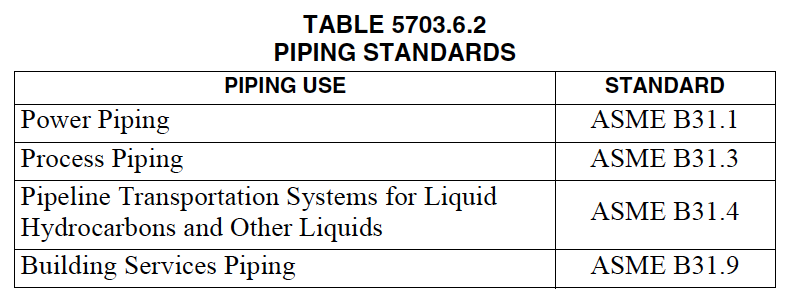
5703.6.2.1 Special materials. Low-melting-point materials (such as aluminum, copper or brass), materials that soften on fire exposure (such as nonmetallic materials) and nonductile material (such as cast iron) shall be acceptable for use UNDERGROUND in accordance with the applicable standard listed in Table 5703.6.2. Where such materials are used OUTDOORS in above-ground piping systems OR WITHIN BUILDINGS, they shall be in accordance with the applicable standard listed in Table 5703.6.2 AND one of the following:
-
- Suitably protected against fire exposure.
- Located where leakage from failure would NOT unduly expose people or structures.
- Located where the operation of accessible REMOTELY LOCATED VALVES can readily control leakage.
IN ALL CASES, nonmetallic piping SHALL be used in accordance with Section 27.4.6 of NFPA 30. [see below]
NFPA 30
27.4.6 Nonmetallic Piping.
27.4.6.1 Piping systems of nonmetallic materials, including piping systems incorporating secondary containment, shall be designed and built in accordance with recognized standards of design or approved equivalents and shall be installed in accordance with 27.4.4.
27.4.6.2 Nonmetallic piping shall be built and used within the scope of their approvals or within the scope of UL 971, Standard for Nonmetallic Underground Piping for Flammable Liquids.
27.4.6.3 Nonmetallic piping systems and components shall be installed in accordance with manufacturer’s instructions.
…
27.4.4 Low Melting Point Materials.
27.4.4.1 Low melting point materials, as defined in 27.2.4, shall be compatible with the liquids being handled and shall be used within the pressure and temperature limitations of ASME B31, Code for Pressure Piping.
27.4.4.2 Low melting point materials shall NOT be used as part of a tank’s NORMAL OR EMERGENCY VENT PIPING.
27.4.4.3 Low melting point materials shall be permitted to be used underground.
27.4.4.4 Low melting point materials shall be permitted to be used OUTDOORS ABOVEGROUND, OUTSIDE A DIKE, OUTSIDE A REMOTE IMPOUNDING AREA, or INSIDE BUILDINGS, provided they meet one of the following conditions:
(1) They are resistant to damage by fire.
(2) They are located so that any leakage resulting from failure will not expose persons, important buildings, tanks, or structures.
(3) They are located where leakage can be controlled by operation of one or more accessible, remotely located valves.
27.4.4.5 Low melting point materials shall be permitted to be used WITHIN A DIKE OR WITHIN A REMOTE IMPOUNDING AREA, provided they meet ONE of the following:
(1) They are connected ABOVE the normal operating liquid level of the tank.
(2) They are connected BELOW the normal operating liquid level of the tank, and ONE of the following conditions is met:
(a) The stored liquid is a Class IIIB liquid, the tank is located outdoors, and the piping is not exposed to a potential spill or leak of Class I, Class II, or Class IIIA liquid.
(b) The low melting point material is protected from fire exposure, such as by using materials that have a fire resistance rating of NOT LESS than 2 hours.
27.4.4.6 Piping systems of these materials shall be designed and built in accordance with recognized standards of design for the particular materials chosen or with approved equivalent standards or shall be listed.