With all the chatter these past few weeks about flammable gases and their NFPA 704 Diamond “Degree of Hazard”, it was suggested by several SAFTENG members that I write an article explaining what a “flammable gas” actually is, as some of our group text indicate some may not fully understand the true hazard of working with/around a liquified pressurized gas. So here we go…
First thing is to establish what a “gas” actually is. Keeping this simple, we know we have three (3) states of matter:
- Solid
- Liquid
- Gas
Gas is a state matter that is in that state at the Standard Temperature and Pressure (STP), which is 68°F and 14.7 psi. In other words, the material wants to naturally be a gas and this means it will have a boiling point <68°F at 14.7 psia.
There are three major groups of gases:
- Liquefied [Pressurized] Gases
- Non-Liquefied Gases (commonly called a “compressed gas”)
- Dissolved Gases
Liquefied [Pressurized] Gases
Liquefied [pressurized] gases are gases which can become liquids at NORMAL TEMPERATURES when they are inside containers UNDER PRESSURE. They exist inside the container in a LIQUID-VAPOR EQUILIBRIUM. Initially, the container is filled with liquid, and gas fills the space above the liquid. As gas is removed from the container, enough liquid evaporates/boils to replace it, keeping the pressure in the container constant. In technical terms:
A gas, which when packaged under pressure for transportation is PARTIALLY LIQUID at temperatures above -58°F, is considered to be a liquefied pressurized] gas. Liquefied pressurized] gas is further categorized as follows:
(1) High pressure liquefied gas which is a gas with a critical temperature between -58°F and 149°F;
(2) Low pressure liquefied gas which is a gas with a critical temperature above 149°F
Anhydrous ammonia, chlorine, propane, nitrous oxide, and carbon dioxide are examples of liquefied [pressurized] gases.
Non-Liquefied Gases [Compressed Gas]
Non-liquefied gases are also known as COMPRESSED (pressurized or permanent) gases. These gases do NOT become liquid when they are compressed at NORMAL TEMPERATURES, even at very high pressures. Common examples of these are common cryogenics such as oxygen, nitrogen, helium, and argon. (i.e. cryogenic liquids are REFRIGERATED LIQUEFIED GASES having a boiling point<-130°F at 14.7 psia)
Compressed gas is ENTIRELY GASEOUS at -58°F with a critical temperature less than or equal to -58°F, is considered to be a non-liquefied compressed gas.
Dissolved Gases
Acetylene is the only common dissolved gas. Acetylene is chemically very unstable. Even at atmospheric pressure, acetylene gas can explode. Nevertheless, acetylene is routinely stored and used safely in cylinders at high pressures (up to 250 psig at 70°F). This is possible because acetylene cylinders are fully packed with an inert, porous filler. The filler is saturated with acetone or other suitable solvents. When acetylene gas is added to the cylinder, the gas dissolves in the acetone. Acetylene in solution is stable.
The best example I can provide is how we store and transport Natural Gas. Compressed Natural Gas (CNG) is made by compressing natural gas to less than 1% of the volume it occupies at STANDARD ATMOSPHERIC PRESSURE (14.7 psia). It is stored in pressure vessels/cylinders at a pressure between 2,900–3,600 psig. But the key here is that it is stored ENTIRELY as a GAS.
We also store and ship NG as Liquefied Natural Gas (LNG) which is natural gas that has been COOLED TO A LIQUID STATE, at about -260°F. The volume of natural gas in its liquid state is about 600 times smaller than its volume in its gaseous state.
Both are Natural Gas – just in different states.
So what makes a “gas” a flammable gas?
Basically, it’s flammability. Any “gas” that has any flammable range in air is called a “flammable gas”. In terms of OSHA, there are two (2) categories of flammable gases:
| Category | Criteria |
| 1 |
Gases, which at 68°F and a standard pressure of 14.7 psia: (a) are ignitable when in a mixture of 13% or less by volume in the air; OR (b) have a flammable range with the air of at least 12 percentage points regardless of the lower flammable limit. |
| 2 | Gases, other than those of Category 1, which, at 68°F and a standard pressure of 14.7 psia, have a flammable range while mixed in air. |
In terms of DOT, there is a single Class and Division of flammable gases:
Division 2.1 (Flammable gas) – a flammable gas means any material which is a gas at 68°F or less and 14.7 psia of pressure (a material which has a boiling point of 68°F or less at 14.7 psia) which –
(1) Is ignitable at 14.7 psia when in a mixture of 13 percent or less by volume with air; OR
(2) Has a flammable range at 14.7 psia with the air of at least 12 percent regardless of the lower limit
Let’s break this down:
A flammable gas has an LEL and a UEL (e.g. a flammable range). For the gas to be a CATEGORY 2 Flammable Gas it just has to have a “flammable range”, REGARDLESS of what it’s LEL is or the size of the flammable range. Anhydrous Ammonia (NH3) is, in fact, a CATEGORY 2 Flammable Gas as it’s LEL is 16% and it’s flammable range is only 9 percentage points; so it does not qualify for a CAT 1 Flammable Gas but does meet CAT 2 Flammable Gas.
However, under DOT criteria, NH3 is NOT a flammable gas. Instead, it is shipped as a Division 2.2 (non-flammable, nonpoisonous compressed gas). A non-flammable, nonpoisonous compressed gas (Division 2.2) means any material (or mixture) which:
(1) Exerts in the packaging a gauge pressure of 29.0 psig/43.8 psia or greater at 68°F, is a liquefied gas, or is a cryogenic liquid, AND
(2) Does not meet the definition of Division 2.1 (Flammable) or 2.3 (Gas poisonous by inhalation)
Propane is a CAT 1 Flammable Gas because it has an LEL of around 2.5% and also meets the DOT criteria for a Division 2.1 Flammable Gas. Thus we end up with two VERY DIFFERENT LABELS for both shipping and fixed storage containers.
| Transpotation | |
|
Propane (Flammable) |
Anhydrous Ammonia (Non-Flammable) |
 |
 |
| Fixed/Stationary Containers | |
|
Propane (Flammable) |
Anhydrous Ammonia (Non-Flammable) |
 |
 |
|
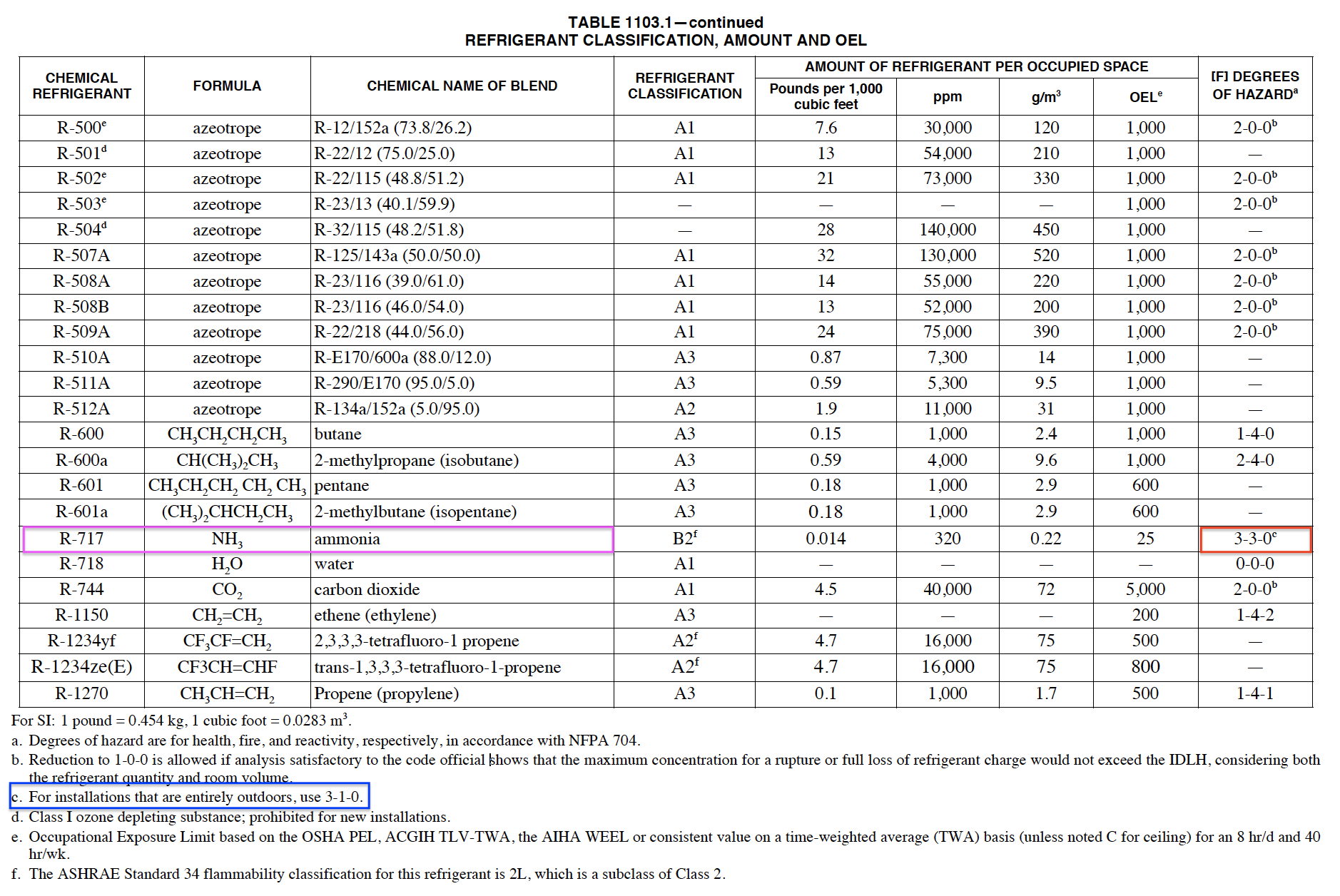
NOTE: NH3 may have a “3” flammable when indoors* |
|
*As noted below, the International Mechanical Code, as well as the International Institute of Ammonia Refrigeration (IIAR), classifies Anhydrous Ammonia: